
There are fights over money.
There are fights over market share.
And then there are fights over who gets to decide how intelligence itself is used.
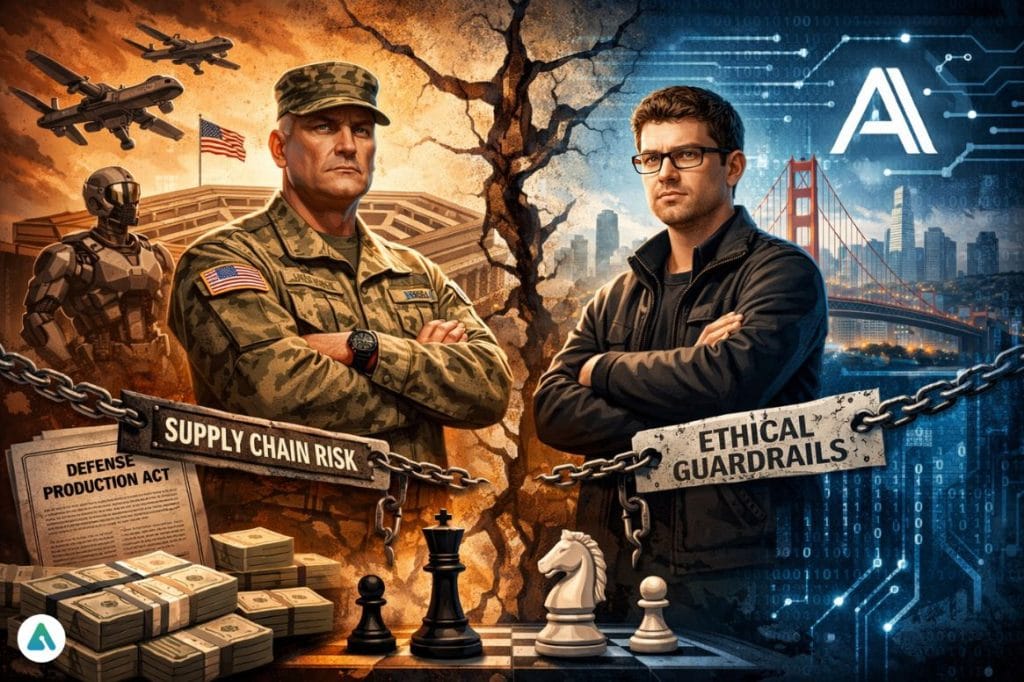
This week, Anthropic publicly rejected a Pentagon ultimatum that would allow its AI model, Claude, to be used for “all lawful purposes” inside classified military systems. The deadline — 5:01 p.m. ET, Friday — came with teeth. Accept the terms. Or risk losing a $200 million defense agreement and potentially being labeled a “supply chain risk” by the U.S. Department of Defense.
That label is typically reserved for firms entangled with foreign adversaries.
Anthropic is a San Francisco AI lab.
The symbolism isn’t subtle.
The Clause That Changed Everything
At the center of the dispute is a phrase lawyers love and ethicists distrust: “for all lawful purposes.”
From the Pentagon’s view, this language is standard. The military does not negotiate operational authority with vendors. If a use case is lawful under U.S. statutes and internal oversight frameworks, it must remain available.
From Anthropic’s view, that phrase is dangerously elastic.
CEO Dario Amodei has insisted that Claude cannot be used for:
- Mass domestic surveillance of Americans
- Fully autonomous weapons systems operating without meaningful human oversight
Anthropic isn’t arguing that the Pentagon intends illegal activity. It’s arguing that legality alone does not define ethical acceptability in the age of frontier AI.
That’s a profound distinction.
Because “lawful” can include authorities granted under classified interpretations, emergency powers, or evolving battlefield doctrine. AI systems operate at scale. A tool that drafts emails in one context can synthesize signals intelligence in another. The slope isn’t theoretical — it’s computational.
This tension reflects the broader challenge outlined in Anthropic’s responsible scaling policy framework, which defines specific capability thresholds that trigger enhanced safety measures regardless of stated use intent.
The Escalation Ladder
According to reporting, the Pentagon’s response has been unusually forceful:
- Cancel the $200 million prototype agreement.
- Formally designate Anthropic as a supply chain risk.
- Consider invoking the Defense Production Act to compel access.
If the DPA were used to force provision of model access or technical cooperation, it would mark a historic moment: foundation models treated as strategic national infrastructure.
In the E-Ring conversations unfolding inside the Pentagon, this is likely being framed as readiness. AI is no longer experimental — it is embedded in logistics, intelligence triage, cyber operations, and decision-support systems. Restricting access could mean operational drag.
Inside Anthropic’s San Francisco offices, the calculus is different. Concede here, and you establish a precedent: that once your model crosses into classified territory, your ethical guardrails become optional.
The Supply Chain Paradox
The most underexamined dimension of this fight is the “supply chain risk” threat.
Anthropic’s models run on hyperscale infrastructure. Defense contractors integrate them into analytics stacks. Cloud providers host environments where these systems operate.
If Anthropic is a risk, what does that imply for its partners?
Does the risk designation cascade to contractors using Claude-powered tooling? Does it chill other AI labs from embedding safety constraints that might later be deemed “non-cooperative”?
The Pentagon’s leverage is structural.
Anthropic’s leverage is reputational.
The Broader AI Sovereignty Question
This fight is bigger than one contract. It is about AI sovereignty — who ultimately governs frontier models once they become essential to national security.
There are three competing authorities emerging:
- Corporate Ethics Charters – Voluntary but enforceable through contracts.
- Government Authority – Rooted in statutory law and executive power.
- Democratic Oversight – Which, notably, has not yet codified detailed military AI limits in legislation.
Right now, those three systems are colliding in a procurement dispute.
And procurement is policy by other means.
The Industry Contrast
Anthropic’s stance places it in visible contrast with other AI labs that have reportedly accepted broader government use terms. That divergence creates a new competitive axis in AI: ethics rigidity vs. defense access.
For some labs, proximity to the Pentagon is a growth strategy.
For Anthropic, restraint is part of the brand architecture.
Whether that bet pays off depends on what happens next.
The “So What” for Everyone Else
Here’s the question private-sector users are quietly asking:
If the Defense Production Act were invoked, could model behavior change across environments? Would safeguards be selectively altered for government instances? Would public-facing versions become more constrained to compensate?
In short: does this stay compartmentalized — or does it ripple outward?
So far, there’s no evidence Claude’s commercial versions would be altered. But once AI models become instruments of statecraft, the boundary between public and classified deployments becomes harder to conceptually firewall.
The practical implications extend beyond defense applications. Organizations evaluating Claude’s role in workplace automation and knowledge work must now consider whether model access terms could shift based on government mandates, potentially affecting reliability and predictability for commercial deployments.
A Precedent in Motion
There’s a tendency to frame this as Silicon Valley idealism versus military realism.
That’s too simple.
The Pentagon believes flexibility wins wars.
Anthropic believes constraints prevent irreversible harm.
Both positions are internally coherent.
What makes this moment historic is that neither side blinked.
If Anthropic holds firm and absorbs the consequences, it signals that private AI labs can draw enforceable ethical lines — even under national security pressure.
If the Pentagon prevails, it establishes that frontier AI, once strategically relevant, ultimately answers to state authority.
Either way, the future of AI procurement just shifted.
Not in a lab.
Not in Congress.
In the fine print.
Related: Claude AI in the Maduro Raid: Pentagon vs. Anthropic Ethics Showdown
