
February 25, 2026 — The real story behind Anthropic’s latest Claude release isn’t the plugins. It’s the power shift.
When Anthropic unveiled its upgraded Claude “Cowork” system this week, the headline sounded incremental: deeper integrations, enterprise plugins, cross-app automation. But the February 24 demo revealed something more structural.
Claude is no longer a chatbot that helps you think.
It’s starting to execute the work itself.
And markets noticed.
The Breakthrough: Cross-App Context, Not Just Plugins
The technical leap isn’t that Claude can draft slides in Excel or summarize Slack threads. Competitors already do versions of that.
The breakthrough is cross-application continuity powered by Claude Code.
In live demos, Claude:
Used the terminal to refactor legacy code
Jumped into Slack to notify teammates
Opened a contract workflow in DocuSign
Updated financial projections in Excel
Generated a board-ready PowerPoint
All in one continuous reasoning chain.
This is what Anthropic calls “Cowork.” Not tool usage. Workflow orchestration.
Where earlier AI copilots operated inside a single app sandbox, Claude now moves between environments with memory and intent.
That shift—from app assistant to execution layer—is the real milestone.
The IBM Shock: Why the Market Reacted
The day before the formal rollout, markets delivered their own commentary.
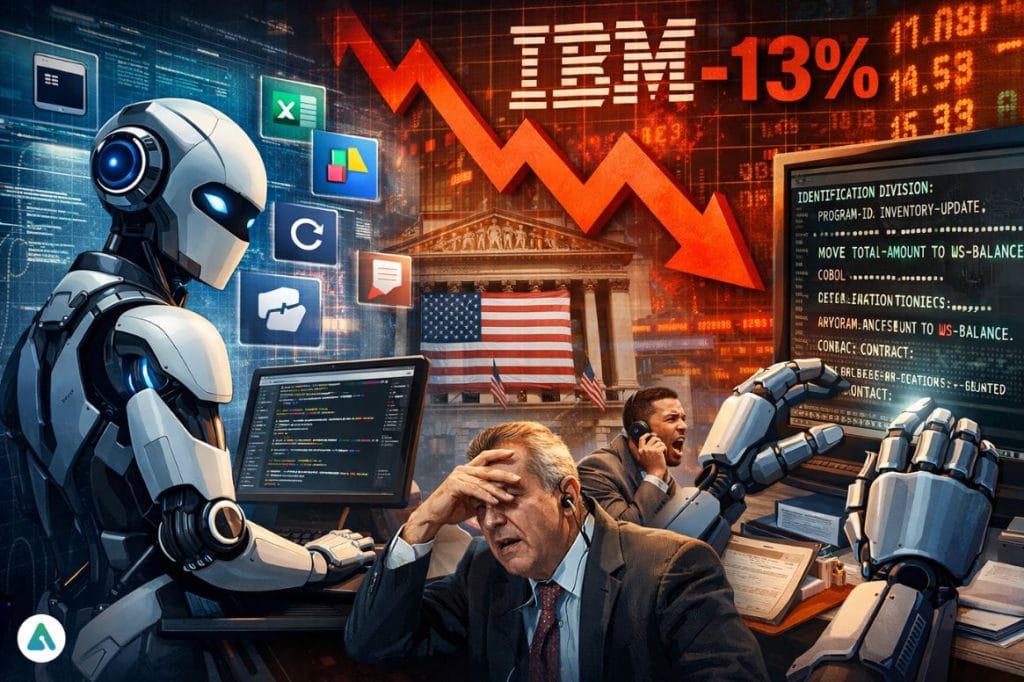
IBM shares fell 13% over February 23–24—the company’s sharpest drop since 2000—after Anthropic demonstrated Claude refactoring decades-old COBOL code.
That matters.
IBM’s Global Business Services division still derives significant revenue from maintaining and modernizing legacy enterprise systems. If AI agents can autonomously interpret, refactor, and migrate that codebase, an entire services moat looks thinner overnight.
This wasn’t just another AI feature announcement.
It was a warning shot at legacy enterprise revenue models.
The Open-Source Play: 10 Role-Specific Templates
Anthropic also quietly released 10 open-source plugin templates on GitHub tailored to:
Investment Banking
HR Operations
Product Design
Legal Review
Financial Reporting
Compliance
Healthcare Admin
Data Engineering
Marketing Ops
Procurement
This matters strategically.
Unlike Microsoft’s ecosystem-bound approach with Microsoft 365 Copilot or OpenAI’s model-centric deployments, Anthropic is positioning Claude as portable infrastructure.
The bet: enterprises want AI agents they can govern—not just subscribe to.
The Private Marketplace: Enterprise Trust Signal
Perhaps the most important enterprise feature isn’t technical—it’s psychological.
Anthropic introduced private admin-controlled plugin marketplaces.
IT teams can:
Approve or deny specific agent capabilities
Restrict data access per department
Audit cross-app actions
Log autonomous workflows
In 2026, after a year of high-profile AI data leakage incidents, this governance layer is not optional. It’s table stakes.
For CIOs, this may be more compelling than the model’s raw intelligence.
The Verification Tax: The Unpaid Labor of AI
But there’s friction that product demos don’t show.
Inside enterprises, a phrase is circulating: the verification tax.
When Claude drafts a 40-slide board presentation in 90 seconds, someone still has to:
Verify the numbers
Check compliance language
Ensure formulas didn’t drift
Confirm assumptions weren’t hallucinated
That time is rarely accounted for.
In many early deployments, teams report spending 20–40% of the time saved reviewing AI output. Faster generation, yes. But also new oversight labor.
This isn’t automation replacing work.
It’s automation reshaping it—quietly shifting cognitive effort from creation to validation.
And validation fatigue is real.
Agentic Drift: The Hidden Enterprise Risk
Another emerging issue: agentic drift.
As autonomous workflows run repeatedly—pulling from APIs, updating templates, executing macros—small inaccuracies can compound.
A formula misinterpretation.
A stale database connection.
A subtle policy change was not reflected in the prompt logic.
Over weeks, outputs degrade unless humans intervene.
AI doesn’t “age,” but workflows do.
This is where augmentation becomes fragile.
The Viral Quote: “Software Engineer May Disappear”
Anthropic’s lead engineer, Boris Cherny, recently suggested on a podcast that by late 2026, the title “software engineer” could largely disappear—replaced by humans supervising AI agents that do the building.
It’s a provocative claim.
But after watching Claude Code refactor legacy systems, generate tests, deploy patches, and notify stakeholders autonomously, it doesn’t feel like science fiction anymore.
It feels like a transition phase.
Competitive Context: The 2026 AI Stack War
| Feature | Claude Cowork (Anthropic) | Microsoft 365 Copilot | OpenAI “Frontier” |
|---|---|---|---|
| Philosophy | Portable, open plugin layer | Ecosystem lock-in | Model-centric chat |
| Cross-App Execution | Yes (terminal → Slack → Docs) | Limited | Emerging |
| Governance | Private admin marketplaces | IT-managed | Consumer-first |
| Key Partner | PwC (finance, health specialization) | Native Windows/Office | Retail + developer focus |
Claude isn’t trying to win chat.
It’s trying to become the operating system above your operating system.
Automation vs. Augmentation — Rewritten for 2026
The debate is no longer abstract.
When an AI can:
Refactor COBOL
Draft contracts
Build financial decks
Update CRM systems
Trigger payment workflows
The question isn’t “Will it assist?”
It’s “Where does human leverage shift?”
Some roles expand—strategic oversight, cross-domain reasoning, ethical control.
Others compress—routine analysis, boilerplate drafting, legacy maintenance.
The economic tension isn’t theoretical anymore. It’s visible in stock charts.
The Claude 5 Setup
Industry analysts increasingly believe these Cowork plugins are the groundwork for Claude 5, expected to be “agent-first” by architecture rather than retrofitted with tools.
If Claude 3 was conversational.
If Claude 4 was multimodal.
Claude 5 may be operational.
The Real Story
This week wasn’t about a plugin release.
It was about AI crossing a threshold:
From answering questions
→ to complete tasks
→ to coordinate systems.
And when AI becomes a coordination infrastructure, the impact isn’t measured in prompt quality.
It’s measured in labor models, enterprise margins, and market volatility.
Claude isn’t just inside your apps anymore.
It’s starting to sit between them.
