
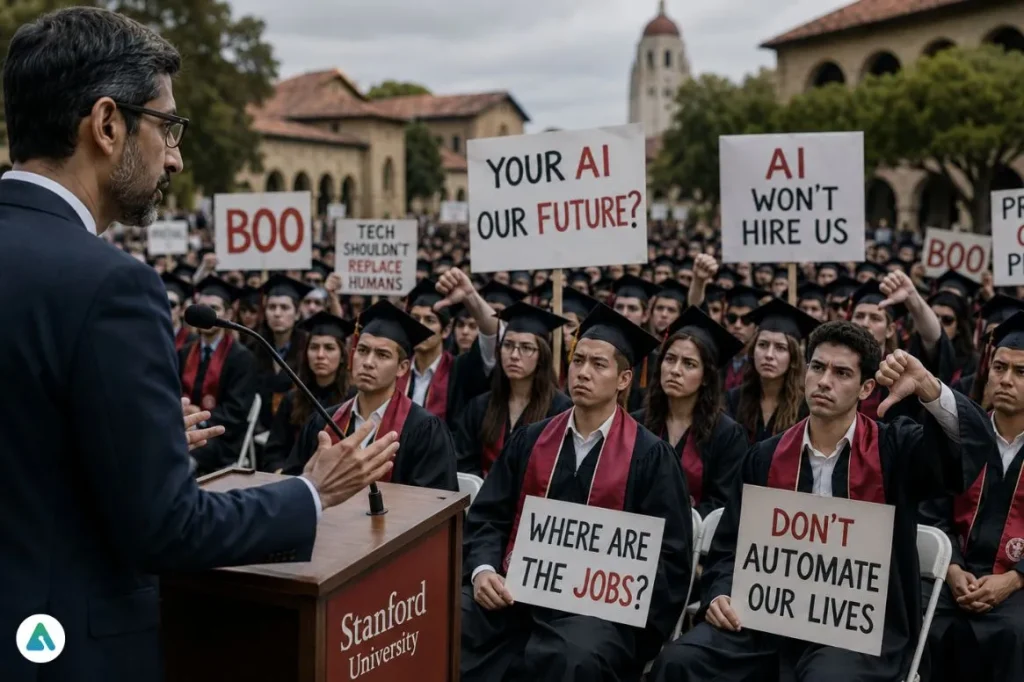
The Google CEO is scheduled to deliver Stanford University’s commencement address next month. When the hosts of the Hard Fork podcast recently asked him what his “boo strategy” would be, it did not sound like a joke. It sounded like a realistic communications concern.
That alone says something about where the public conversation around AI has moved.
Former Google CEO Eric Schmidt was recently jeered during a commencement appearance at the University of Arizona after speaking optimistically about artificial intelligence. Real estate executive Gloria Caulfield faced similar pushback at the University of Central Florida. Scott Borchetta was heckled at Middle Tennessee State University after discussing AI’s growing role in creative industries.
What used to be a safe environment for corporate optimism has quietly become a public stress test.
Graduation season in 2026 is turning into a referendum on Silicon Valley’s AI narrative.
When the Crowd Stops Clapping
There is a simplified version of this story where graduates are merely resistant to change or hostile toward technology. That interpretation misses the deeper issue entirely.
The anxiety surrounding AI is no longer theoretical. It is becoming economic, institutional, and deeply personal — especially for students entering one of the most unstable early-career job markets in years.
The unemployment rate for recent graduates reached a four-year high at the start of 2026. Multiple major firms have openly connected restructuring efforts, hiring slowdowns, or workforce reductions to AI-driven efficiency initiatives. Public concern is also rising. Research from the Pew Research Center has consistently shown that many Americans remain more concerned than excited about AI’s expanding role in everyday life.
At the same time, universities are sending mixed signals.
Students must learn and use AI tools professionally, while many institutions still label those same tools as academic misconduct in classrooms. More graduates now describe a strange contradiction: universities tell them AI will define their future careers while also warning them not to rely on it during their education.
That tension matters.
When AI Becomes a Credential and a Constraint
Across platforms like Reddit, TikTok, and student forums, discussions about AI are increasingly tied to fears about shrinking entry-level opportunities, automated résumé filtering, and disappearing junior roles. The skepticism is not necessarily anti-technology. In many cases, students actively use AI every day. What they distrust is the way the transition is being managed — and who appears protected from its consequences.
Communities across the United States are also pushing back against the infrastructure powering the AI boom itself. Proposed data centers connected to systems like Gemini and ChatGPT have faced mounting resistance over energy demand, water consumption, and land use concerns.
These are not abstract fears about the future anymore. They are material concerns tied directly to work, stability, and economic power.
The Commencement Backlash at a Glance
| Speaker | Institution | Flashpoint |
|---|---|---|
| Eric Schmidt | University of Arizona | Framed AI as a defining force shaping the future |
| Gloria Caulfield | University of Central Florida | Compared AI to a new industrial revolution |
| Scott Borchetta | Middle Tennessee State University | Discussed AI’s growing role in creative work |
Individually, these incidents may look isolated. Collectively, they point toward a broader shift in public mood.
Pichai’s Response — And Its Limits
To his credit, Pichai has adopted a more measured public tone than many of his peers.
Speaking on Hard Fork, he acknowledged that people are “rightfully anxious” and noted that “humans aren’t evolved to process that much change.” It was one of the clearest public acknowledgments yet from a major technology executive that the backlash surrounding AI is not irrational.
That tone stands in contrast to some of Silicon Valley’s more triumphant messaging.
Earlier this month, Jensen Huang told graduates at Carnegie Mellon University that “the timing could not be more perfect” to begin their careers. For some students, that message may have sounded motivating. For others — particularly graduates struggling through hiring freezes and shrinking entry-level pipelines — it likely felt disconnected from reality.
Pichai’s strategy at Stanford appears more rooted in personal narrative than technological evangelism. He is expected to emphasize adaptation, share parts of his own career journey, and present AI as a collaborative tool rather than a replacement for human work.
And Stanford may prove more receptive than many other campuses.
The university sits near the center of the AI economy itself, with close institutional ties to the companies and investors shaping the current wave of development. Stanford’s AI ecosystem has hosted figures like Sam Altman and Huang as guest speakers this year.
But that environment is not representative of the broader public mood.
The deeper issue facing Silicon Valley is no longer simply communication. It is credibility.
The industry’s core promise — that AI will ultimately create more opportunity than it destroys — has become harder to sell when graduates can already see disruption appearing inside internship pipelines, creative industries, and junior-level hiring.
The Optics Problem Silicon Valley Cannot Ignore
There is something increasingly jarring about a commencement circuit where the loudest public voices discussing labor disruption are executives whose companies profit directly from accelerating it.
Pichai oversees Google’s AI expansion through DeepMind and Gemini. Huang leads the company producing the chips powering much of the AI economy. The people most insulated from the immediate consequences of workforce disruption are often the same people telling graduates to embrace the transition.
That symbolism matters.
The boos are not really about software or innovation alone. They reflect a growing distrust around who absorbs the risks of technological change and who benefits from the rewards.
When Schmidt was heckled in Arizona, he paused and acknowledged the tension directly, telling the audience that he understood there was “fear.” The reaction was not necessarily a rejection of AI itself. It was a reaction to the feeling that the people shaping this future may not fully share in its costs.
Research from the Stanford Human-Centered AI Institute has repeatedly shown that public trust in corporate AI leadership remains fragile. Independent researchers and educators consistently rank as more credible messengers on AI than executives from the industry itself.
The challenge, in other words, is not just persuasion.
It is legitimacy.
Why This Matters Beyond Commencement Season
The significance of these moments extends far beyond a few uncomfortable graduation speeches.
For decades, Silicon Valley operated under a largely accepted assumption: technological acceleration would eventually translate into broad social progress. That assumption is weakening.
Increasingly, audiences want concrete evidence that the economic gains from AI will be distributed fairly — not simply assurances that disruption is temporary or necessary.
That shift changes the emotional atmosphere surrounding AI entirely.
Commencement stages used to function as safe spaces for aspirational corporate messaging. In 2026, they are becoming public arenas where trust in the technology industry is actively tested in real time.
That is why Pichai’s Stanford appearance matters beyond the ceremony itself. It may become one of the clearest indicators yet of how Google intends to publicly frame its AI ambitions during a period of growing skepticism and labor anxiety.
If Pichai leans into humility, realism, and uncertainty, he may successfully navigate the moment.
If he falls back on triumphalist messaging, the backlash could travel far beyond Stanford’s campus.
The “boo strategy” is ultimately not a public relations strategy at all.
It is a trust strategy.
And right now, Silicon Valley’s trust account looks increasingly overdrawn.
