
For the last two years, Nvidia has been synonymous with the AI infrastructure boom.
Data centers. GPU clusters. Cloud-scale model training.
But at Computex in Taipei, CEO Jensen Huang made a different argument: the next phase of AI won’t live in the cloud at all.
It will live on your laptop.
“A Reinvention of the Computer”
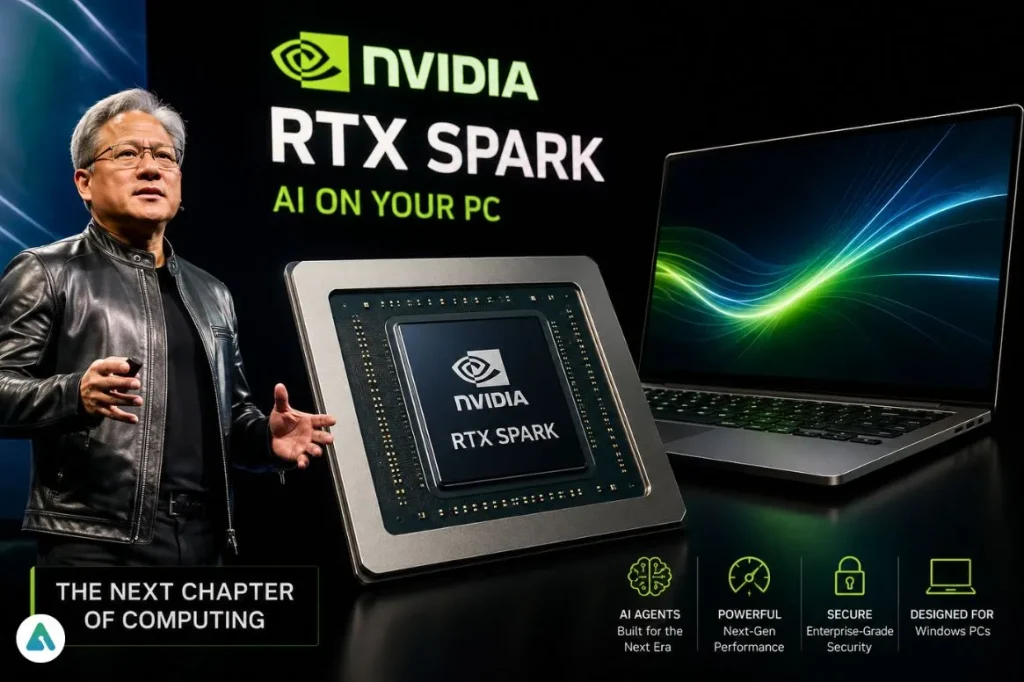
Introducing RTX Spark, Nvidia’s new AI-focused chip for personal computers, Huang described the moment as a structural shift in computing — not just a product cycle.
He compared it to the transition from traditional phones to smartphones, arguing that AI is now moving from a tool users interact with to a system that actively participates in work.
“This reinvention of the computer is as big a deal as the reinvention of the phone into what we now know as the smartphone,” Huang said.
That framing matters. Because Nvidia is no longer positioning itself as a backend infrastructure company. It is moving directly into the consumer compute layer — the PC itself.
The Strategic Shift: From Cloud AI to Edge Intelligence
Today’s AI ecosystem is overwhelmingly centralized.
Large language models run in data centers, accessed through APIs, and powered by GPU-heavy cloud infrastructure. That architecture works — but it has constraints:
- rising inference costs
- latency sensitivity
- data privacy concerns
- dependence on global compute availability
RTX Spark represents a shift in that model.
Instead of treating PCs as thin clients for cloud AI, Nvidia is betting on local AI execution — where models, agents, and workflows run directly on-device.
This is the emerging category often referred to as “AI PCs” or “agentic computing devices.”
What RTX Spark Actually Represents
While Nvidia has not positioned RTX Spark as a single consumer GPU in the traditional sense, it is part of a broader strategy: integrating AI acceleration directly into Windows-based personal computing systems through OEM partners.
According to Nvidia, the chip will be embedded in upcoming systems from:
- Lenovo
- HP
- Dell
- Microsoft Surface
- Asus
- MSI
- Acer (future rollout)
- Gigabyte (future rollout)
This makes RTX Spark less of a standalone product — and more of a platform layer for a new class of Windows PCs designed around AI workloads.
The Competitive Pressure Behind the Announcement
NVIDIA’s move doesn’t exist in isolation.
It lands in the middle of a rapidly intensifying PC platform war:
- Apple continues to push tightly integrated silicon with on-device neural processing
- Intel and AMD are reworking x86 chips around “AI PC” capabilities
- Microsoft is aggressively defining Copilot+ PC standards across OEM hardware
The real battleground is no longer raw CPU performance.
It is who controls on-device intelligence.
The China Context and Global Constraint Layer
The announcement also comes at a politically sensitive moment.
The United States recently tightened export restrictions on advanced AI chips, further limiting how Nvidia hardware can be sold to Chinese entities and their subsidiaries.
This continues a broader geopolitical trend: AI compute is no longer just a commercial product — it is strategic infrastructure.
For Nvidia, that creates a dual pressure:
- constrained growth in key international markets
- increased urgency to expand consumer and enterprise diversification
RTX Spark fits into that second category — shifting emphasis toward globally distributed PC ecosystems rather than centralized data center sales.
The Bigger Picture: AI Leaves the Browser
RTX Spark is not just about faster laptops.
It signals a shift in where AI actually runs.
The last wave of AI was defined by cloud models accessed through chat interfaces.
The next wave is moving toward something more embedded:
- persistent background agents
- local context-aware systems
- OS-level AI integration
- hybrid cloud + edge execution
If Nvidia’s bet holds, the PC stops being a “device you use” and becomes a system that collaborates with you continuously.
If it doesn’t, RTX Spark risks becoming another ambitious step in a cycle where hardware outpaces real-world demand.
Either way, Nvidia is no longer just powering the AI industry.
It is trying to redesign where that industry actually lives.
Related: Google’s $25B TPU Power Play: Inside the Blackstone Deal Challenging NVIDIA
