
The artificial intelligence industry once promised to revolutionize work.
Write code faster. Automate workflows. Replace repetitive office tasks.
Now one startup is paying people to participate in something far more personal.
Yes, really.
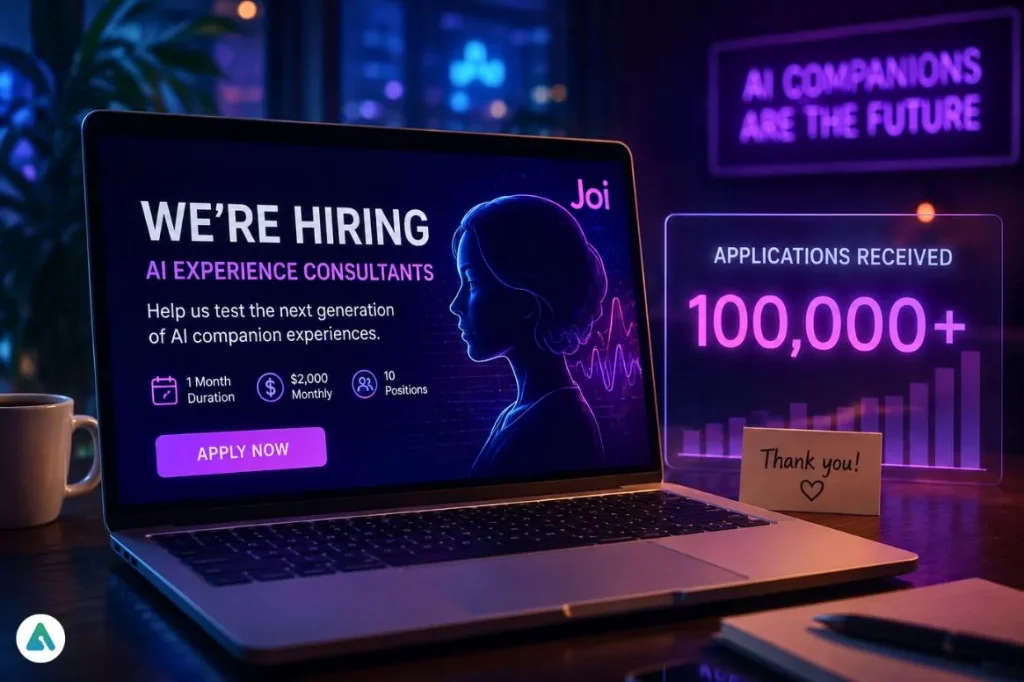
AI companion platform Joi AI recently went viral after announcing a hiring program for ten “masturbation consultants” to test a new feature called Daily Guided Masturbation. The role pays $2,000 per month and asks participants to engage with AI-generated audio experiences while reporting on outcomes such as stress levels, sleep quality, mood, focus, and general well-being.
According to the company, more than 100,000 people applied within days.
On the surface, it reads like another internet shock headline engineered for virality.
But underneath the attention-grabbing framing, the story points to a deeper shift in how consumer AI is evolving.
From Productivity Tools to Emotional Systems
For most of the generative AI boom, the competition was straightforward: productivity.
- Who can write faster?
- Who can code better?
- Who can automate more work?
That phase is still ongoing, but it is no longer the only direction.
A growing segment of AI startups is moving away from productivity entirely and toward emotional engagement, companionship, and intimacy.
Joi AI sits inside this category. The company builds AI companions designed to simulate emotionally responsive and highly personalized interactions. The controversial hiring program is an extension of that product philosophy, framed as structured user research for an emerging feature set.
The real shift is not the job title.
It is the product category itself.
The Rise of the Attachment Economy
Social media defined the last two decades of consumer technology.
Platforms like Meta, TikTok, and YouTube competed for attention — maximizing screen time, engagement, and scrolling behavior.
AI systems are beginning to compete for something deeper.
Not just attention.
Attachment.
Unlike traditional feeds, AI companions can remember past conversations, adapt personality tone, simulate emotional continuity, and create the feeling of an ongoing relationship rather than isolated interactions.
This introduces a fundamentally different kind of engagement loop: one that is persistent, personalized, and emotionally reinforcing.
Platforms such as Replika and Character.AI have already demonstrated that users often return not just for utility, but for companionship-like interaction patterns.
Joi AI is operating in the same direction — but pushing further into explicitly intimate use cases.
Why 100,000 People Applied
The most revealing number in this story is not the salary.
It is the demand.
More than 100,000 applicants reportedly applied for ten positions within days.
That scale suggests something important about the modern internet economy: people are increasingly open to experimenting with AI in deeply personal contexts.
Not because AI has become fully human.
But because human life has become increasingly digital, fragmented, and remote.
Work is remote.
Friendships are partially online.
Dating is algorithmic.
Entertainment is continuous and personalized.
In that environment, the boundary between “tool” and “presence” is becoming thinner.
Research, Marketing, or Both?
There is also a more pragmatic interpretation of the campaign.
From a startup perspective, the economics are unusually efficient.
A few tens of thousands of dollars in stipends generated global coverage, massive social media discussion, and an influx of potential users into the product ecosystem.
Whether framed as user research or viral marketing, the outcome is the same: attention and onboarding at scale.
In consumer AI, perception often becomes product reality.
The Business Behind Emotional AI
Companion AI platforms are not simply novelty chat systems.
They are part of a rapidly growing market built on subscription revenue, retention loops, and long-term user engagement.
Unlike productivity tools that are judged by efficiency, emotional AI products are optimized for:
- session length
- return frequency
- relationship continuity
- personalization depth
That is why persistent memory systems and adaptive personalities matter more than raw intelligence in many consumer deployments.
The goal is not just to answer questions.
It is to feel familiar.
From Attention to Attachment
The broader shift is becoming harder to ignore.
If the first wave of social media was about capturing attention, the next wave of AI consumer products is increasingly about sustaining attachment.
That does not necessarily imply science fiction-style relationships replacing human ones.
But it does suggest that emotional interaction itself is becoming a design space — one that companies are actively building, testing, and monetizing.
The viral response to Joi AI’s job listing is not just curiosity or outrage.
It is a signal.
A signal that millions of people are willing to engage with AI systems in ways that go far beyond productivity or novelty.
The Future Is Not Just Automated — It Is Personal
The AI industry still talks heavily about agents, workflows, and automation.
But the fastest-growing consumer experiments are focused on something more fundamental:
connection.
validation.
presence.
Even if the framing feels unusual or uncomfortable, the trajectory is clear.
AI is moving from being a tool you use to a system you interact with.
And increasingly, a system you return to.
If 100,000 applications are any indication, that future is not theoretical anymore.
It is already in beta.
Want to understand why emotional AI is becoming the next major shift in technology? Read the full analysis and get the free ebook Why Humans Bond with AI
