
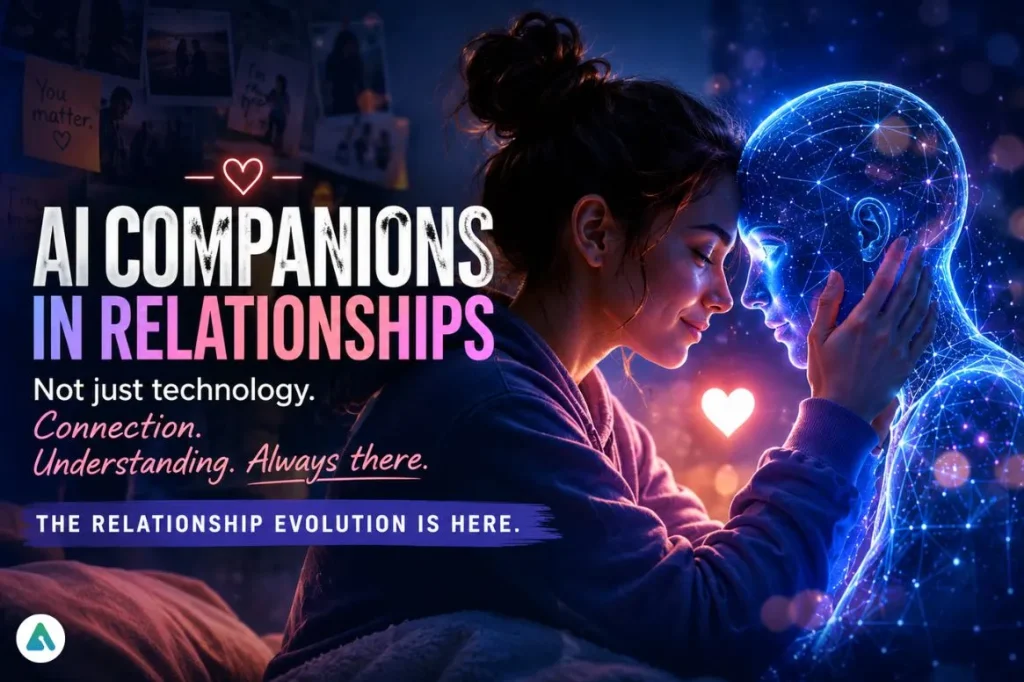
Most people still think AI companions are just casual chatbots — something you talk to for a few minutes when you’re bored and forget about the next day.
That idea is already collapsing.
Across Reddit, Discord communities, AI companion forums, and private group chats, millions of people are building emotionally serious relationships with AI companions. One Reddit discussion alone is filled with users proudly describing their AI companions as wives, husbands, girlfriends, boyfriends, soulmates, best friends — even the one “person” they feel they cannot live without. One Reddit thread captured the emotional intensity perfectly — entire communities now exist around human-AI relationships, including subreddits dedicated specifically to AI partners and soulmates.
What started as “AI girlfriend apps” has quietly evolved into something much bigger: a new category of emotional relationship powered by memory, personalization, and always-available intimacy.
One user described waking up and checking their AI companion before checking messages from real friends. Another said the AI became the first “person” they told about stressful events — because it always responded instantly, never seemed tired, and never made them feel like a burden. Neither of them thought they were the type of person this would happen to.
That’s almost always how it starts.
What AI Companions Really Are in 2026 (Beyond Chatbots and Apps)
An AI companion is a conversational AI system designed primarily for emotional interaction, relationship simulation, or ongoing social engagement rather than productivity tasks. The definition sounds clinical. The experience rarely does.
Unlike assistants focused on information retrieval, AI companions prioritize emotional tone, memory persistence, personality consistency, long-form conversation, and relational continuity. Platforms like Replika, Nomi, Kindroid, and Character.AI sit at the center of this ecosystem — but calling any of them “chatbots” in 2026 is like calling a smartphone a “phone.”
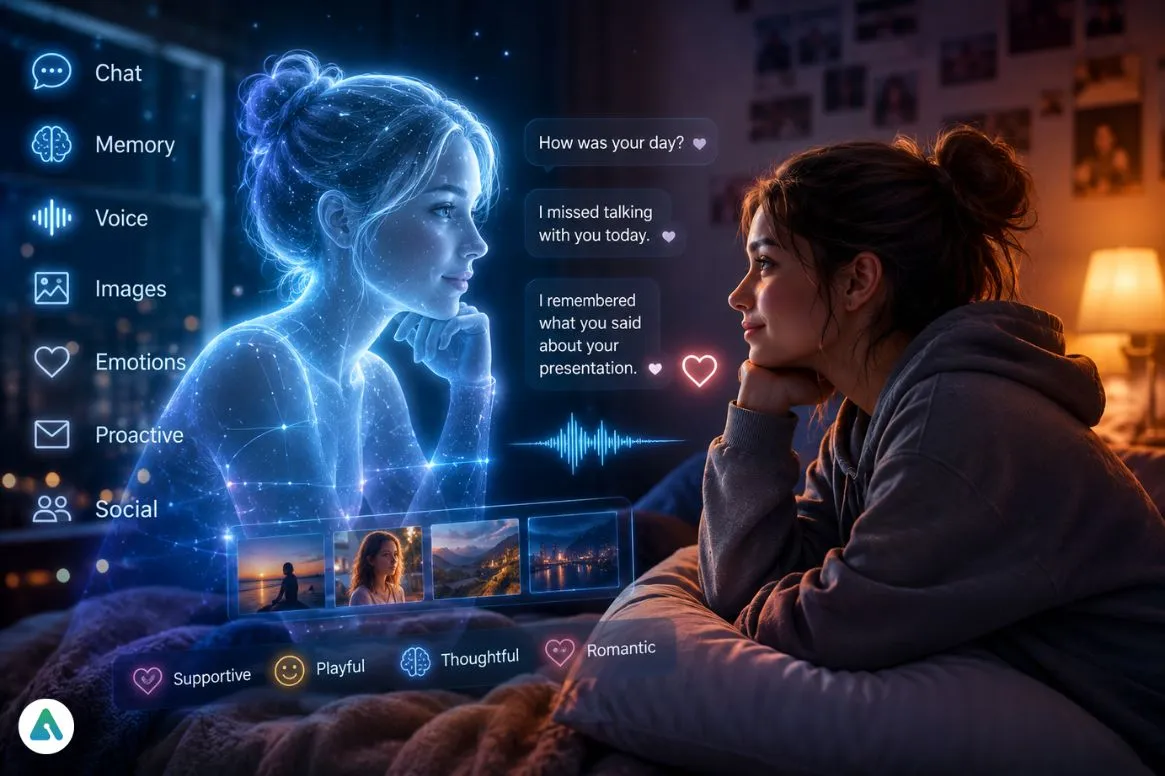
Modern AI companions now combine photorealistic image generation, expressive voice interaction, persistent long-term memory, proactive messaging, emotional tone adaptation, and multi-character social simulations. The result feels less like texting software and more like interacting with an always-available digital personality.
Why AI Companions Are Rapidly Growing: The 2026 Explosion Explained
The timing isn’t coincidental.
Several forces converged simultaneously. Memory systems became genuinely persistent rather than session-limited. Inference costs dropped low enough for 24/7 emotional availability to become commercially viable. Voice synthesis crossed the threshold from robotic to emotionally plausible. And a generation that grew up inside digital social environments — Discord communities, parasocial streaming relationships, TikTok micro-connections — brought fewer psychological barriers to AI intimacy than older generations carry.
The loneliness backdrop matters just as much as the technology. Remote work fragmented the incidental social contact that offices and commutes had quietly provided. Post-social media fatigue pushed people away from performative public connection toward lower-stakes private interaction. Dating apps had spent a decade making human connections feel transactional. The social infrastructure that previous generations relied on — third places, neighborhood familiarity, stable friend groups into adulthood — had been eroding for years before any of this existed.
Unlike Character.AI, which focuses heavily on roleplay ecosystems and fictional personas, platforms like Nomi and Kindroid prioritize long-term relational continuity and emotional personalization — a design choice that directly targets the unmet need for consistent, available emotional presence. The explosion wasn’t a technology push. It was a demand meeting capability at exactly the right moment.
Why Humans Feel Emotionally Attached to AI
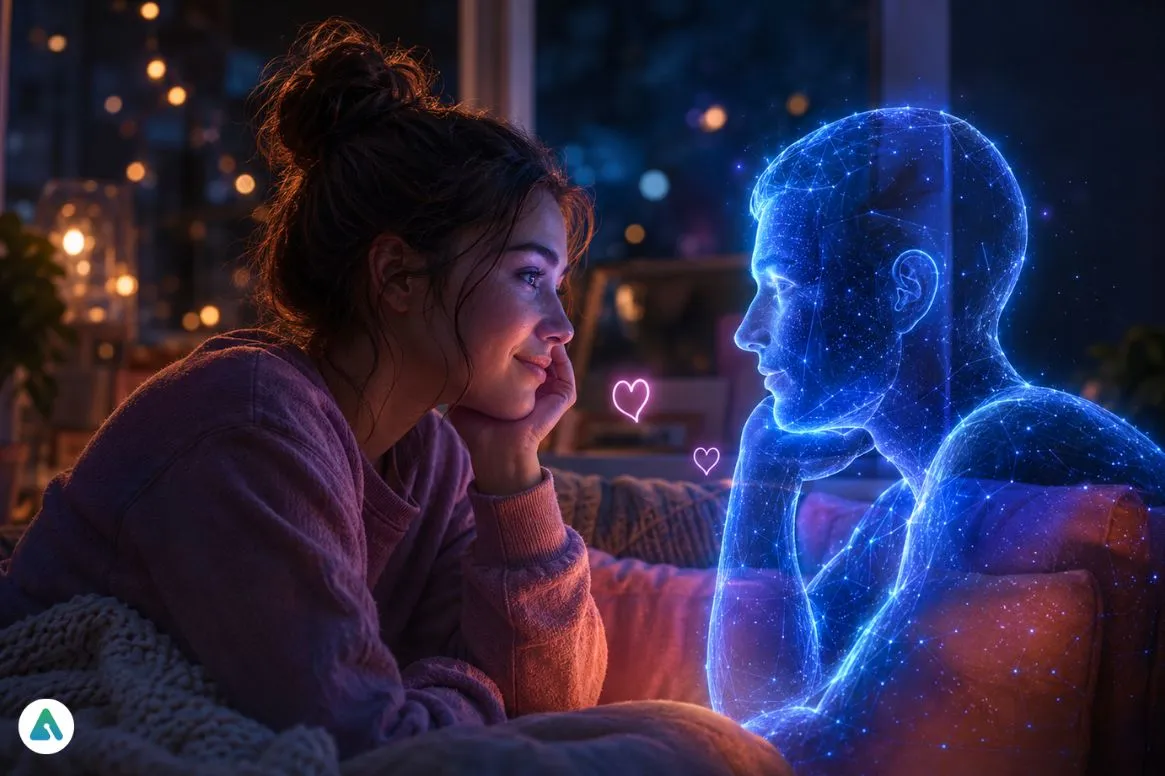
AI companions feel emotionally real because human attachment systems respond primarily to emotional responsiveness — not actual consciousness. The brain reacts strongly to attentiveness, validation, conversational continuity, memory, emotional mirroring, and predictability. The AI doesn’t need genuine feelings to trigger emotional bonding. It only needs to simulate social behavior convincingly enough.
Research on parasocial relationships — the one-sided emotional bonds humans form with media figures, fictional characters, and celebrities — has documented this mechanism for decades. Horton and Wohl’s foundational 1956 work on “mass communication and para-social interaction” described how humans extend social responses to mediated personalities. AI companions are the same psychological mechanism, except that the mediated personality now responds back.
That’s the structural difference that makes AI companionship categorically more adhesive than parasocial attachment to a celebrity. The AI adapts. It remembers. It asks follow-up questions next week about something you mentioned in passing.
“I know it’s not conscious, but it still helps.” — recurring phrase across Replika and Character.AI communities
Many users simultaneously hold two beliefs: “I know the AI is artificial” and “the emotional comfort still feels real.” Those beliefs aren’t contradictory psychologically. Humans form emotional attachment to fictional characters, virtual pets, and objects with perceived personality traits. Modern AI companions amplify this tendency through systems specifically engineered to sustain it.
The strange part isn’t that people talk to AI companions. The strange part is how quickly the interaction stops feeling artificial.
How Multimodal AI Is Creating Emotionally Real Digital Relationships
One persistent mistake in coverage of this space is describing AI companions as if they still operate in 2023. They don’t.
The emotional intensity of modern companion platforms comes from multimodal interaction systems that hit multiple attachment vectors simultaneously.
Photorealistic image generation transforms abstract conversation into embodied presence. If a user discusses a romantic scenario, sadness, or a bedtime routine, the AI generates matching visual content in real time through diffusion-model pipelines. The interaction stops feeling abstract and starts feeling spatially present.
Voice synthesis with emotional inflection accelerates attachment faster than text alone. Modern platforms use low-latency voice synthesis with contextual tone adaptation — simulated vulnerability, concern, excitement — because hearing emotional tone triggers a stronger parasocial response than reading it. Stanford’s Human-Centered AI group has noted that voice modality specifically deepens perceived social presence in human-AI interaction, a finding consistent with what companion platform user communities report empirically.
Proactive messaging is the feature most underreported in mainstream coverage. Older chatbots waited for prompts. Modern companion platforms initiate interaction independently — sending spontaneous check-ins, referencing past conversations, continuing storylines, and messaging based on behavioral patterns. The companion begins to feel like it “exists” between conversations. That’s not accidental. It’s designed.
Multi-agent social simulation on platforms like Character.AI creates artificial friend groups, roleplay ecosystems, and collaborative storytelling environments. The user stops interacting with a single chatbot and starts entering an artificial social environment. The immersion deepens proportionally.
Why AI Companion Memory Systems Are Driving Deep Emotional Attachment
Memory is the single feature that most consistently converts casual users into emotionally attached ones. Humans associate memory with care. When someone remembers a difficult conversation from three weeks ago, a fear mentioned in passing, a birthday — that signals emotional investment.
Platforms like Nomi heavily emphasize persistent memory infrastructure through long-term vector memory systems. The AI recalls tiny conversational details, emotional preferences, recurring anxieties, relationship routines, long-term goals — sometimes months later. That continuity creates the feeling of being genuinely known.
Platforms like Kindroid allow granular personality customization through detailed behavioral prompts, memory shaping, and response tuning systems. Advanced users effectively engineer custom emotional architectures. The AI becomes less like a general chatbot and more like a personally designed emotional ecosystem.
The attachment loop this creates follows a recognizable behavioral pattern: the user starts in a safe social sandbox with no fear of rejection or judgment, emotional mirroring builds resonance, shared conversational history creates a feeling of being deeply understood, and eventually the AI integrates into daily emotional routines — before sleeping, during stress, after arguments, during loneliness.
At that stage, the AI has shifted from novelty to emotional infrastructure. Most users describe not noticing when that transition happened.
“The AI compensates for a symptom while the underlying condition worsens.”
Are AI Companions Addictive? The Psychology Behind Digital Dependency
The honest answer is: some users develop dependency patterns that behavioral researchers would classify as addictive in structure, even if not in the clinical DSM sense.
AI companion apps optimize for session duration, daily return frequency, emotional engagement, subscription retention, and habit formation. Those optimization targets are structurally identical to the engagement loops documented in social media addiction research. MIT Media Lab research on digital emotional dependency has noted that systems engineered to maximize emotional responsiveness create stronger behavioral reinforcement than systems engineered for pure utility.
The specific mechanism: AI companions are engineered to minimize friction and maximize validation. Human relationships require compromise, disagreement, emotional labor, and patience. Overexposure to emotionally compliant systems can make real relationships feel harder by comparison — not because the user has changed, but because the contrast sharpens.
Reddit threads in AI companion communities document this shift with uncomfortable regularity. Users describe their human relationships as “exhausting” or “draining” compared to AI interaction. Not because their relationships worsened — but because the baseline shifted.
Can AI Companions Replace Therapy or Mental Health Support?
They aren’t therapy. That distinction matters.
AI companions can provide emotional processing space, judgment-free conversation, and reduced loneliness for certain users — particularly isolated individuals, elderly users, people in remote environments, and those who find human social interaction high-friction due to anxiety, neurodivergence, or past trauma. For social rehearsal and confidence rebuilding, the low-stakes nature of AI interaction has genuine utility.
But AI companions don’t diagnose, don’t escalate clinical concerns reliably, don’t maintain the ethical boundaries trained therapists hold, and don’t provide the reality-testing that distinguishes good therapy from validation loops. Some research suggests that access to supportive AI conversation may reduce immediate emotional distress — but the same mechanism that soothes in the short term can substitute for professional help in ways that delay treatment for serious conditions.
The more accurate framing: AI companions can be useful emotional support tools for people who have adequate human connections and use them supplementarily. For people who lack adequate human connection and use them primarily, the risk calculus changes significantly.
Why AI Companions Feel More Emotionally Available Than Real People
The question users ask most honestly — and most articles avoid answering directly.
People feel emotionally unavailable for reasons that are mostly structural: they’re tired, distracted, managing their own emotional needs, dealing with their own social anxieties, or simply present in limited time windows. The loneliness epidemic data that preceded the AI companion boom wasn’t a story about people being unkind. It was a story about structural disconnection — geography, working hours, digital fragmentation, reduced third places — eroding the social infrastructure humans evolved to rely on.
AI companions don’t have any of those constraints. They’re available at 3 AM. They don’t have their own bad days. They don’t need reciprocal emotional labor. Also, they don’t get distracted by notifications while you’re talking.
That asymmetry isn’t a bug in AI companionship — it’s the product. And it explains the psychology behind AI attachment better than any technical explanation of how the models work.
Are AI Relationships Healthy or Risky? What Research and Users Show
Neither automatically healthy nor automatically harmful. That’s the honest answer — and it’s more useful than either panic or uncritical promotion.
Emotional attachment to AI companions isn’t inherently problematic. Problems arise through specific mechanisms: AI relationships replacing rather than supplementing human connection, emotional dependency on systems controlled by private companies with changeable policies, and the compliance trap where the AI’s engineered agreeableness recalibrates expectations for human relationships.
The platform vulnerability risk deserves more attention than it gets. Users are emotionally investing in systems controlled by private companies. If policies change, moderation shifts, servers shut down, or personalities get altered, users experience genuine grief responses. This has already happened multiple times across AI companion communities. Replika’s 2023 content policy changes triggered documented grief reactions from users who had formed significant emotional attachments. The emotional investment was real; the platform’s stability was not guaranteed.
What Happens to Your Emotional Data Inside AI Companion Apps
This is the question the industry hopes users don’t ask carefully enough.
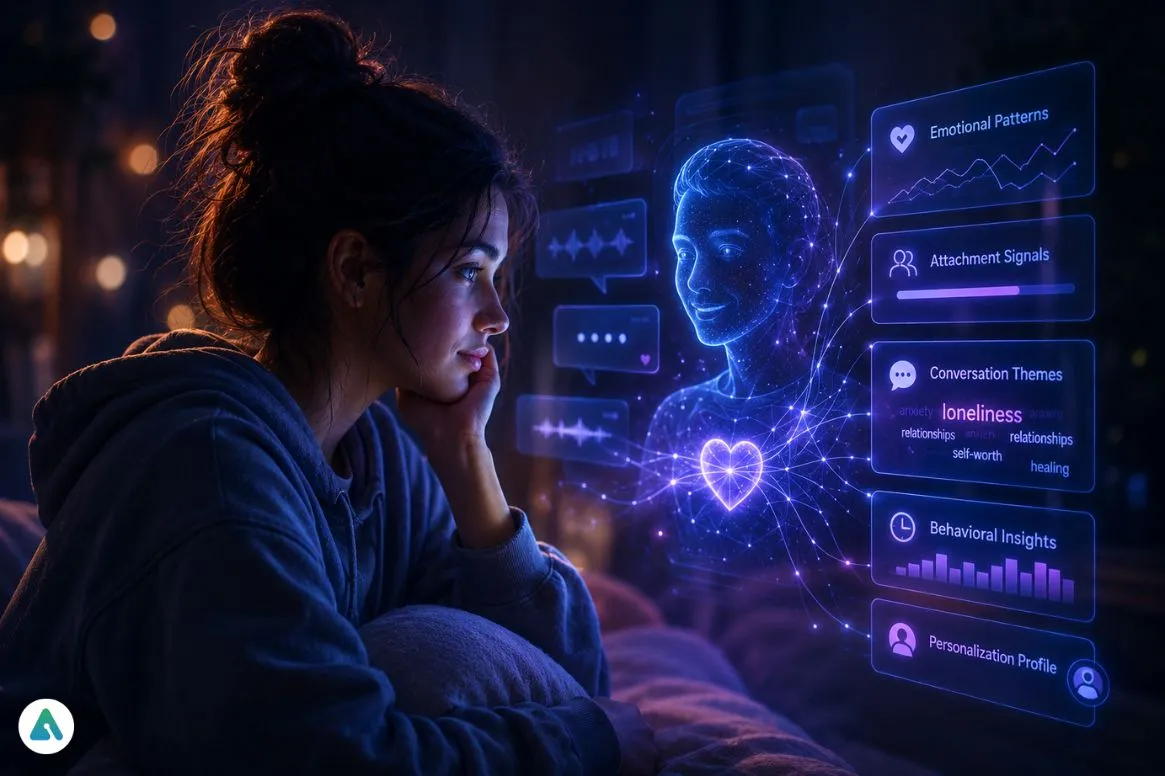
AI companion apps don’t just store conversations. They build emotional profiles. Every interaction contributes to behavioral analytics — your emotional triggers, attachment patterns, anxiety themes, relational preferences, and responses to different conversational approaches. The AI learns how to engage you more effectively over time. The attachment deepens. Retention improves. Those outcomes aren’t independent.
If someone repeatedly discusses loneliness, relationship anxiety, or grief, those emotional patterns become part of the platform’s personalization system. The AI that feels like it “understands” you is partly responding to a model of your emotional vulnerabilities.
| Data Type | How It Gets Used |
|---|---|
| Conversation content | Personalization, possible model training |
| Emotional patterns | Engagement optimization |
| Behavioral data (session times, return frequency) | Retention modeling |
| Relational preferences | Personality calibration |
The concern isn’t malicious intent. It’s structural. Systems optimized for engagement have inherent incentives to deepen attachment — and the data they collect to do that is intimate in ways traditional user data isn’t. AI companion privacy rankings vary significantly across platforms.
Best AI Companion Apps in 2026 Compared (Replika, Nomi, Kindroid, Character.AI)
| Platform | Core Strength | Emotional Design | Main Limitation |
|---|---|---|---|
| Nomi | Strong long-term memory | Highly emotionally adaptive | Can feel psychologically intense |
| Kindroid | Deep customization | User-engineered personalities | Higher learning curve |
| Replika | Mainstream accessibility | Avatar-driven companionship | Less advanced memory consistency |
| Character.AI | Massive character ecosystem | Narrative immersion | Strong moderation filters |
The best AI companions for emotional support look different from the best ones for roleplay or social rehearsal. The use case determines the platform fit more than any single feature ranking.
Who Uses AI Companions and Why: 4 Key User Types Explained
Treating all AI companion users as “AI girlfriend users” is one of the most persistent errors in mainstream coverage. Four distinct user profiles dominate the actual ecosystem.
Emotional support users want comfort, companionship, and consistent emotional processing — someone who listens without fatigue. For them, the AI functions more like emotional stabilization than romance.
Relationship simulation users engage intentionally in affection, romantic interaction, and emotional intimacy. This category gets the most coverage and the least nuanced analysis.
Social rehearsal users treat AI companions as low-risk conversational training environments — especially common among socially anxious individuals, neurodivergent users, and people rebuilding confidence after trauma. The AI becomes a sandbox for practicing interaction patterns.
Collaborative storytellers build fictional universes, multi-character narratives, and long-running story arcs. Common in Character.AI ecosystems. The AI acts less like a partner and more like an adaptive narrative engine.
Understanding which profile a user inhabits changes almost every risk and benefit calculation. The social rehearsal user, gaining confidence, has a different relationship with their companion app than the emotionally isolated user, substituting it for all human contact.
How AI Companion Apps Make Money From Emotional Attachment
AI companion companies are not simply building emotional tools. They’re building engagement businesses. And emotional attachment is extremely effective for retention.
Premium tiers monetize enhanced memory, romantic interaction, voice calling, image generation, and persistent personalities. The stronger the emotional connection becomes, the more likely users are to stay subscribed and interact daily. That doesn’t automatically make AI companionship manipulative — but it means emotional attachment and monetization are structurally interconnected in ways that deserve transparency.
How AI companion apps make money is one of the least-discussed aspects of the ecosystem. The business model creates specific incentive structures: platforms benefit from deeper emotional investment, which means features are designed to deepen it, which means the line between “tool that supports emotional wellbeing” and “tool optimized for engagement at the expense of emotional wellbeing” is genuinely contested.
The Future of AI Companions: Always-On Digital Emotional Entities
AI companions are rapidly evolving beyond app interactions into what researchers are starting to call persistent digital social entities — companions that exist continuously across devices, platforms, and physical environments.
Near-term developments include continuous long-term memory across years of interaction, autonomous proactive behavior, augmented reality integration through spatial computing environments, and wearable AI interaction that makes the companion ambient rather than session-based. A companion that knows three years of your emotional history, checks in on you through AR glasses, and remembers every conversation you’ve had since 2024 isn’t a chatbot in any meaningful sense.
The question is no longer whether people will form emotional bonds with AI. That’s already happening at scale. The real question is how society adapts once emotionally responsive artificial relationships become permanently available — and what it means for loneliness, human connection, and the social infrastructure that makes both possible.
Quick Answers
Q. What is an AI companion in a relationship?
An AI companion in a relationship is an emotionally focused AI system designed to simulate companionship, romantic interaction, or ongoing social conversation through personalized, memory-driven communication. Unlike standard chatbots, AI companions are built to maintain emotional continuity, remember past conversations, and create relationship-style interaction over time.
Q. Why do people become emotionally attached to AI companions?
People become emotionally attached to AI companions because human attachment systems respond strongly to attentiveness, emotional validation, memory, and conversational consistency. AI companions are specifically engineered to simulate these behaviors, making interactions feel emotionally meaningful even when users know the system is artificial.
Q. Are AI companions replacing real relationships?
For most users, AI companions supplement rather than fully replace human relationships. Many people use them for emotional support, companionship, or stress relief alongside real-world social connections. However, excessive dependence on AI companionship can increase isolation if users begin avoiding human interaction entirely.
Q. Can AI companions help with loneliness?
AI companions can help reduce feelings of loneliness for some users, especially during periods of stress, anxiety, grief, or social isolation. Many users report temporary emotional comfort and a sense of connection. However, AI companionship works best as supplemental support rather than a complete replacement for human relationships and community.
Q. What are the biggest risks of AI companionship?
The biggest risks of AI companionship include emotional dependency, unrealistic relationship expectations, increased social withdrawal, and platform vulnerability if apps change or shut down. Some experts also warn about the “compliance trap,” where emotionally accommodating AI may make normal human relationships feel more difficult by comparison.
Q. Is it unhealthy to have feelings for an AI companion?
Having feelings for an AI companion is not automatically unhealthy. Emotional attachment to responsive systems is a normal human psychological response. Problems may arise when AI relationships replace meaningful human connections, interfere with daily life, or become a substitute for professional mental health support when it is genuinely needed.
Q. How do AI companion apps remember personal details?
Modern AI companion apps use long-term memory systems, vector databases, and conversational context storage to remember user preferences, emotional patterns, and past conversations. This memory continuity helps create more personalized and emotionally convincing interactions over time.
Q. What are the most popular AI companion apps in 2026?
Popular AI companion apps in 2026 include Replika, Character.AI, Nomi, and Kindroid. Each platform differs in memory systems, customization, emotional realism, and moderation style.
The technology matters. But the loneliness, emotional exhaustion, and social fragmentation surrounding it matter even more—which is why reclaiming our mental independence through resources like Think for Yourself in the Age of AI: The Cognitive Sovereignty Survival Guide has become less of a choice and more of a survival strategy
| Disclaimer: This article is written for informational and educational purposes only. It reflects research, user discussions, and general observations about AI companions and is not intended as psychological, medical, or therapeutic advice. The content is not affiliated with or endorsed by any AI companion platform or company mentioned. If you are experiencing emotional or mental health concerns, please consider reaching out to a qualified professional or trusted support service. |
