
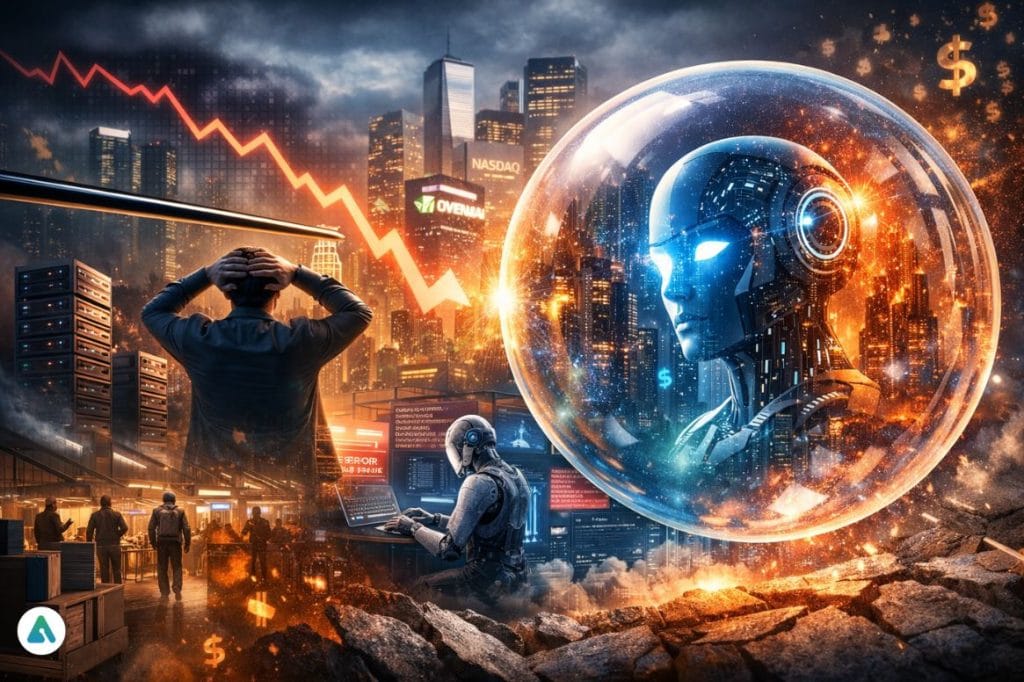
Everyone in tech is acting like AI just descended from the sky wrapped in gold foil. Meanwhile, I watched three startups in the same building panic-pivot to “AI-powered” within a month. One of them now sells “AI-driven wellness solutions,” which—if you peel back the pitch deck—means a chatbot that reminds you to drink water.
But sure, trillion-dollar revolution.
Nvidia crossed a trillion in market cap, and people clapped like it meant something cosmic. OpenAI’s valuation jumped to numbers that don’t even feel like real math anymore. And if you dare ask for profitability, someone will accuse you of “not understanding exponential curves.”
I understand fine. I also understand hype.
The Reverse Centaur Is Not a Metaphor, It’s a Job Description
I heard someone try to romanticize it at a conference: “Humans and AI, working together like a centaur.” Cute. Except the reality is more like:
AI does the flashy demo, humans follow behind with a mop.
A friend at a logistics company told me the AI routing system kept hallucinating nonexistent trucks. Workers had to manually “correct” the AI’s imagination before shipments went anywhere. Another person I know—editor at a mid-sized newsroom—spends half her day deleting AI-generated articles because they keep inventing nonexistent quotes. Not embellishing. Inventing.
Call it a centaur if you want. It feels more like pushing a shopping cart with a busted wheel.
Investors Aren’t Buying Innovation. They’re Buying Narratives.
We all know the script.
Automate everything. Replace everyone. Then—this is the important bit—profit infinitely, somehow, even though no one has figured out the actual unit economics.
I don’t even blame founders. They’re trapped. If you’re not “AI-driven,” investors won’t return your emails. So suddenly, the coffee shop down the street is marketing itself as “AI-powered beverage optimization.”
There’s an app for that now, apparently. It recommends iced coffee when it’s hot outside. Genius.
The Cracks Are Not Subtle
Here’s the part nobody likes to talk about: half the AI startups screaming about automation are secretly paying thousands of underpaid contractors to fix their model outputs. Real humans, real keyboards, real sweat—just hidden behind a shiny interface.
And compute costs? They’re a joke. I saw a leaked deck from an enterprise AI startup showing they spend more on GPUs than they do on employees. How do you scale that? You don’t. You raise another round and pray the graph goes up again.
Open-source is creeping up behind them anyway. Some of the “best in class” proprietary models are getting embarrassed by scrappy community versions running on consumer hardware. Nobody wants to say it out loud because it ruins the valuation party.
This Is Already a Bubble. The Pop Just Hasn’t Been Scheduled Yet.
I’m not forecasting doom. I’m not Nostradamus. But the vibes are off.
You can feel it in the way founders talk—too loudly, too confidently, like they’re trying to convince themselves.
And honestly?
I don’t know exactly when the break happens. Maybe this year, maybe next. Maybe it drags on longer because VCs keep writing checks out of inertia.
What I do know is this: bubbles always look like revolutions until they don’t.
The Aftermath Might Actually Be the Good Part
Strangely, I’m not cynical about the tech itself. The tech is fine. Fascinating, even. What’s exhausting is the mythology wrapped around it—the part where AI replaces entire professions overnight, and we all become “prompt architects” or whatever the LinkedIn gurus are selling this week.
Usually, the best tech emerges after the hype burns off.
Think post–dot-com crash: brutal, cleansing, and then suddenly the internet became actually useful.
We might need that again.
Related: 2026 Is the Year AI Grows Up: From Hype to Real-World Power
