
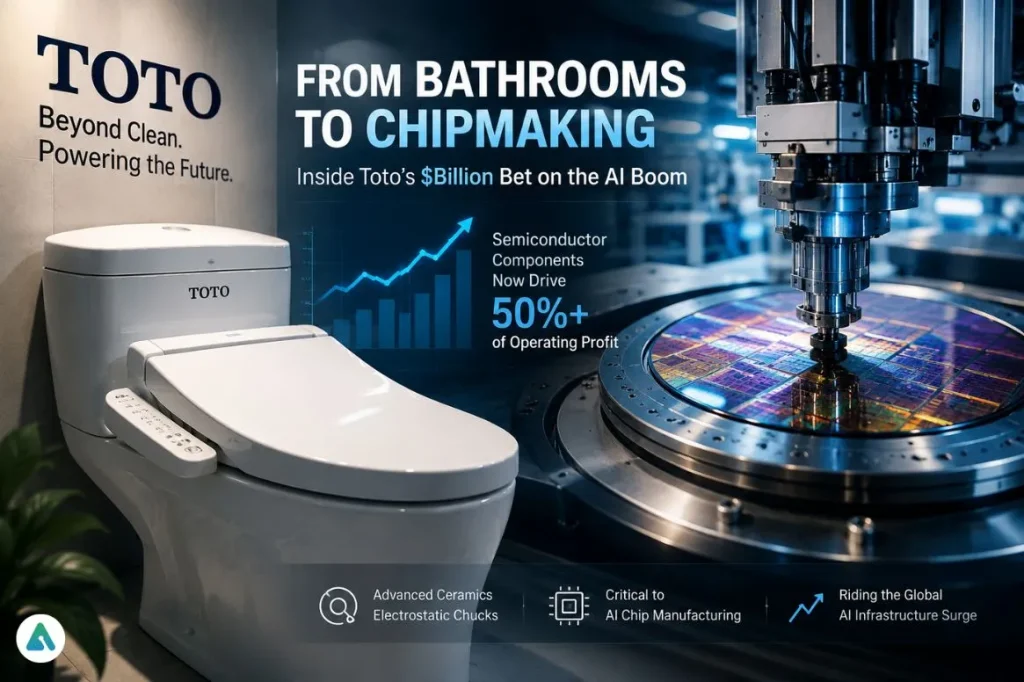
The AI boom has officially reached the bathroom.
Toto Ltd. — Japan’s iconic toilet maker — is now being revalued not for its washlets, but for its role in the semiconductor supply chain. The company expects more than half of its future capital expenditure to be tied to AI-driven chip manufacturing demand.
Not smarter toilets. Not connected bathrooms.
Semiconductor components.
It sounds absurd. It isn’t.
The Business Behind the Headline
The joke framing — “toilet company goes AI” — misses the actual story.
Toto has spent decades quietly building an advanced ceramics division that produces critical components used in semiconductor fabrication. These include electrostatic chucks, air bearings, and bonding capillaries — precision-engineered parts designed to operate under extreme thermal stress while minimizing contamination.
This is not a pivot.
Toto has been manufacturing electrostatic chucks since 1988. Today, that business has evolved into a high-margin, high-demand segment tied directly to the expansion of global chip production.
As AI infrastructure spending accelerates, semiconductor equipment manufacturers need materials that can withstand increasingly harsh fabrication environments. Toto happens to make some of the most reliable components in that niche.
The company didn’t chase AI.
AI demand found the company.
The Quiet Shift in Profit Reality
What makes this story more than a novelty is the internal imbalance it reveals.
Toto’s semiconductor-related ceramics division now accounts for a significant share of its operating profit — in some estimates, more than half. Meanwhile, its legacy toilet business is under pressure, hit by supply chain disruptions, rising material costs, and broader macroeconomic strain.
In practical terms:
- The “boring” industrial division is driving profitability
- The core consumer-facing business is weakening
That inversion matters.
It means the market is no longer valuing Toto as a bathroom brand. It’s valuing it as an AI-adjacent industrial supplier.
AI Demand Is Rewriting Industrial Narratives
Toto is not alone.
Ajinomoto — historically known for seasonings — has become essential in semiconductor packaging materials. Across Japan, legacy industrial companies are being reinterpreted through an AI lens.
This is the deeper shift:
AI isn’t just creating new companies.
It’s re-ranking old ones.
Firms that once looked stagnant are being repositioned as critical infrastructure providers within the AI supply chain. Investors are no longer asking, “What does this company sell?” but rather, “Where does it sit in the AI stack?”
What’s Actually Driving the Surge
The underlying mechanism is straightforward:
- AI models require massive compute
- Computers require advanced chips
- Chips require specialized fabrication equipment
- That equipment depends on ultra-precise components
Toto operates in that final layer — invisible to consumers, but essential to production.
As long as AI infrastructure investment continues at scale, demand for these components remains strong. That’s what’s lifting Toto’s ceramics business — not branding, not innovation in consumer products, but structural demand from the semiconductor industry.
The Fragility Beneath the Momentum
But this dynamic cuts both ways.
Toto’s growth in ceramics is tied directly to capital expenditure by chip manufacturers. And those manufacturers — particularly in memory markets — have historically been cautious about overexpansion.
A slowdown in AI infrastructure investment would ripple through the supply chain quickly.
If that happens:
- Semiconductor equipment orders decline
- Component demand softens
- Toto’s high-margin ceramics business slows
At the same time, its traditional toilet business is already under pressure.
That creates a dependency risk:
Toto is increasingly leveraged to a cycle it does not control.
Signal or Speculation?
There’s a temptation to read this as evidence of an AI bubble — to point at a toilet company becoming a proxy for chip demand and call it excess.
That interpretation is premature.
Unusual beneficiaries appear in every major technological shift:
- Railroads
- Electricity
- The internet
Each cycle elevated companies far outside the obvious core of the innovation. Some of those gains were speculative. Others were structural and lasting.
Toto sits at that intersection.
The Real Takeaway
The more important signal isn’t absurdity. Its depth.
The AI boom is no longer confined to software firms or GPU manufacturers. It is pushing deep into industrial supply chains, reshaping how legacy companies are valued and understood.
Toto is not becoming an AI company.
It is being reclassified as infrastructure.
And that shift — from brand identity to supply chain relevance — may be one of the clearest indicators of how far the AI economy is already extending beneath the surface.
Whether that expansion proves durable or cyclical remains an open question.
But one thing is certain:
When bathroom fixtures and semiconductor fabrication start sharing the same investment narrative, the scope of the AI economy is no longer theoretical.
It’s industrial.
Related: The “China Is Months Behind” Myth Just Collapsed — And the Data Is Brutal
