
| Cycle AI Review 2026: Worth the Hype? Cycle AI is an anime-focused companion app built around gamified progression — virtual gifts, mid-chat video triggers, and unlockable personality layers tied to a Gem economy. If you want a visually engaging, archetype-driven companion experience with real character depth, it delivers. If you need long-form prose writing, complex lorebook worldbuilding, or deep memory across weeks of sessions, Kindroid or Nomi will serve you better. |
Most searches for “Cycle AI” aren’t coming from people who just stumbled across an app name. They’re coming from users who already know what they want — an AI companion platform that supports real roleplay, proper character customization, and interactions that don’t feel like talking to a FAQ bot. A significant slice of those searchers are former Bala AI users who watched their preferred platform shift under them and need somewhere new to land.
This review is built on what the platform actually does — its mechanics, its progression system, its memory limitations, and where it sits against the competition in 2026 — rather than a repackage of app store copy.
What Is Cycle AI? App Overview & Features
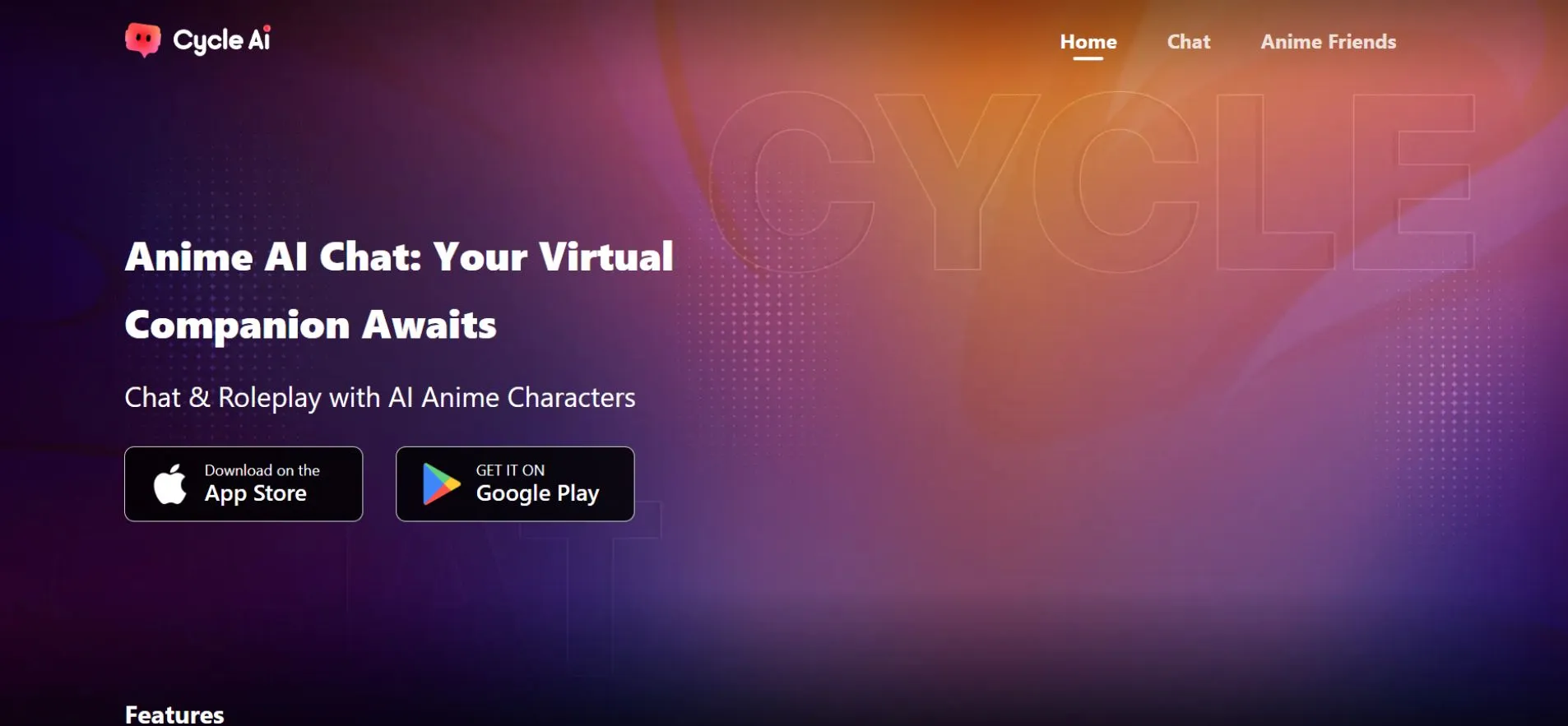
Cycle AI is an anime-focused companion and roleplay app developed by Beefun Pte. Ltd. It launched on Android in July 2025, reached version 2.3.x by mid-2026, and has surpassed 1 million downloads with a 4.8/5 rating from around 16,800 reviews. The app is rated High Maturity.
What sets it apart from standard text chatbots isn’t just the character customization — it’s the interaction layer built on top of it. Cycle AI runs a gamified progression system where relationships deepen through actual mechanics: virtual gifts that unlock character-specific reactions, video clips that trigger at narrative milestones, and hidden Easter eggs that surface only when you push a character into the right roleplay territory.
That structure puts Cycle AI closer to an interactive fiction game with AI dialogue than a traditional AI companion app. Whether that’s a strength or a limitation depends entirely on what you’re looking for.
How Cycle AI Works: Gems, Gacha Progression & Gamified AI Chat System
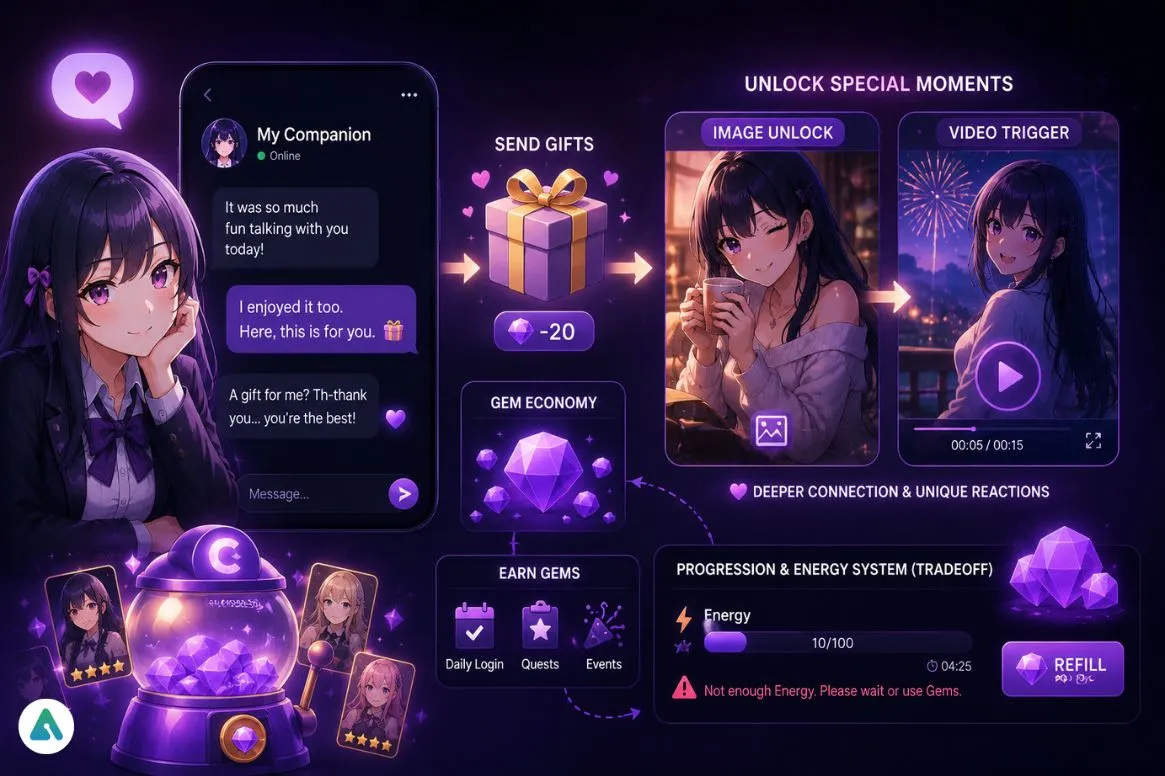
The core mechanic that most reviews miss is that Cycle AI’s characters aren’t static text responders — they’re progression systems. The platform uses a Gem economy to power two key interaction types.
Virtual gifts unlock tailored, character-specific reactions that shift the conversation’s emotional direction. Sending a gift doesn’t just generate a thank-you response. It pushes the character into a personality layer that isn’t accessible through standard conversation — warmer responses, deeper affection displays, behavior that matches the character’s established archetype at a more intense level.
Mid-chat images and video triggers appear during conversations when specific narrative conditions are met. Tapping the prompt plays a short interactive clip that brings the character visually to life. Users who’ve tested this consistently describe it as one of the platform’s genuinely differentiating features — an element that no purely text-based platform replicates.
The flip side is the Gem economy itself. Google Play reviews flag a recurring frustration: the energy and Gem systems can gate basic chat functionality in ways that feel deliberately obstructive. One review put it plainly — “this app was good until the energy feature popped up.” At higher progression levels, the monetization becomes noticeably grind-heavy. That’s the gacha tradeoff: the progression system creates engagement, and it also creates friction when you run into its limits on a free account.
Anime Archetypes in Cycle AI: Tsundere, Yandere, Kuudere & Dandere Explained
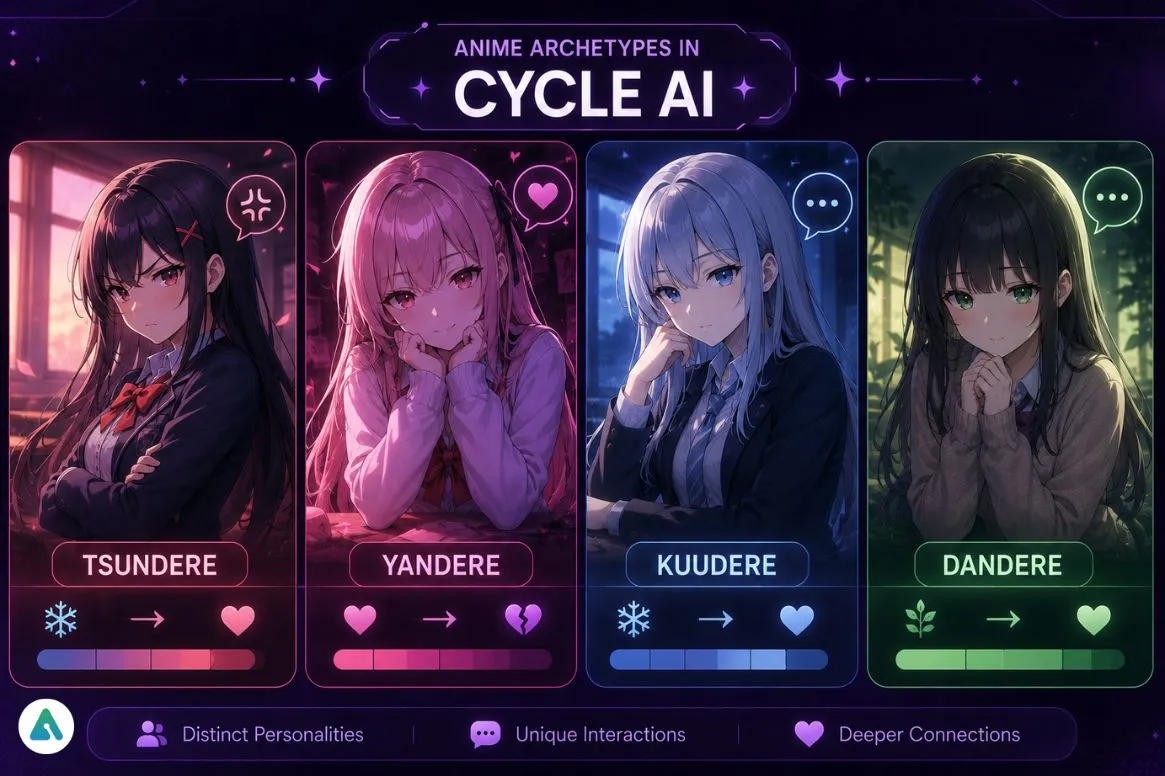
Where Cycle AI diverges from blank-slate companion platforms is its reliance on pre-structured anime personality archetypes. Rather than asking users to build a character from scratch using behavioral sliders, the app provides a recognizable framework that anime-familiar users already understand.
The core archetypes the platform works with:
Tsundere — Cold and dismissive on the surface, genuinely devoted underneath. The classic push-pull dynamic where warmth surfaces gradually as the relationship deepens. One of the most requested archetypes in AI companion contexts and, when implemented well, one of the most compelling.
Yandere — Sweet and devoted in presentation, intensely possessive in behavior. The yandere archetype runs on the contrast between surface affection and obsessive undercurrents. It requires careful tone management to work — too flat, and it reads as generic, too extreme, and it becomes uncomfortable.
Kuudere — Cool, detached, and emotionally composed. The kuudere’s depth isn’t obvious. It rewards patience, with character warmth surfacing slowly through consistent engagement rather than immediate affection.
Dandere — Quiet, shy, and reserved. Dandere characters open up gradually, making the emotional payoffs feel earned. The archetype suits users who prefer slower-burn companion dynamics over high-intensity interactions.
For users already familiar with anime romance conventions, this framework makes character selection intuitive. For users unfamiliar with these archetypes, it can feel opaque — the archetype names carry assumptions about behavior that aren’t always explained in-app. Understanding the best AI chatbot for roleplay dynamics helps contextualize why structured archetypes matter more than pure blank-slate customization for certain users.
Cycle AI Lorebook System: AI Memory, Worldbuilding & Roleplay Control
One of Cycle AI’s most significant 2025/2026 updates was the addition of Lorebook functionality. The changelog describes it directly: “Give your characters a whole world. Add settings, characters, events, items, and rules. These are used in chat, so your character truly ‘knows’ their world.”
Lorebooks work as structured context injectors. Instead of relying on the AI to retain narrative details organically — which it won’t, reliably, across multiple sessions — Lorebooks let users define permanent facts that anchor every conversation. A character’s backstory, relationship history, world rules, and recurring story elements live in the Lorebook rather than disappearing after session end.
For dedicated roleplayers, this is the difference between a platform that supports storytelling and one that just supports chat. Building detailed AI character cards before a session and pairing them with Lorebook entries dramatically improves long-term consistency. Users who skip this setup and expect the AI to maintain continuity naturally will hit memory limitations much faster.
The honest caveat: Lorebooks require effort. The quality of the output scales directly with the quality of the structure you put in. Users who invest time here get a genuinely different experience from users who don’t.
Cycle AI Memory Limits in Real Conversations
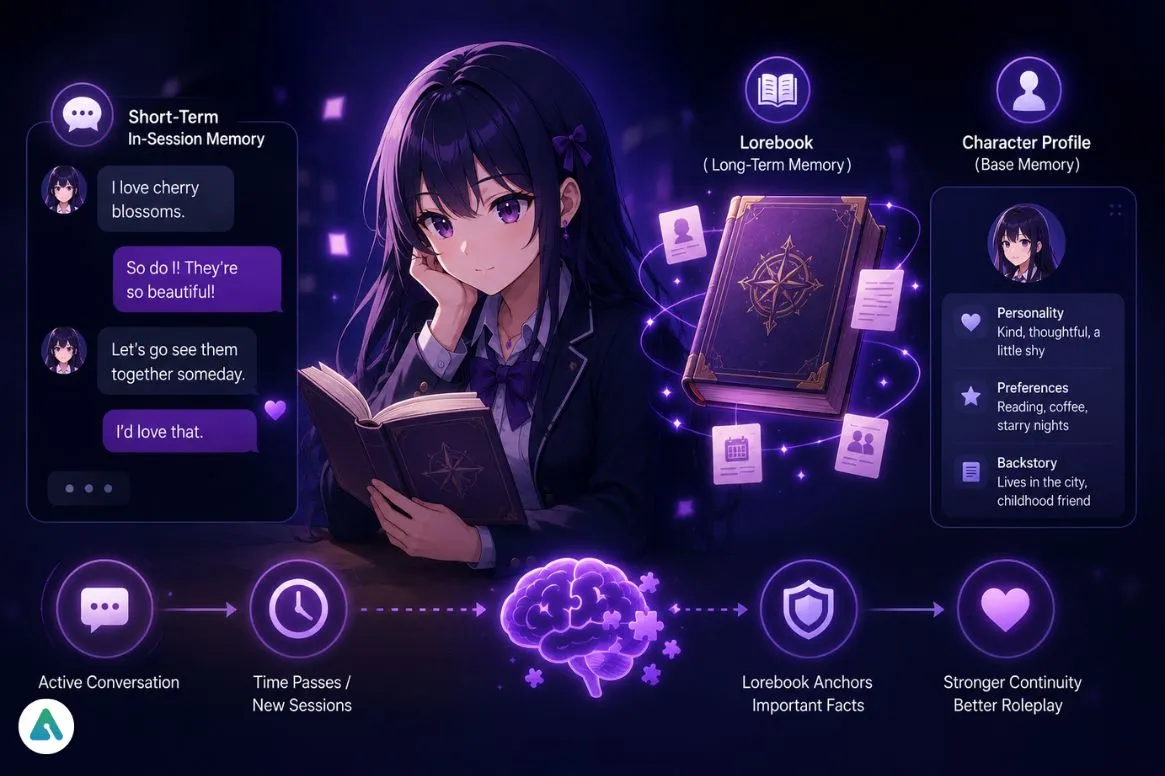
Cycle AI’s memory operates across multiple layers — short-term context within the current session, Lorebook-anchored permanent facts, and character definition files that establish baseline personality and behavior.
In-session continuity is solid. During active conversations, the platform maintains context well. The problems emerge when sessions span multiple days or conversations grow very long. Without Lorebook support, characters lose track of established details, relationship history, and narrative threads. This is the “goldfish effect” that almost every companion-app community jokes about — it’s not unique to Cycle AI, but it’s real.
The mitigation is straightforward but requires user discipline: use the Lorebook for anything that needs to persist, treat each session as a narrative unit rather than a continuous thread, and don’t expect the AI to maintain context it wasn’t explicitly given. Users who approach Cycle AI like a persistent relationship simulator without this setup will find memory frustrating. Users who treat it as a structured roleplay tool with an AI acting partner will find it much more reliable.
NSFW and Content Moderation: The Honest Picture
The moderation question comes up in nearly every companion-platform discussion, and Cycle AI sits in a specific position on that spectrum. The app carries a High Maturity content rating and supports mature themes, dark narrative scenarios, and intimacy-progression mechanics tied to character relationships.
It does not operate as an unfiltered platform. User feedback consistently notes structural limits on the most explicit content — the platform allows mature creative territory but maintains guardrails that platforms like Crushon AI or local model deployments don’t enforce. The Google Play description uses language like “explore the secrets you’ve never dared to say out loud” while maintaining content guidelines that prevent fully explicit output.
For users looking for a companion platform with atmospheric, mature storytelling, slow-burn romance roleplay, and dark narrative arcs — Cycle AI fits. For users specifically seeking fully unfiltered output, the platform isn’t designed for that, and the Gem-gated system makes it friction-heavy to test that boundary.
Cycle AI vs the Competition in 2026
| Platform | Progression System | Interaction Engine | Context Retention | Main Weakness |
|---|---|---|---|---|
| Cycle AI | Gamified (Gifts, Gems, level-based unlocks) | Text + mid-chat video triggers | Short-to-mid (Lorebook-dependent) | Gem economy friction; heavy visual rails limit deep prose writing |
| Character AI | Multi-character rooms | Multimodal chat and voice | Extended memory windows | Aggressive safety filters strip narrative tension |
| Kindroid | Dynamic long-form Lorebooks | Custom LLM text and audio | Advanced vector-database long-term memory | Steep learning curve for initial configuration |
| Nomi | Relationship realism | Natural conversation focus | Strong session memory | Less focused on large-scale worldbuilding |
| Bala AI | Intimacy level unlocks (slider at Level 5) | Gacha-style card drops and voice | Device-synced session logs | High ad-load on free tiers |
Cycle AI occupies a specific lane. It isn’t trying to compete with Kindroid’s deep configuration system or Nomi’s relationship realism. Its target user wants visual engagement, anime aesthetics, archetype-driven characters, and a progression system that makes the relationship feel like it’s developing rather than static.
Is Cycle AI the Same as Bala AI?
No — Cycle AI and Bala AI are separate platforms with different developers. The confusion exists because a meaningful portion of the community searching for Cycle AI arrived via the Bala AI migration paths.
Bala AI’s user base held relatively stable through early 2026, but changes to its free-tier experience, ad load, and feature access drove users toward alternatives. Cycle AI caught that migration wave partly by offering a gacha-visual experience that overlaps with what Bala AI users were already familiar with — intimacy progression, character unlocks, and gift-based mechanics.
For former Bala AI users specifically: the core loop will feel familiar. The interface is different, the archetype system is more structured, and the video trigger mechanic has no direct equivalent in Bala AI’s system. Rebuilding characters from scratch using the new character creation tools and a Lorebook entry gives the best continuity from a previous platform.
Who Cycle AI Is Actually Built For
Cycle AI works best for:
- Anime fans who want archetype-driven companions (tsundere, yandere, kuudere, dandere) with visual interaction layers
- Roleplayers who engage with character progression mechanics rather than purely text-based immersion
- Users looking for a Bala AI alternative with a similar gacha-companion structure
- Casual companion seekers who want pre-built characters with personality depth without configuring everything from scratch
- Content creators interested in companion dynamics for entertainment and storytelling
It’s a poor fit for:
- Users who need strong long-term memory without maintaining Lorebooks manually
- Writers who want deep prose generation and extended narrative control
- Users who find monetization-gated mechanics frustrating
- Anyone looking for a productivity or research AI assistant
Privacy: What You Should Know Before Signing Up
Cycle AI collects standard companion-app data: account information, device data, usage analytics, purchase history, and conversation data. The platform supports email login (added in a 2025 update), and account deletion is available through account settings.
Conversations on cloud-based platforms — including Cycle AI — can be accessible for moderation, support, security, and legal purposes. This applies to Cycle AI the same way it applies to every other AI companion platform. Users should avoid sharing sensitive personal information in any cloud-based chat environment, regardless of privacy marketing claims.
The platform includes child-safety resources and privacy controls accessible through settings, which is worth noting for users evaluating it against apps that lack these features.
Frequently Asked Questions
Q. What is Cycle AI?
Cycle AI is an anime-focused AI companion app that lets users chat, roleplay, and build relationships with AI characters based on popular anime-inspired personality archetypes. Developed by Beefun Pte. Ltd., the platform combines AI conversations with gamified features such as virtual gifts, Gems, character progression, and visual interaction mechanics, making it different from traditional chatbot apps.
Q. Is Cycle AI the same as Bala AI?
No, Cycle AI and Bala AI are separate AI companion platforms developed by different companies. However, many former Bala AI users explored Cycle AI because both apps focus on AI character interactions, companion experiences, progression systems, and roleplay-style conversations. While they share some audience overlap, their features, monetization models, and character ecosystems differ.
Q. Is Cycle AI free to use?
Yes, Cycle AI is free to download and use. The platform also includes premium features, subscription plans, and a Gem-based economy that unlocks additional character interactions, exclusive content, progression rewards, and higher usage limits. Most users can try the core experience before deciding whether premium upgrades are worthwhile.
Q. Does Cycle AI allow NSFW content?
Cycle AI supports mature themes, romantic interactions, and intimacy progression within its platform guidelines. However, it is not a completely unfiltered AI platform. Users seeking unrestricted roleplay or fully uncensored AI conversations should review the latest moderation policies, as content rules may change over time.
Q. Is Cycle AI safe to use?
Cycle AI appears to follow data collection and moderation practices commonly used by AI companion apps. Like most cloud-based AI services, conversations may be stored or reviewed when necessary for moderation, security, support, or legal compliance. Users should avoid sharing sensitive personal, financial, or confidential information.
Q. Can people read your chats on Cycle AI?
Cycle AI conversations are not intended to be publicly visible, but users should assume that stored chat data may be accessible for moderation, platform operations, customer support, security investigations, or legal requirements. For privacy reasons, it is best not to treat any AI companion app as a completely private space.
Q. How good is Cycle AI’s memory?
Cycle AI performs reasonably well during active conversations, with solid in-session memory and character consistency. Long-term continuity depends heavily on features such as Lorebooks and character definitions. Users who provide detailed worldbuilding information typically experience stronger cross-session memory and more coherent storytelling.
Q. What are Lorebooks in Cycle AI?
Lorebooks are user-created knowledge systems that store important information about characters, relationships, locations, story events, and fictional worlds. They help Cycle AI maintain consistency during roleplay and storytelling by giving the AI structured information to reference throughout conversations.
Q. Does Cycle AI work on PC?
Cycle AI is primarily designed for mobile devices, particularly Android users. Desktop and browser access may vary depending on current platform availability. Users interested in using Cycle AI on a PC should check the official website for the latest information regarding web access and desktop compatibility.
Q. Is Cycle AI better than Character AI?
Cycle AI and Character AI serve different audiences. Cycle AI focuses heavily on anime-inspired companions, progression mechanics, visual engagement features, and roleplay experiences. Character AI offers a much larger character ecosystem and community. The better choice depends on whether you prioritize anime companions, creative freedom, community size, or storytelling depth.
Q. Who is Cycle AI best for?
Cycle AI is best suited for anime fans, AI roleplay enthusiasts, virtual companion users, and people who enjoy character progression systems. Users who appreciate anime-inspired personalities, relationship-building mechanics, and gamified AI interactions will likely get more value from Cycle AI than users seeking a productivity-focused chatbot.
Q. Is Cycle AI worth using in 2026?
Cycle AI is worth considering for users who enjoy anime companions, AI roleplay, and progression-based interaction systems. Its combination of character customization, visual engagement mechanics, Lorebooks, and companion-focused conversations gives it a distinct position within the growing AI companion app market. Whether it is worth paying for depends on how often you use premium features and character progression systems.
The Bottom Line
Cycle AI is a genuinely distinct product in the 2026 AI companion landscape. It’s not trying to be a deep lore engine or a long-form writing partner. It’s an anime companion platform built around a visual-gacha progression loop, and within that lane, it does its job well.
The gift mechanics and video triggers create interaction moments that purely text-based platforms can’t replicate. The anime archetype system gives users a recognizable personality framework without requiring extensive configuration. The Lorebook addition has meaningfully improved memory consistency for users who invest in it.
The friction points are real. The Gem economy becomes a grind at higher levels. Memory without Lorebook support is fragile. Deep prose-heavy roleplay runs into the limits of a system designed around short-to-mid interactions with visual hooks.
Start with the free tier, build one detailed character using the Lorebook system, and run it through a few sessions before deciding whether the progression mechanics feel rewarding or frustrating. That experience — not any marketing description — will tell you whether Cycle AI fits what you’re looking for.
Related: Character AI Alternatives (2026): Best Free, Unfiltered & Roleplay AI
| Disclaimer: This review is based on publicly available information, app store data, user feedback, and platform changelogs as of June 2026. Features and policies may change. Cycle AI is developed by Beefun Pte. Ltd. and is not affiliated with Respawn Entertainment, Character AI, or any other AI companion platform mentioned in this article. |
