
The water bill for the AI boom is coming due. The problem is not just the size of the tab. It’s who’s being charged.
In places like Querétaro, Mexico—where drought conditions have already strained local aquifers—industrial water demand is no longer an abstract policy issue. Farmers, manufacturers, and now data centers are drawing from the same finite reserves. What used to be a background infrastructure question is turning into a visible competition.
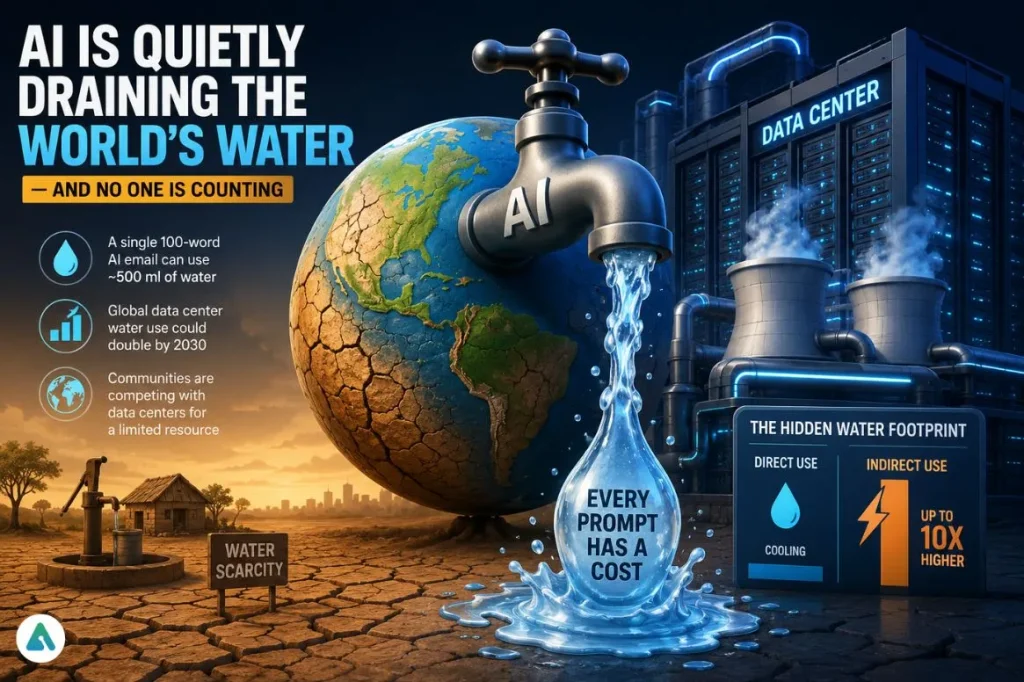
At the same time, a peer-reviewed paper in Communications of the ACM, based on research from the University of California, Riverside, put a number on something the tech industry has largely avoided quantifying: generating a simple 100-word email with a large AI model can consume roughly 500 millilitres of water under typical data center conditions.
That figure varies depending on infrastructure, geography, and model efficiency. But it reveals a deeper reality: artificial intelligence has a physical footprint, and water is one of its least visible constraints.
Even if that per-query estimate is significantly overstated, the scale of global AI usage pushes the total into territory that looks less like marginal resource use and more like industrial consumption.
The Physics No One Can Ignore
AI doesn’t consume water because companies are careless. It consumes water because of thermodynamics.
The GPUs that power modern AI systems—many supplied by NVIDIA—generate enormous amounts of heat. Large-scale training runs can involve tens of thousands of chips operating simultaneously for weeks or months.
That heat must be dissipated. In many hyperscale data centers, evaporative cooling remains one of the most cost-effective methods. Water absorbs the heat and carries it away—but a significant portion is lost as vapor.
Not all of that water disappears permanently. Some is returned to local systems, often warmer or chemically altered. But much of it is effectively removed from the immediate water cycle, especially in already stressed regions.
The Accounting Problem
The bigger issue isn’t just consumption—it’s measurement.
Most companies publish water data, but in ways that obscure real impact. Three gaps matter:
| Water Metric Category | What It Measures | Why It Misleads |
|---|---|---|
| Withdrawal | Total water taken from a source | May be returned, masking real depletion |
| Consumption | Water is permanently lost (evaporation, contamination) | Often excludes local seasonal stress |
| Indirect Use | Water is used to generate electricity | Frequently omitted, despite being far larger |
Research from institutions like Lawrence Berkeley National Laboratory shows that indirect water use—especially from thermoelectric power generation—can exceed direct data center cooling consumption by up to an order of magnitude.
Most corporate sustainability reports do not include this number.
The result is a system where disclosures are technically accurate, but practically incomplete.
Where the Strain Shows Up
This is where the story stops being abstract.
Data centers are built where energy is available, land is affordable, and infrastructure can scale quickly. The result—regardless of intent—is a geographic concentration in regions where water is often already under pressure.
Across parts of Latin America, local opposition has emerged around proposed or operational facilities drawing from overextended aquifers. Similar tensions are appearing in drought-prone regions globally.
What matters is not just how much water AI uses, but where that water is coming from—and who else depends on it.
The Missing Trade-Off
The industry responds that AI will ultimately help solve resource challenges, including water scarcity. That claim is not without merit.
AI systems are already being deployed for:
- leak detection in urban infrastructure
- precision irrigation in agriculture
- drought forecasting and climate modeling
These applications are real and increasingly valuable. But there is no comprehensive public accounting showing that these efficiency gains offset the rapidly growing infrastructure demand.
That trade-off remains unmeasured.
The 2026 Inflection Point
Recent data suggests the scale of the issue is accelerating.
A 2026 assessment from the United Nations University Institute for Water, Environment and Health projects that global data center water consumption could nearly double by 2030, driven in large part by AI workloads.
At the same time, the industry is beginning to respond.
Major cloud providers, including Google and Microsoft, are investing in:
- Direct-to-chip liquid cooling (reducing evaporation losses)
- Closed-loop water systems (minimizing net consumption)
- Waste heat reuse (including experimental water purification systems)
Some facilities are even being designed as “water-positive,” aiming to return more clean water to the environment than they consume.
These are meaningful developments—but they are not yet the industry standard, and deployment is uneven.
The Coming Collision
For now, the issue remains largely invisible. Water accounting is complex. Infrastructure is geographically distant from most users. The costs are externalized.
That won’t last.
As AI demand grows and climate pressures intensify, conflicts between digital infrastructure and local water access are likely to become more visible—and more political.
When drought conditions and data center expansion collide in the same community, the conversation changes quickly.
The story of AI has largely been told in terms of intelligence, productivity, and economic transformation. Those narratives are real.
But beneath them is a physical layer that cannot be abstracted away.
Every prompt runs on infrastructure.
That infrastructure runs on energy.
And increasingly, it runs on water.
The meter is running. The only question is whether anyone is truly measuring it—and who ultimately pays the cost.
