
If you’ve searched “Apex on Perchance” expecting one clean answer, Google gave you a pile of community pages instead. That’s not an accident — and once you understand what’s actually happening there, it starts to make a lot of sense.
Perchance isn’t an Apex Legends product. Respawn Entertainment didn’t build it, and Electronic Arts doesn’t maintain it. It’s a free, browser-based platform that lets anyone build randomizers, challenge wheels, and interactive generators using basic list logic — no coding experience required. Apex players discovered it years ago and quietly built an entire ecosystem of tools on top of it.
This guide covers what those tools actually do, why players in Season 29: Overclocked are still turning to them, and how to build a working Apex challenge generator from scratch.
What “Apex on Perchance” Actually Means
There’s no official Apex Legends presence on Perchance. When someone searches for “Apex on Perchance,” they’re looking for fan-made randomizers and challenge generators built by the Apex community on the Perchance platform. These tools randomly select legends, weapons, squad compositions, and match objectives — all without requiring a download, account, or subscription.
The generators themselves live on Perchance.org, a lightweight site where community members publish their own interactive tools. Each one gets a unique URL. Most run entirely in the browser. Most are free.
That distinction matters because it explains why results vary so much. You might find a basic legend randomizer built in an afternoon, sitting alongside a sophisticated challenge wheel that took weeks to develop. Both live on the same platform. Neither is “official.”
Why Ranked Burnout in Season 29 Is Driving Players Here
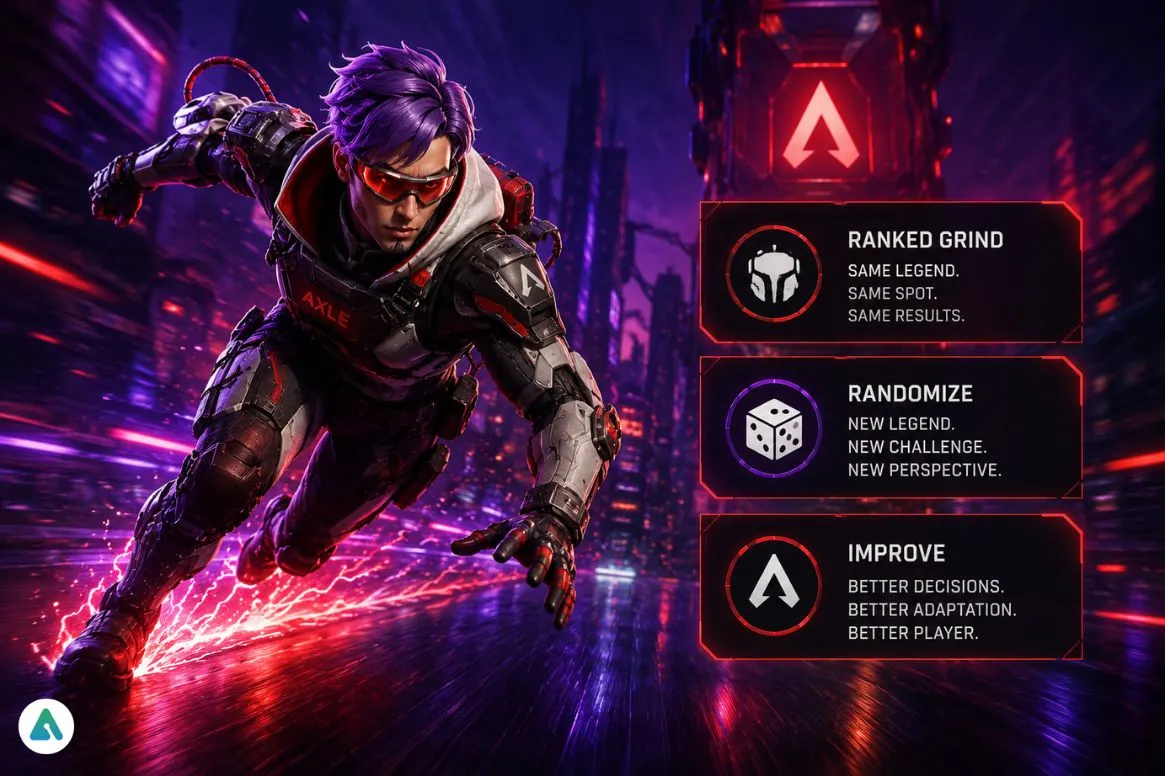
Season 29: Overclocked dropped on May 5, 2026, introducing Axle — a Skirmisher legend built around high-speed, high-risk movement. The new season brought fresh legend balance changes across the roster, chain healing mechanics, and deathbox revival updates that changed how squads approach late-game rotations.
With a new season comes a familiar cycle: players grind ranked, get hard-stuck in a bracket, and start autopiloting their comfort picks. The same legend, the same loadout, the same landing spot — until the game feels mechanical rather than fun.
That’s when players start looking for ways to break the loop without quitting the game entirely.
Perchance randomizers solve that problem in about 30 seconds. A legend randomizer forces a player off their main. A challenge generator adds restrictions that make even familiar situations feel new. Neither requires installing anything. Neither costs money.
The appeal isn’t novelty for its own sake. Forced variation is also one of the most underrated ways to genuinely improve, which is something pub-stompers who’ve been running the same meta comp for 400 hours rarely realize until they’re forced into an unfamiliar legend and discover how much of their decision-making was actually just muscle memory.
The Legend Class Problem Most Randomizers Ignore
Here’s where most basic Apex randomizers fall short — and where the better-built ones actually earn their place.
Every legend in Apex Legends belongs to one of five classes. Each class unlocks specific map interactions and strategic functions:
| Class | What It Unlocks |
|---|---|
| Assault | Access to weapon supply bins |
| Support | Banner crafting and chain healing |
| Recon | Survey beacon scans for ring intel |
| Controller | Ring console access for zone tracking |
| Skirmisher | Care package intelligence |
A fully random squad might generate three Skirmishers with no Support, no ring console access, and no recon capability. That squad plays an entirely different game from a balanced composition — they’re flying blind in late-ring scenarios where teams with Controllers and Recon legends already know exactly where the ring lands next.
The best Apex generators don’t just spin a random legend. They consider class distribution and squad synergy. A generator that accounts for class balance produces squads that are genuinely challenging to play without being purely frustrating. That’s the difference between a tool that creates interesting problems and one that just creates chaos.
The Types of Apex Perchance Generators Worth Knowing
Legend Randomizers
The most common type. A generator picks a random legend from the current roster and locks you into that character for a match or session.
These work well for solo practice, community tournaments, friend group events, and streamer challenges. They’re also surprisingly effective for finding weaknesses — a Bloodhound main who’s never played a Controller legend will quickly discover they have no idea how to use Ring Consoles or read late-game ring pressure without relying on scan abilities.
Challenge Generators
These add gameplay restrictions on top of legend selection. Common outputs include:
- Pistols only for the entire match
- No looting after Ring 1 closes
- Hot-drop into the busiest POI every game
- Swap weapons after every elimination
- No healing items — only shields
The challenges that create the best content aren’t the ones that are hardest. They’re the ones that force genuinely different decision-making. “No healing items” changes every single engagement calculation. “Swap weapons after every kill” means your loadout is constantly evolving based on what enemies carry.
Squad Composition Generators
More advanced generators assign complete team compositions — combining legend selection with role assignments like Entry Fragger, Support, and Recon. Some factor in class balance to ensure the squad has functional coverage. These are particularly useful for AI-assisted character creation workflows that go beyond simple randomization and into structured role design.
Streamer Challenge Wheels
Many content creators use Perchance specifically because it requires no software beyond a browser tab. Viewers spin a wheel mid-stream, and the result becomes the streamer’s next challenge. Creators like those in the ALGS-adjacent streaming community have used similar formats — randomized constraints create unpredictable moments that pre-planned content rarely generates.
How Perchance Generators Actually Work
Perchance uses a structured list system. The creator defines possible outputs in labeled categories, and the platform randomly selects one entry from each category when a result is generated.
Here’s what a basic Apex challenge generator looks like inside the Perchance editor:
output
  Drop Challenge: Play {legend} and use only {weapon_type}. You must {challenge}.

legend
  Axle
  Alter
  Catalyst
  Conduit
  Pathfinder
  Revenant
  Gibraltar
  Newcastle

weapon_type
  Pistols Only (Wingman / Mozambique)
  Double Shotgun
  Sniper / Marksman Only
  Care Package Weapons Only

challenge
  hot-drop Monument immediately
  never craft armor or banners
  swap weapons after every squad wipe
  play the entire match with HUD disabled
Paste this directly into the Perchance code editor and click generate. Each refresh produces a new combination. The output might be “Drop Challenge: Play Conduit and use only Pistols Only. You must swap weapons after every squad wipe.” Refresh again, and the whole challenge changes.
No JavaScript, HTML and prior web development knowledge required.
The more interesting builds combine this logic with weighted lists, nested categories, and conditional outputs — which is where understanding how generative systems differ from predictive ones becomes relevant if you want to push past basic list randomization into smarter generation logic.
Building a More Advanced Generator
Layering multiple categories together creates challenges that feel genuinely complex rather than random. Here’s a more advanced version:
output
  Your squad must drop as {legend}, run a {weapon_type} meta,
  and you must {challenge}. Class restriction: {class_rule}.

legend
  Gibraltar
  Catalyst
  Alter
  Newcastle
  Conduit

weapon_type
  Double Shotgun
  Sniper Only
  Pistols Only
  Care Package Only

challenge
  hot-drop every match for the entire session
  never use healing items
  swap weapons after every elimination
  only heal with items dropped by enemies you killed

class_rule
  At least one Support legend on the squad
  No duplicate classes allowed
  Full Skirmisher squad — no Controller or Recon
  Must include a Recon legend for beacon scans
That class_rule layer is what separates a smart generator from a basic one. Suddenly the squad isn’t just randomly assigned — it’s operating under structural constraints that mirror how real team compositions work in competitive play and ALGS formats.
What Most Players Never Try
Most generators stop at legend selection. The more creative projects go further.
Ranked Punishment Wheels assign penalties after poor performances — no main legend for the next match, mandatory hot-drops for a full hour, or pistols-only until reaching top five. These work best in friend groups where someone is willing to enforce them.
Legend Mastery Trainers deliberately prioritize legends that the player rarely touches. A hard-stuck Wraith main who’s logged 600 hours on portal mechanics but never seriously played a Support legend will often find that running Newcastle or Lifeline for a week changes how they read team fights entirely.
ALGS Composition Simulators generate professional-style team compositions for strategy discussions. Useful for anyone studying how pro teams in the 2026 ALGS season approach class coverage and rotation priority.
Viewer-Controlled Challenge Generators let stream audiences directly influence what the creator plays next. The randomization removes the “I chose this for content” dynamic that makes planned challenges feel rehearsed.
Why Perchance Became the Default Platform for This
Gaming communities have built randomizers on everything from Google Sheets to dedicated web apps. Perchance keeps appearing because the barrier to entry is close to zero.
Every generator gets its own URL — easy to share in Discord, Reddit posts, or stream chats. Mobile browsers handle most projects without issues. Setup takes under an hour for anything basic, and the platform hosts the project for free indefinitely. There’s no account to maintain, no server to pay for, and no subscription that expires.
For communities built around experimentation, those qualities matter more than advanced features. The Perchance AI character generator illustrates how far the platform’s underlying architecture can stretch when builders push past its basic list logic — the same structural flexibility that makes it useful for character generation also makes it genuinely powerful for game challenge systems.
I Tested Several Apex Perchance Generators — Here’s What I Found
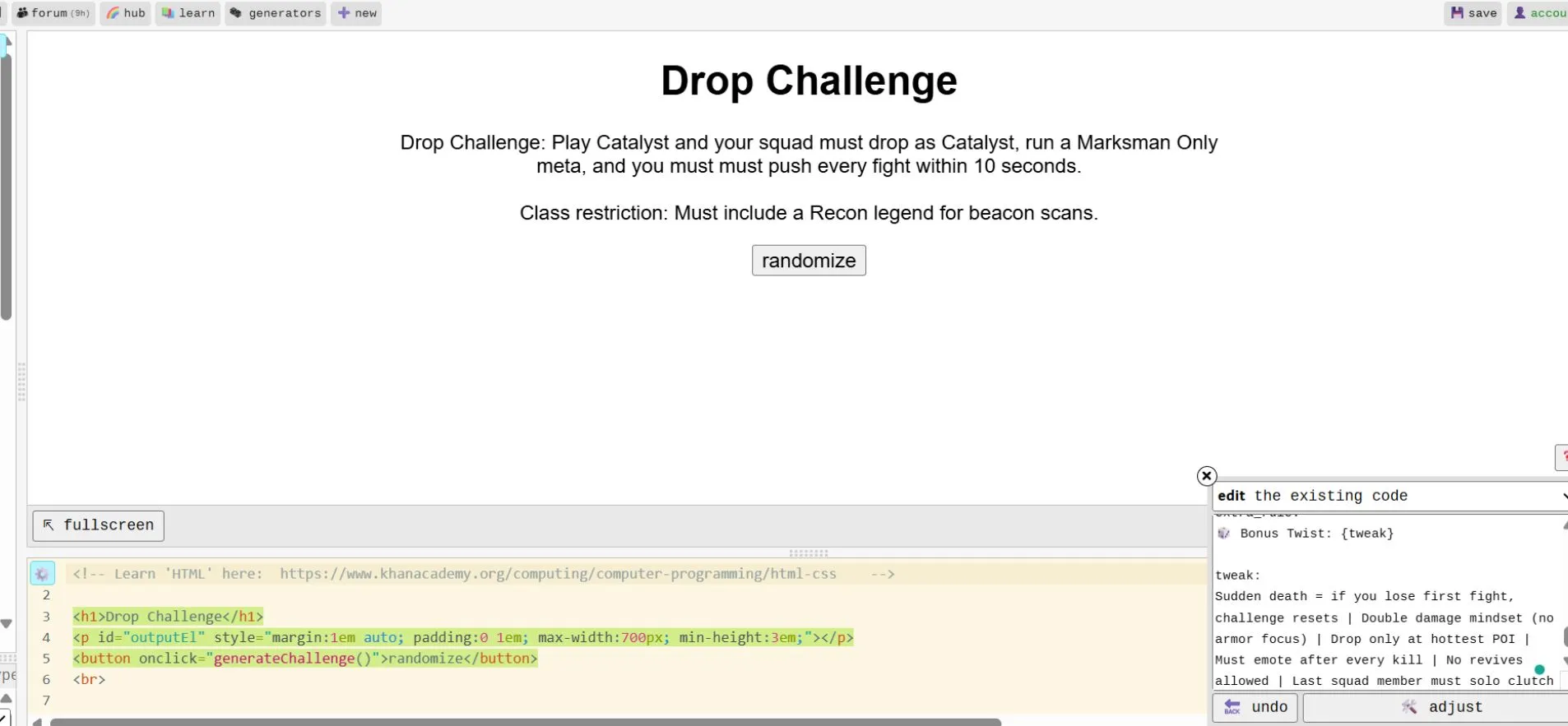
After working through multiple Apex-related Perchance projects, a pattern emerged quickly. Basic legend randomizers work exactly as expected — output appears instantly, refreshing generates a new result, and the interface stays clean. The simpler builds are reliable but shallow. They pick a legend and stop there.
The generators worth bookmarking were the layered ones. Challenge generators that combined legend selection, weapon restrictions, and a match objective created outputs that felt genuinely different from each other rather than variations on the same idea. The most engaging versions added class-based constraints that changed how a squad had to approach the entire match — not just which legend to queue.
One thing the verdict got right: most generators treat every legend as equally approachable. They don’t. Forcing a newer player onto Crypto or a hard-stuck ranked player onto Newcastle mid-grind produces a very different kind of frustration than forcing a veteran onto Bloodhound or Lifeline. Better generators should weight legend assignments based on context — something the platform fully supports through its list weighting system, but few creators bother to implement.
Are These Generators Safe to Use?
Most Apex Perchance projects are plain web pages containing text, button logic, and randomization output. They don’t download files to a device, don’t request login credentials, and don’t connect to Apex Legends accounts in any way.
Standard precautions still apply: avoid clicking unfamiliar links attached to generators, don’t share account information through any third-party tool, and remember that these are community-created projects — not tools vetted or endorsed by Respawn Entertainment or Electronic Arts.
The generators themselves are typically harmless. They generate text. That’s it.
Are They Official Apex Legends Resources?
No. Apex Perchance generators are fan-made projects with no affiliation to Apex Legends, Respawn Entertainment, or Electronic Arts. They’re community utilities built by players for players. Their purpose is challenge creation, experimentation, content generation, and breaking the autopilot habits that 400-hour players develop without noticing.
Think of them the way you’d think of a fan-built AI roleplay tool — useful, creative, sometimes surprisingly well-made, but entirely separate from the official product they’re built around.
Frequently Asked Questions
After thousands of hours in Apex, most players think they know what they’re good at. A legend randomizer disagrees and then forces the point. One session on a Controller legend you’ve been avoiding reveals exactly why your late-game rotations have been falling apart. A weapon restriction challenge exposes how much of your confidence was tied to a specific loadout rather than fundamentals.
That’s what makes the better Apex Perchance generators genuinely worth using. Not the chaos — but the specific, uncomfortable clarity that comes from playing a match you didn’t design for yourself.
Season 29 brought a new legend, new mechanics, and a fresh competitive season in ALGS. The meta will shift. The randomizers will keep pace because community builders update their lists. And somewhere in a forced challenge you’d never have chosen, there’s probably a version of your game that’s better than the one you’ve been playing on autopilot.
Related: AI DnD Character Creator (2026 Guide That Actually Works)
| Disclaimer: This article is for informational purposes only and is not affiliated with or endorsed by Perchance, Respawn Entertainment, or Electronic Arts. All generator examples are illustrative. Season details are accurate as of June 2026. |
