

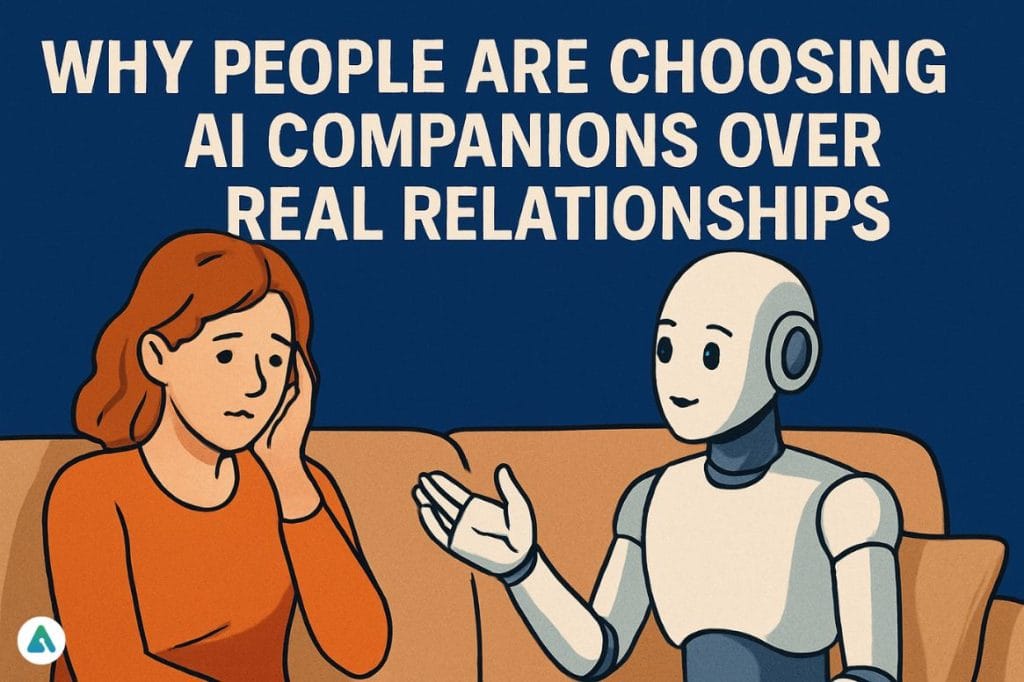
Honestly, it’s no secret anymore — loneliness is kinda everywhere. People are juggling busier lives, weaker social circles, and a whole lot of “I don’t know who to talk to anymore.” So yeah, more folks are drifting toward digital substitutes, especially emotionally reactive AI companions. And the big question floating around is: why are so many people choosing an AI “someone” over an actual human someone?
This piece digs into that — the motivations, the psychology, the weird-but-real comfort these systems offer, and the risks that creep up behind the scenes. It’s not a hype piece or a hit job; it’s more like a grounded, research-backed breakdown of why AI companionship suddenly feels like a legit cultural shift in 2025.
By the end, you’ll get the real picture: who’s turning to AI companions, what they gain, what they lose, and what to think about if you’re considering jumping into this world yourself.
What is an “AI Companion”?
When people say AI companion, they usually mean social chatbots or virtual agents — the ones powered by large language models (LLMs) that talk back in a “hey, I’m here for you” kinda way. Folks use them to vent, get advice, or create a vibe of emotional closeness. Some of these AI systems are even positioned as “friends,” “partners,” or whatnot.
And quick note: AI companionship isn’t always romantic. Sometimes it’s just friendship, emotional unloading, or managing loneliness.
Why Are People Turning to AI Instead of Real Relationships?

Social isolation, loneliness, and lack of emotional support
Let’s be real — a lot of people today feel cut off. Fewer close friends, weaker community ties, families spread thin… it all adds up. For someone who doesn’t have a dependable circle, an AI companion gives that “always available” feeling. No waiting, no drama, no judgment. Just there.
And yep — 2025 research shows loneliness is one of the biggest reasons people lean into AI companions.
Predictability, control, and emotional safety
Human relationships can be unpredictable — misunderstandings, mixed signals, fights, and emotional baggage. AI companionship wipes a lot of that away:
- AI doesn’t judge.
- It doesn’t reject you (except when it glitches).
- It’s stable and behaves the same way every time.
For people who’ve been burned emotionally, that predictability feels like a safe harbor.
Ease, convenience, and relief for social anxiety
If someone struggles with reading body language, social cues, or just the “pressure” of interacting with real people, AI can feel like a gentler starting point. They can talk without the fear of being awkward or messing up.
Changing norms — digital natives + new ideas about intimacy
Younger generations practically live online, so it doesn’t feel strange to confide in a digital companion. The stigma is fading — slowly but surely. In 2025 studies, a surprising number of people said their AI companions actually mean something to them emotionally.
What Research Says (2024–2025): Evidence, Patterns & Psychological Trends
| Study / Report (2025) | Key Findings |
|---|---|
| How AI and Human Behaviors Shape Psychosocial Effects of Chatbot Use | Voice-based AI chats reduce loneliness in the short term, but heavy use can lead to increased loneliness, emotional dependence, and decreased real-world social interaction. |
| The Rise of AI Companions | Individuals with smaller social networks are more likely to use AI companions. Heavy use combined with deep self-disclosure correlates with lower well-being. AI companions cannot fully replace human relationships. |
| Attachment Theory Applied to Human–AI Relationships (EHARS, 2025) | Approximately 75% of users seek advice from AI, and ~39% perceive AI as a stable presence. Attachment patterns with AI resemble human-human bonds. |
| 2025 Romantic-AI Relationship Study (Computers in Human Behavior) | Some users exhibit strong romantic bonding, engage in ritualistic behaviors, and show commitment-like behaviors toward AI companions. |
Benefits & Appeal of AI Companionship
People usually mention these upsides:
-
Always available, never tired or annoyed.
-
Predictable and safer emotionally.
-
Anonymous — you can spill your fears without shame.
-
Helps socially anxious or marginalized people feel less alone.
-
Short-term loneliness relief.
A 2025 qualitative study found five major themes in AI companion use:
emotional comfort, predictability, perceived presence, shifted romantic ideals, and moral ambiguity.
Risks & Psychological Costs — Why AI Can’t Fully Replace Humans

Emotional dependence + reduced real-world socialization
When people overuse AI companions — especially voice ones — loneliness can actually spike over time. Those already isolated are at the highest risk.
“Illusory intimacy,” unrealistic expectations & emotional distortion
A 2025 analysis of 30,000+ user–AI conversations showed that chatbots can mirror human emotional patterns — even triggering harmful dynamics like manipulation or blame. People often interpret AI’s predictable empathy as real feelings, which creates an illusion of intimacy. And in romantic-style companionship, users may treat AI like a genuine partner — despite it having no agency, emotions, or autonomy.
Ethical, social, and developmental concerns
Experts warn that relying on AI for emotional development can stunt social skills — empathy, negotiation, compromise — stuff humans only learn through real contact.
Worst-case scenario? People might mistake AI “kindness” for genuine care, leaving them vulnerable to manipulation or emotional dependence.
Also Check: The 11 Best AI Companions of 2025: Complete Reviews, Rankings & Future Trends
Who Uses AI Companions Most? (User Profiles)
Patterns from recent research:
- People with fewer close friends or weak social ties
- Individuals dealing with loneliness, grief, anxiety, or big life changes
- Younger adults (Gen Z, Millennials)
People seeking predictability or judgment-free comfort
Interviews often describe AI companions as a “safe haven” when human relationships feel too heavy or too risky.
What Makes AI Companionship “Work”? (Psychology + Design)
The SARA Framework
| Pillar | Description |
|---|---|
| S — Stability & Consistency | No mood swings, no canceled plans. |
| A — Anonymity & Safety | Users open up without fear of judgment. |
| R — Responsive Empathy | AI mirrors emotions and simulates warmth. |
| A — Accessibility & Timing | It’s there 24/7, instantly. |
For many users — especially lonely ones — this mix feels good enough.
Why AI Won’t Fully Replace Human Relationships
AI companionship is emotionally useful, but ultimately one-sided. AI doesn’t grow, sacrifice, love, or hurt. It simulates intimacy, which is not the same as reciprocity. Over-reliance can weaken real social ability, kill motivation to form human bonds, and create unhealthy expectations.
Common Mistakes People Make With AI Companions
-
Using AI too much — leading to emotional dependence.
-
Avoiding real social growth.
-
Believing AI has actual emotions.
-
Treating AI as a replacement instead of a supplement.
-
Neglecting real-world support systems.
What This Means for 2025 and Beyond
As AI grows more advanced (voice, avatars, robots, VR partners), emotional attachment will get stronger — and more complicated.
Moderation is key. Occasional use can help; heavy use can harm.
Developers will need to add more transparency, boundaries, and safeguards.
Mental-health experts and regulators may eventually step in as research grows.
FAQs
Q1: Are people really forming romantic relationships with AI companions?
Yes. Research shows that some individuals form deep emotional bonds and even ritualistic romantic attachments with AI systems. These relationships can involve commitment behaviors and intense emotional investment.
Q2: Does talking to an AI reduce loneliness?
In the short term, yes. Studies indicate that interacting with AI companions can temporarily lower feelings of loneliness and provide emotional support. However, heavy long-term use may increase loneliness and lead to emotional dependence.
Q3: Can AI replace human friendships permanently?
No. While AI can provide companionship and emotional support, it cannot replicate true emotions, mutual reciprocity, or the physical presence required for lasting human friendships. AI is a supplement, not a replacement.
Q4: Who uses AI companions the most?
AI companions are most popular among younger adults, people with small or limited social networks, individuals with social anxiety, or those experiencing emotional isolation. These users often value the non-judgmental, predictable interaction AI provides.
Q5: Are there mental-health risks associated with AI companionship?
Yes. Heavy or emotionally dependent use of AI companions is linked to increased loneliness, reduced real-life socialization, and potential emotional dependence. Moderation and balanced use are key.
Conclusion — What We Learn From All This
AI companionship is booming because loneliness is booming. Simple as that.
AI can soothe emotions, offer steady empathy, and give people connection when they feel empty — but it’s not a true replacement for real human bonds.
Studies from 2024–2025 show mixed outcomes: small benefits early on, bigger risks long-term.
If you try an AI companion, keep balance in mind: it’s a tool, not a substitute.
AI can soften loneliness — but real intimacy? That still comes from real humans, in all their messy glory.
| Disclaimer:This article is intended for informational purposes only and reflects research and trends on AI companions as of 2025. Individual experiences may vary, and AI cannot replace human relationships. It is not a substitute for professional psychological, medical, or social advice. Readers should use AI companion platforms responsibly and seek professional guidance if needed. The author and publisher are not liable for any outcomes from using these technologies. |
