
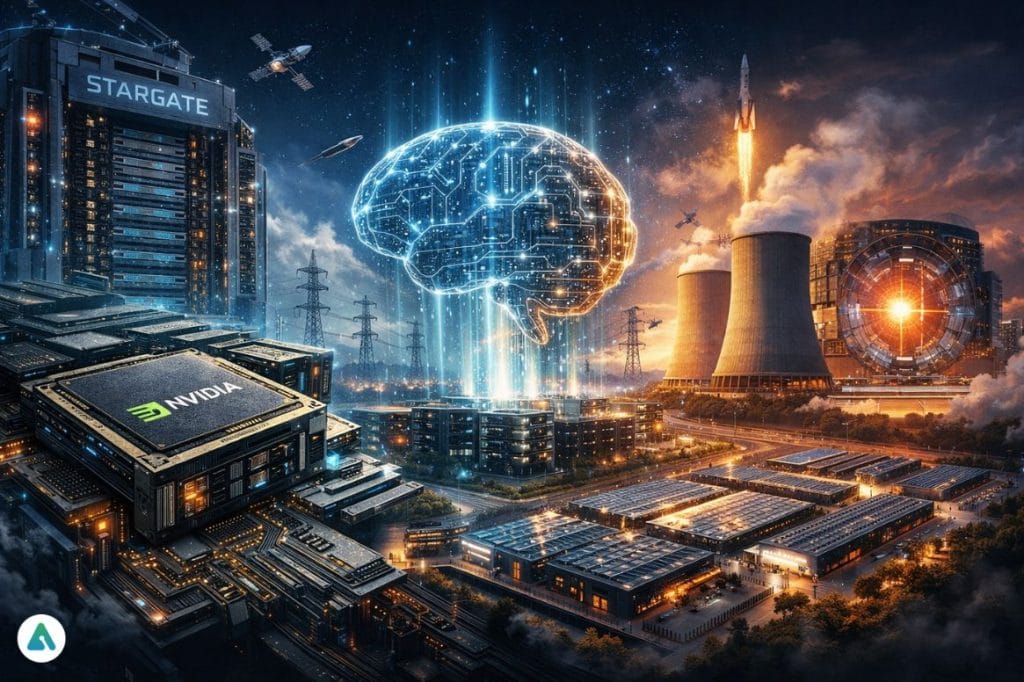
Artificial intelligence is no longer a software story.
It’s a capital expenditure story.
OpenAI is projecting that its cumulative compute spend could reach $600 billion by 2030 — a figure based on internal financial modeling that assumes a 5x expansion in training clusters and a dramatic surge in inference demand.
At that scale, AI stops looking like an app layer.
It starts looking like industrial policy.
From Training Arms Race to Inference Economy
In 2024, AI scaling was training-heavy. Bigger models. Bigger clusters and benchmarks.
By 2026, the spending center of gravity has shifted.
OpenAI’s O1 architecture and successor systems prioritize inference-time reasoning — models that “think” longer per query. This increases what insiders now call the Inference Ratio: the amount of compute consumed during runtime compared to training.
The result?
Higher marginal cost per task.
While distillation and quantization reduce model size, agentic systems — AI that iterates, plans, and self-corrects — consume exponentially more tokens per request. The shift from “one-shot generation” to “multi-step reasoning” is driving infrastructure demand faster than most 2024-era forecasts predicted.
This is why $600 billion doesn’t just fund bigger models.
It funds thinking time.
Definition: Compute-to-GDP Ratio
Compute-to-GDP Ratio
A 2026 macroeconomic metric measuring national or corporate AI compute spending as a percentage of economic output. Analysts argue that firms with high compute-to-revenue leverage may influence sector-wide productivity the way railroads influenced 19th-century trade.
By 2030, OpenAI’s projected annual compute outlay could rival the GDP of small nations.
The Physical Manifestation: Stargate
The $600B number is not theoretical.
It materializes in projects like Stargate, the reported $100B+ supercomputing collaboration between OpenAI and Microsoft.
Stargate represents the industrialization of frontier AI:
Multi-gigawatt data center campuses
Custom silicon optimization
Liquid cooling at hyperscale
Dedicated power procurement agreements
If cloud computing were elastic, Stargate is concrete.
Silicon, Power, and Vertical Alignment
At the chip layer, OpenAI’s roadmap is increasingly intertwined with Nvidia.
Blackwell-class GPUs and the upcoming Rubin architecture are being co-optimized with OpenAI’s proprietary kernels — a form of vertical alignment that tightens the feedback loop between model architecture and hardware design.
In 2026, the metric that matters is no longer raw FLOPs.
It’s Compute-to-Revenue Alpha — how much revenue a company can extract per marginal unit of compute deployed.
The Energy Question: Nuclear, Geothermal, and Helion
Computing at this scale demands power stability measured in gigawatts.
Enter SMRs — Small Modular Reactors — and private fusion bets. Sam Altman has invested in Helion Energy, a fusion startup aiming to commercialize grid-scale power.
Whether Helion succeeds is uncertain. But the signal is clear:
AI’s next bottleneck isn’t chips.
It’s electrons.
Geothermal contracts, long-term nuclear procurement, and private energy hedging are becoming part of AI’s balance sheet strategy.
Estimated $600B Allocation Breakdown
| Category | Allocation | Strategic Purpose |
|---|---|---|
| Silicon (GPUs/Accelerators) | 45% | Frontier model training (GPT-6/7 scale) |
| Energy & Power | 25% | Nuclear, geothermal, grid security |
| Real Estate & Cooling | 20% | Stargate-scale data campuses |
| Research & Talent | 10% | Efficiency gains, compute waste reduction |
This distribution signals something critical:
OpenAI isn’t just buying hardware. It’s buying control over constraints.
Capital Efficiency in Historical Context
To grasp the magnitude:
The Apollo Program (inflation-adjusted): ~$280B
The U.S. Interstate Highway System: ~$600B+ (inflation-adjusted)
OpenAI’s compute trajectory is effectively equivalent to building a national highway system — but for machine cognition.
The difference?
Highways depreciate slowly. GPUs depreciate quarterly.
The Skeptical Voice: A Silicon Bubble?
Critics argue that a breakthrough in smarter scaling — perhaps via liquid neural networks or radically efficient architectures — could render massive GPU stockpiles partially obsolete.
If inference efficiency doubles unexpectedly, today’s hyperscale campuses could become tomorrow’s stranded assets.
There’s precedent.
Telecom overbuilt fiber in the early 2000s. It took a decade for demand to catch up.
The risk for OpenAI isn’t underbuilding.
It’s overbuilding before algorithmic efficiency stabilizes.
Why LLM Inference Costs Are the New Technical Debt
In 2026, enterprises are discovering a hidden truth:
Inference cost compounds like interest.
Every autonomous agent deployed across customer service, logistics, finance, and R&D increases ongoing compute obligations. Unlike traditional software, AI doesn’t just sit idle — it reasons continuously.
This creates a new class of technical debt:
Compute debt.
Companies that don’t optimize their inference pipelines early risk margin compression later.
Financial Analyst Perspective
From a capital markets standpoint, $600B only makes sense if three conditions hold:
Enterprise AI penetration exceeds 70% of Global 2000 workflows
Consumer AI subscriptions maintain high retention and ARPU
Efficiency improvements offset at least 30–40% of raw compute growth
If OpenAI’s revenue trajectory crosses the $250B+ annual mark by 2030, the spend looks strategic.
If not, margins tighten under infrastructure weight.
The Bigger Picture
The AI race is no longer about who builds the smartest model.
It’s about who can industrialize intelligence without collapsing under its own infrastructure.
OpenAI’s $600 billion projection is not hype.
It’s a declaration that the future of AI will be won in:
Data centers
Power grids
Chip foundries
Balance sheets
The real question isn’t whether AI will scale.
It’s whether intelligence at a planetary scale can be built profitably — before efficiency breakthroughs make today’s silicon obsolete.
That’s the compute gamble of the decade.
Related: Why OpenAI Isn’t the Real Winner — The Infrastructure Giants Cash In
