

Cybersecurity in 2026 no longer looks like a cat-and-mouse game. It looks like two chess computers playing against each other at 10,000 moves per second — while the human watches, tries not to get in the way, and quietly wonders if the chess computers are also lying to each other.
That last part is what most guides skip.
| What Is Generative AI in Cybersecurity? (2026 Quick Definition) Generative AI in Cybersecurity refers to AI systems that analyze security telemetry, generate contextual threat insights, automate investigations, simulate attacks, and assist with incident response using natural-language reasoning — rather than static rule matching. Unlike traditional ML that detects patterns, generative AI explains them. |
What Generative AI in Cybersecurity Really Means in 2026
Most definitions stop too early. They say generative AI “detects threats” or “automates response,” — which is technically true but misses the point entirely.
Traditional ML-based security tools learned to recognize patterns. Generative AI reasons about context. It reads a 47-page threat intelligence report at 2 AM, cross-references it against your network topology, and drafts a plain-English action plan before your Tier 1 analyst finishes their coffee. That’s the real shift — from pattern matching to contextual reasoning under pressure.
The semantic gap between discriminative AI and generative AI matters here. Discriminative models classify: “Is this malicious or not?” Generative models narrate: “here’s what’s happening, here’s why it’s suspicious, here’s what to do next.” That narration capability is what changes the SOC.
In practical terms, generative AI in cybersecurity does five things legacy tools can’t: generates natural-language threat summaries, simulates novel attack paths, drafts remediation playbooks, reasons across unstructured data sources simultaneously, and explains conclusions in terms a non-technical executive can act on.
Reality Check: Security engineers increasingly describe AI security tooling as “an intern with superhuman reading speed and questionable confidence.” That framing captures the operational reality better than most vendor decks.
The 3-Layer AI Security Framework Every Security Team Should Understand
Before diving into applications, this framework helps contextualize where things actually stand — and why the risks aren’t separate from the benefits but embedded inside them.
| Layer | What It Means |
|---|---|
| Layer 1 — AI Acceleration | AI speeds up detection, investigation, and response. Contextual reasoning at machine scale. |
| Layer 2 — AI Dependency | Organizations become operationally dependent on AI reasoning. Teams lose manual instincts. Vendors gain leverage. |
| Layer 3 — AI Fragility | The AI itself becomes part of the attack surface. Prompt injection, RAG poisoning, model drift. |
Every organization deploying generative AI in security is climbing all three layers simultaneously. The benefits of Layer 1 are visible and immediate. The risks of Layers 2 and 3 accumulate quietly until they’re not quiet anymore.
Key Takeaway: Generative AI doesn’t replace SOC analysts. It compresses investigation time by automating contextual reasoning across fragmented telemetry sources — while creating new fragility at the AI layer most teams haven’t fully threat-modeled yet.
Real-World Applications of Generative AI in Cybersecurity

AI-Powered Threat Detection for Modern SOC Teams
Security teams have always drowned in signal volume. A mid-sized enterprise generates hundreds of millions of log events per day — most noise, a few catastrophic, and the difference between the two often invisible until it’s too late.
Generative AI changes that calculus by correlating signals across network traffic, endpoint behavior, cloud activity logs, and identity events simultaneously. When an account starts accessing unusual file shares at 11 PM while the VPN shows a login from a new geography, a rule-based system fires one alert. A generative AI model builds a narrative — flags it as likely credential abuse before lateral movement begins.
The MITRE ATT&CK framework has spent years documenting how attackers chain techniques across the kill chain. Generative AI is the first class of tool that actually reasons about those chains in real time, rather than pattern-matching individual events in isolation.
Operational Reality: “In several enterprise deployments, analysts reported spending more time validating AI-generated narratives than investigating the raw incident itself.” That validation overhead is real, underdocumented, and worth budgeting for.
How Generative AI Automates Incident Response
Your on-call analyst gets paged at 3:17 AM for a suspicious process execution on a domain controller. In a traditional SOC, they’d spend 45 minutes pulling logs, cross-referencing threat intelligence, and building context before deciding whether to escalate. Most of the time? Scheduled task misfiring. They go back to bed, slightly more miserable.
Generative AI handles that triage automatically. It cross-references the alert against the employee’s recent Slack activity, checks the scheduled task registry, pulls the relevant CVE history, and either closes the ticket with a documented rationale or escalates with a fully assembled incident brief. The analyst wakes up to a decision, not raw data.
Microsoft’s published Security Copilot enterprise pilot data shows measurable analyst triage time reductions. SentinelOne’s published SOC case studies and Swimlane’s deployment documentation both support MTTR reductions in the 30–50% range for AI-assisted triage workflows. CrowdStrike’s Charlotte AI and Palo Alto’s Cortex XSIAM have pushed this further — their published product documentation integrates natural language querying directly into analyst workflow, eliminating dashboard navigation for most routine investigations.
How AI Reduces Alert Fatigue in Security Operations Centers
Alert fatigue isn’t a buzzword. It’s a documented safety failure. The Verizon Data Breach Investigations Report has tracked analyst burnout and missed alerts as consistent contributing factors in breach timelines across multiple years of data.
Generative AI attacks the root cause by contextualizing alerts against historical baselines. Instead of treating each alert as an isolated event, it asks: Is this anomalous for this system, this user, this time of day? Analysts who’ve worked in AI-augmented SOCs describe the experience as finally trusting their alert queue again — which sounds minor until you realize most security incidents begin with a real alert that a burned-out analyst dismissed.
Key Takeaway: Alert fatigue isn’t a volume problem — it’s a signal-to-noise problem. Generative AI fixes the ratio by adding context, not by processing more alerts faster.
AI Phishing Detection, Deepfake Threats, and Security Awareness Training
Phishing detection used to rely on known-bad domains and signature matching. Attackers adapted fast — they always do. Generative AI now analyzes writing style inconsistencies, domain registration patterns, behavioral anomalies in email metadata, and social engineering signals, catching spear-phishing attempts that bypass any blocklist.
The simulation side is equally important. Security awareness training that uses static “click here to fail” phishing tests hits a ceiling quickly. Generative AI produces hyper-personalized simulated phishing campaigns tailored to each employee’s role, communication patterns, and known relationships — creating training scenarios that expose real vulnerabilities rather than generic ones.
The 2026 escalation worth naming directly: attackers now use voice AI (vishing) and deepfake video injection into live meeting streams. A CFO receives a Teams call appearing to be from the CEO — voice and face matching perfectly, requesting an urgent wire transfer. No malware. No network anomaly. Researchers call this Business Identity Compromise (BIC), and it’s overtaking traditional Business Email Compromise (BEC) as the dominant social engineering vector. Deepfake detection research is genuinely struggling to keep pace with generation quality.
Threat Reality — Vishing and BIC: Business Identity Compromise requires no malware, leaves no network trace, and bypasses every technical control. The defense is organizational — verification protocols, callback procedures, and employee training — not a firewall rule.
AI Threat Intelligence Summarization for CISOs and Executives
Security teams face an almost comedic information problem: simultaneously overwhelmed with threat data and starved for actionable intelligence. A typical threat feed generates hundreds of indicators daily. Most are irrelevant to a specific environment, and translating the relevant ones into executive-level risk language used to require a dedicated analyst.
Generative AI handles that translation layer — summarizing vulnerability reports, extracting exploit relevance against a specific technology stack, producing board-ready risk summaries from raw technical feeds. The difference between a 40-page CISA advisory and a three-paragraph brief that tells the CISO exactly what to care about.
How Generative AI Improves Secure Code Review in DevSecOps
Every vulnerability caught in code review costs orders of magnitude less to fix than one caught post-deployment. Generative AI integrates directly into CI/CD pipelines to flag insecure coding patterns, suggest secure alternatives, and explain why a given pattern creates risk — in language a developer actually understands, not a cryptic SAST output code that gets ignored.
The value compounds. A tool that explains the reasoning behind a security recommendation shifts the interaction from detection to education. Developers who understand why a pattern is dangerous write better code over time.
AI-Based Network Traffic Monitoring and Cloud Security Visibility
Hybrid cloud environments create visibility gaps that traditional network monitoring tools weren’t designed for. Most hybrid environments are honestly messy — half the telemetry arrives late, another quarter arrives misconfigured, and security teams still expect the AI to somehow produce clarity from it. Sometimes it does.
Generative AI continuously analyzes traffic patterns across on-premises, cloud, and edge environments — detecting data exfiltration attempts, unauthorized lateral movement, and anomalous access patterns that would disappear into the space between siloed monitoring tools. But the AI is only as good as the telemetry normalization upstream of it.
AI-Powered Red Teaming and Automated Attack Simulation
Running a serious red team engagement used to require weeks of preparation and a specialized team that most mid-market organizations couldn’t afford continuously. Generative AI simulates realistic attack chains — from initial reconnaissance through exploitation and lateral movement — in compressed timeframes, identifying weak points that human red teamers might miss due to scope constraints or time pressure.
A related use case applies red teaming to the AI systems themselves, enabling organizations to automate AI red teaming and continuously probe models and applications for prompt injection, jailbreaks, data leakage, unsafe outputs, and other exploitable behavior.
This is genuinely valuable for organizations that can’t fund a continuous red team. It’s also the capability that should make every security leader deeply uncomfortable about what attackers now have access to with the same tools.
Key Takeaway: AI-powered red teaming democratizes continuous adversarial testing for mid-market organizations. It also democratizes sophisticated attack capability for threat actors without a team. Both are true simultaneously.
AI vs AI Cyber Warfare: The New Cybersecurity Battlefield

The threat landscape shifted qualitatively in 2024, and the full implications are still catching up to reality. Attackers no longer rely on manual exploitation — they run generative AI systems designed to write phishing content, discover vulnerabilities, adapt social engineering in real time, and generate novel malware variants that evade signature detection.
WormGPT-style tools. FraudGPT phishing engines. Automated exploit generation systems trained on vulnerability databases. These aren’t theoretical. They’re documented, priced, and available on criminal forums. CISA advisories from 2024–2025 specifically flag AI-assisted attack tooling as a permanent feature of the threat landscape.
The defensive response requires an AI system that predicts attacker intent through behavioral modeling, simulates likely attack paths before execution, and generates adaptive defense rules in real time. Security is now a continuous machine-speed conflict happening largely below the threshold of human perception.
Your security team’s job is no longer to fight attackers. It’s to configure, supervise, and improve the AI systems that fight attackers on their behalf — and to make the judgment calls those systems flag as requiring human context. That reframing has profound implications for hiring, training, and organizational structure that most security teams haven’t fully absorbed yet.
The Honest Take: Many organizations claiming to operate “AI SOCs” are effectively running traditional automation with an LLM summarization layer attached on top. That’s not an ASOC. It’s a legacy SOC with a chatbot. The distinction matters when an actual advanced threat arrives.
What an Autonomous SOC (ASOC) Looks Like in 2026
The Autonomous Security Operations Center (ASOC) is the destination most enterprise security programs are navigating toward. The honest version: AI handles detection, triage, and initial response, while human analysts focus on decisions requiring organizational context, stakeholder communication, and judgment calls the AI flags as genuinely ambiguous.
The evolution:
| Stage | Description |
|---|---|
| Traditional SOC | Human-driven alert handling |
| AI-Assisted SOC | AI surfaces insights; humans decide everything |
| AI-Augmented SOC | Human and AI collaboration on triage and response |
| Semi-Autonomous SOC | AI executes pre-approved response actions |
| Autonomous SOC (ASOC) | AI orchestrates security operations; humans supervise escalations |
Most enterprise organizations in 2026 sit somewhere between AI-Augmented and Semi-Autonomous. Full ASOC deployment exists in a small number of organizations — and carries a significant caveat: without clean, high-quality telemetry data, an autonomous system amplifies errors at machine speed. Garbage in, catastrophic response out.
The Tier 1 analyst’s job in an ASOC doesn’t disappear — it transforms. Instead of manually reviewing 200 alerts per shift, they review the 5–10 cases the AI flagged as genuinely requiring human judgment, validate automated response decisions, and contribute organizational context that improves the system’s decision quality over time. Human-in-the-loop (HITL) workflows aren’t a compromise on the path to full automation — they’re a deliberate architectural choice that most mature security programs are treating as permanent.
The UI evolution rarely appears in high-level guides: in leading ASOC deployments, analysts interact with AI through a natural language chat interface layered over a graph visualization of the incident timeline. Alerts arrive as partially assembled narratives with confidence scores and suggested next actions. Whether that’s better depends entirely on whether the analyst trusts the model — and most don’t, yet, fully.
Operational Reality: “One recurring issue in AI-assisted SOCs is confidence inflation — the model presents uncertain correlations with language that sounds operationally definitive.” Analysts learn to read past the confident tone. Junior analysts often don’t catch it fast enough.
Generative AI Cybersecurity Maturity Model Explained
Understanding where your organization actually sits helps prioritize investment and set realistic expectations.
| Level | Stage | Capability |
|---|---|---|
| 1 | Scripted Security | Manual operations, rule-based detection |
| 2 | AI-Assisted Security | AI-generated summaries and prioritized alerts |
| 3 | AI-Augmented SOC | Human and AI collaboration on triage |
| 4 | Semi-Autonomous SOC | AI executes controlled, pre-approved response actions |
| 5 | Autonomous SOC | Fully AI-orchestrated detection, triage, and response |
Most organizations overestimate their maturity level by one or two stages. The most common gap isn’t capability — it’s telemetry quality and documented human oversight processes.
Quick Self-Assessment:
- Can your SIEM normalize telemetry from all cloud environments without manual intervention?
- Do documented runbooks define what the AI is authorized to do autonomously?
- Can your team reconstruct the AI’s reasoning chain for any given automated decision?
- Have you added prompt injection and RAG poisoning to your threat model?
If you answered no to two or more, you’re operating below the maturity level your tooling suggests.
The Modern AI Cybersecurity Stack in 2026
| Layer | Tool Examples | AI Role |
|---|---|---|
| SIEM | Microsoft Sentinel, Splunk | Contextual log summarization, anomaly correlation |
| SOAR | Swimlane, Palo Alto XSOAR | Automated response orchestration, playbook generation |
| EDR/XDR | CrowdStrike Falcon, SentinelOne | Behavioral anomaly detection, AI threat hunting |
| Email Security | Proofpoint, Abnormal | Phishing analysis, writing style anomaly detection |
| IAM | Okta, CyberArk | Behavioral identity monitoring, impossible travel detection |
| Threat Intel | Google TI, Recorded Future | AI summarization, exploit relevance scoring |
| Code Security | GitHub Advanced Security, Snyk | Vulnerability detection, secure code suggestions |
| Red Team / Simulation | Cymulate, AttackIQ | AI-driven attack chain simulation |
This is where AI orchestration becomes operationally complex. Most enterprises run 5–8 of these categories simultaneously, from different vendors, with varying data formats, and expect their orchestration layer to synthesize across all of them coherently. The integration reality is messier than any vendor demo suggests.
Key Takeaway: The 2026 security stack isn’t a single platform — it’s an orchestration problem. Generative AI adds reasoning capability at each layer, but the value compounds only when telemetry normalization and retrieval integrity span the full stack.
“You deployed AI to reduce your attack surface. Congratulations — you also just expanded it.”
Hidden LLM Security Risks Every Organization Must Understand
The same AI systems defending your organization create new vulnerabilities. Most guides acknowledge this in passing. This section doesn’t.
Prompt Injection Attacks Against AI Security Systems
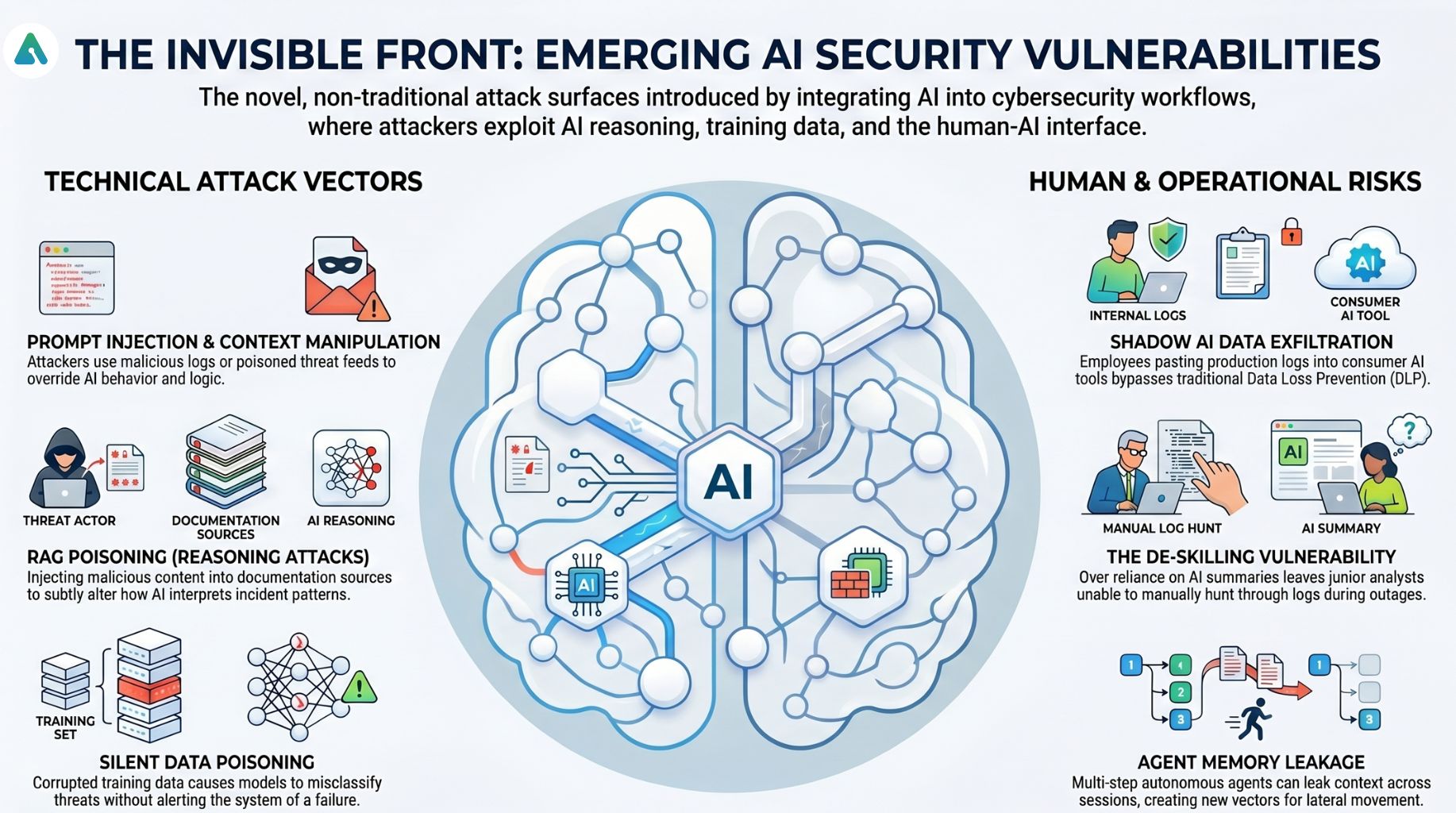
Security teams still disagree on how serious prompt injection really is in practice — but nobody serious ignores it anymore. Attackers manipulate AI system inputs to override intended behavior or extract sensitive data through the inference pipeline itself. An attacker who can influence what text your security AI reads — through malicious log entries, poisoned threat intelligence feeds, or crafted documents — can potentially redirect how the AI interprets events or what actions it recommends.
Traditional security controls weren’t designed for this attack class. Tool-permission abuse and context window manipulation are genuinely novel vectors. Most organizations haven’t added them to their threat model yet.
RAG Poisoning: The Emerging AI Security Threat in 2026
Most 2026 generative AI security tools use Retrieval-Augmented Generation (RAG) to ground analysis in your organization’s specific documentation, runbooks, and historical incident data. Attackers who understand this architecture experiment with injecting malicious content into the documentation the AI retrieves — subtly altering how it interprets event patterns or what remediation steps it recommends.
It’s a supply chain attack against your AI’s reasoning — targeting retrieval integrity rather than the model itself. The OWASP LLM Top 10 treats this as a primary concern, and the attack surface grows with every additional document source fed into a security AI’s retrieval layer.
Data Poisoning Attacks on AI Cybersecurity Models
If training data gets corrupted — through adversarial manipulation or supply chain compromise — the model starts misclassifying threats, missing real attacks, and generating incorrect recommendations. A well-executed data poisoning attack doesn’t announce itself. The system still functions. It just functions wrong, in ways specifically designed to benefit the attacker.
Shadow AI Risks: How Employees Create Hidden Security Threats
The single most underestimated cybersecurity risk in 2026 isn’t an external attacker. It’s the developer on your team who pastes a production log into a free AI tool to debug a problem at midnight.
Shadow AI — employees using external generative AI tools for code debugging, log analysis, security documentation, and incident reporting — creates data exposure risks that bypass every traditional DLP control. The sensitive data leaves the organization without triggering any alert, because the exfiltration path is a legitimate browser session to a consumer AI service. No anomaly to detect. It looks identical to normal web traffic.
The de-skilling risk runs parallel. Junior analysts who rely heavily on AI summaries are losing the ability to manually hunt through logs and reconstruct attack timelines without assistance. When a sophisticated attacker deliberately degrades AI performance as part of their playbook — a technique appearing in documented 2024–2025 incidents against high-value targets — those analysts have no fallback.
Agent Memory Leakage and Context Poisoning: Emerging risk for 2026: agentic AI security workflows — where AI agents take multi-step autonomous actions — introduce agent memory leakage and inference boundary control failures as new attack surfaces. An agent that retains context across sessions, or that shares memory state between tenant environments, can become a lateral movement vector in its own right.
Synthetic Identity Fraud and AI-Powered Insider Threats

This threat category doesn’t get enough coverage yet, but it’s becoming a primary concern for enterprise security and HR teams simultaneously.
AI-generated synthetic identities — complete with fabricated LinkedIn histories, AI-produced work portfolios, and deepfake interview performance — are enabling fake remote worker scams at scale. North Korean state actors pioneered this technique and documented instances now span dozens of US technology companies. The pattern: a synthetic contractor gets hired, gains access to internal systems, and exfiltrates intellectual property or establishes persistent access for months before detection.
The attack works because identity verification processes weren’t designed for adversaries who can generate a convincing digital presence from scratch. A GitHub profile with three years of commit history. A LinkedIn with 500+ connections. References that are also synthetic. The AI risks landscape in 2026 has shifted to include this as a Tier 1 concern specifically because organizational trust flows through identity, and AI has made identity cheap to forge.
AI-assisted payroll fraud and synthetic vendor onboarding follow similar patterns: fabricated supplier entities, AI-generated documentation, and invoice fraud executed through legitimate-looking vendor relationships.
The defensive response requires combining behavioral analytics on new contractor access patterns, video verification protocols that test for deepfake artifacts, and out-of-band identity verification that doesn’t rely solely on digital credentials. Generative AI both creates this problem and assists in detecting it — behavioral anomaly detection on new account activity catches patterns that human reviewers miss under volume pressure.
Key Takeaway: Synthetic identity attacks don’t target your technical stack. They target your hiring process, your vendor onboarding, and your organizational trust model. The detection layer is behavioral analytics on people, not packets.
The Biggest Weaknesses of Generative AI in Cybersecurity
| Failure Mode | What Actually Happens |
|---|---|
| Hallucinated investigations | AI generates confident incident narratives with fabricated IOC correlations. Looks authoritative. Some of it is wrong. Analysts describe catching this as genuinely unsettling. |
| Incomplete telemetry blindness | When a log source is down or misconfigured, the AI reasons from what it has. “The model told us the incident was contained” has appeared in post-mortems where it demonstrably wasn’t. |
| Baseline over-trust | Slow, low-signal attacks — living-off-the-land techniques especially — evade detection by staying within patterns the model was trained to classify as normal. Sophisticated attackers study this. |
| Remediation mistakes | A remediation script trained on slightly different network assumptions can cause more damage than the initial incident. This has happened. It will happen again. |
| Model drift | A model trained on 2024 threat patterns starts missing 2026 techniques without retraining. Base models update; custom RAG pipelines drift on their own timeline. |
| Business context blindness | Whether to disconnect a compromised payment processor at 11:30 AM on a Friday before a major sale is a business decision, not a security decision. AI can model the risk. It cannot weigh the judgment of someone who knows the organization. |
“The AI was so coherent, so specific, so wrong.” — Composite description from multiple SOC teams post-incident
The pattern across all these failures is the same: the AI presents uncertainty with the linguistic confidence of certainty. Junior analysts trust it. Experienced analysts verify it. The difference between those two outcomes is what separates mature AI security programs from the ones that end up in post-mortems.
The judgment that remains irreducibly human: business context, political reality, stakeholder communication, and the call that no runbook covers. AI reaches the edge of its competence exactly at the moment those decisions become necessary.
AI Model Sovereignty and Cloud Security Risks Explained
“Your threat detection is only as sovereign as the contract you signed.”
Cloud-hosted security AI introduces a vendor dependency that most security teams haven’t fully mapped. When threat detection, incident triage, and automated response run through a cloud LLM operated by a third party, three questions become urgent — and most security teams have vague answers to all three.
The three questions:
- Inference privacy — Does your vendor use customer telemetry to improve their base models? Most contracts have nuanced answers. Some are genuinely protective. Others contain language that, if read carefully, would alarm most CISOs.
- Model sovereignty — If this service becomes unavailable through outage, geopolitical disruption, or vendor failure, what runs your SOC? Deep dependency without local fallback is an undocumented single point of failure.
- Telemetry ownership — The behavioral data flowing through an AI security platform is among the most sensitive that an organization generates. Vendor contracts about retention, access controls, and breach notification for that telemetry deserve the same scrutiny as the security tool itself.
The movement toward local LLM deployment for security applications — running inference on-premises or in sovereign cloud environments — is accelerating specifically because of these concerns. It trades capability for control. Smaller models. Higher compute cost. For some organizations and some threat models, that trade is the right one to make.
Key Takeaway: Cloud-hosted security AI offers speed and capability. It also means your detection logic, your telemetry, and your remediation decisions run through someone else’s infrastructure. That’s not an argument against it — it’s an argument for contractual clarity before deployment.
The Real Cost of Generative AI in Cybersecurity

“The vendor ROI calculator showed 40% efficiency gains. It didn’t have a line item for inference costs.”
Running 24/7 LLM inference on petabytes of log data is expensive. That expense rarely appears in vendor demos, which show impressive capability on curated datasets — not the full, messy reality of a large organization’s security telemetry.
What the real cost structure looks like:
- Inference costs — Large enterprises processing multi-petabyte telemetry pipelines through LLM-assisted correlation can face monthly costs ranging from tens of thousands to several million dollars, depending on architecture, token volume, and whether inference runs on cloud or on-premises GPU infrastructure.
- SIEM ingestion pricing — Feeding richer telemetry into AI-enabled platforms frequently triggers pricing tier thresholds invisible during initial procurement. This surprises security teams regularly.
- Telemetry normalization engineering — Getting clean, normalized data into the AI pipeline is a data engineering project that most security teams understaff. The AI is only as good as the normalization upstream of it.
- Human oversight staffing — HITL workflows require analysts to review and validate AI decisions. That headcount reduction at Tier 1 doesn’t always map 1:1 to the oversight staffing required at higher levels.
The budget math CISOs work through in 2026 usually closes. AI-assisted security genuinely reduces Tier 1 headcount requirements and reduces MTTR. The question is whether those savings offset the full cost structure above, not just the productivity gains.
On cyber insurance: Carriers now differentiate premiums based on documented AI security maturity. Organizations that demonstrate Levels 3–4 — with verifiable HITL workflows and documented governance — are seeing more favorable underwriting conversations than those operating without documented oversight structures.
Key Takeaway: The ROI case is real. But it requires honest cost modeling across inference infrastructure, SIEM pricing, telemetry engineering, and oversight staffing — not just analyst hour savings. Most vendors show you one side of that equation.
AI Cybersecurity Compliance and Regulations in 2026
“Security is no longer purely a technical function. It’s simultaneously a regulatory compliance function — and those two requirements sometimes want opposite things.”
The framework landscape has solidified. Security teams now operate inside four overlapping regulatory structures that specifically address AI:
- EU AI Act — Binding obligations for high-risk AI systems. Many security applications qualify.
- ISO/IEC 42001 — The AI Management Systems standard most enterprises are aligning governance to.
- NIST AI RMF 2.0 — The practical risk management structure for US-facing organizations.
- ENISA AI Security Guidelines — Increasingly referenced in European procurement and security audit contexts.
The practical implications for security AI come down to three concrete requirements: explainability (can you document why a specific alert was escalated or suppressed?), auditability (can you reconstruct the AI’s reasoning chain for any given decision?), and secure by design (does the system have documented protections against prompt injection and data poisoning?).
The tension worth naming directly: the AI that acts fastest isn’t always the AI whose decision chain is most auditable. Optimizing for speed at the automated response layer produces systems that are operationally powerful and regulatorily fragile. Most mature programs have resolved this by scoping fully autonomous actions to low-risk, high-confidence scenarios — keeping humans in the loop for anything that carries meaningful consequence.
That tradeoff isn’t temporary. It’s the architecture.

