

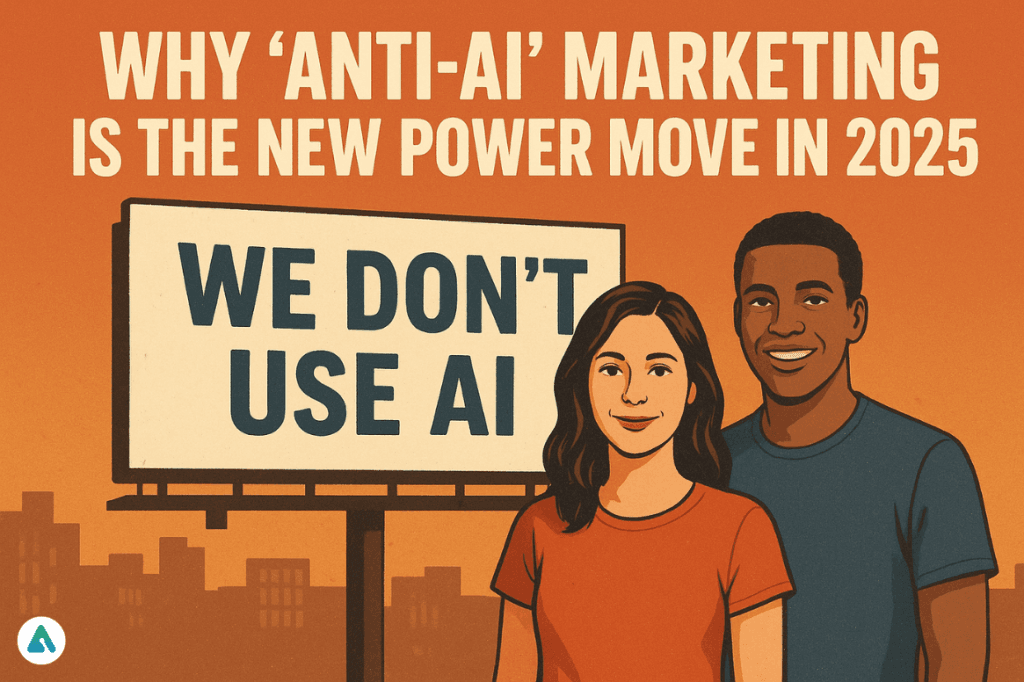
In 2025, a curious phenomenon is sweeping across global marketing: brands are publicly rejecting artificial intelligence — even while quietly using it behind the scenes. The wave of “anti-AI marketing” isn’t exactly a tech‑backlash: it’s a strategic repositioning.
Companies such as Heineken, Polaroid, and Aerie are leading the charge. Their ads — billboards, social media posts, print campaigns — don’t say “We use AI.” They say, “We don’t.” They lean into human‑made authenticity: real people, imperfect moments, analog vibes.
The tone matters: not nostalgic‑hipster, but strategic. These brands aren’t just signalling “we use humans,” they’re wagering on a growing weariness with hyper‑polished, AI‑generated content that feels lifeless.
Meanwhile, behind closed doors, many of these same brands still use AI for efficiencies — data analysis, yield optimization, ad targeting. The anti‑AI stance is reserved for the public face.
In short, authenticity is being weaponized — the much‑hailed “human touch” becomes a differentiator in a saturated market of digital perfection.
Why Audiences (and Brands) Are Leaning Into This Shift
Consumers Are Tired of “Perfect but Lifeless.”
Recent studies/market reports show a growing portion of consumers view AI‑made ads and content with suspicion. Many perceive AI‑generated visuals and copy as overly polished — too perfect to be real. Subtle oddities in faces, lighting, tone, or phrasing can trigger subconscious distrust.
As one creative‑agency exec observed: younger audiences especially want “unpolished, unpretentious, undeniably real.”
For brands targeting authenticity, relatability, emotion, or lifestyle — where trust and identity matter — human‑driven storytelling suddenly becomes a premium asset.
Strategic Differentiation in a Crowded AI Market
In a landscape flooded with AI‑powered campaigns, everyone can generate slick visuals and optimized copy. That makes standing out harder, not easier. By doubling down on “human-first,” brands create contrast: they aren’t another AI‑driven ad; they’re the “real deal.” It’s a positioning play.
For legacy or heritage brands — those built on craft, identity, and emotional resonance — this can even become a protective shield against commodification.
Curious how AI really stacks up against human creativity? Dive into our full breakdown now — and decide for yourself! Read: AI vs Human Writing
Yet the Stance Is Inevitable to Evolve — A Push-Pull Between Reality and Efficiency
Still, the credibility of anti-AI marketing is fragile. Behind closed doors, many of these “anti‑AI” brands continue to tap into AI’s strengths — for data-driven insights, campaign optimization, or backend automation.
That tension creates a paradox: publicly rejecting AI while privately using it. As critics warn, the approach may not scale or hold up when cost, speed, and competition pressures mount — especially in industries where margins or agility matter.
What’s at Stake — For Marketing, Culture, and Trust
-
Redefining what “quality” means. As more people reject the sterile perfection of AI‑driven marketing, imperfection — the subtle human flaws, the rawness, the unpredictability — becomes the new marker of quality. This shifts value away from polish toward authenticity.
-
Trust is a premium commodity. When AI saturation pushes against emotional resonance, brands that genuinely commit to transparency and human‑centered creativity may earn longer‑term loyalty — especially among younger audiences wary of synthetic content.
-
A possible new equilibrium: hybrid authenticity. For many companies, the future isn’t “all human” or “all AI” — it’s “AI behind the scenes, human in front.” Use AI for analytics, scale, efficiency; use humans to tell stories, build trust, create nuance.
-
Risk of hypocrisy and disillusionment. If the gap between marketing messaging (“we don’t use AI”) and reality (“we do”) becomes too wide, brands risk backlash. As the public becomes more aware of what AI can — and is — being used for, claims of “human-only” may ring hollow.
The Bigger Picture: What This Trend Says About Society and Tech in 2025
This surge in anti-AI marketing is more than a branding fad — it’s a cultural signal. It suggests growing unease with automation, synthetic perfection, and the erosion of human imperfection that often gives creative work its soul.
We are entering a moment where humans — with all their flaws — are being re‑valued. In a world where algorithms can produce striking visuals and optimized copy in seconds, what becomes rare and therefore valuable is the messy, real, human touch.
At the same time, this trend underscores a complexity in our relationship with AI: we crave its convenience, but resist its impersonality. We want its speed, but also its humility. We want automation — but not at the cost of identity.
In other words: 2025 might not be the year of “AI everywhere,” but perhaps of “AI, when appropriate — human, always.”
Read More: AI Companion Guide (2025): Types, Costs, Benefits & Real Use Cases
