

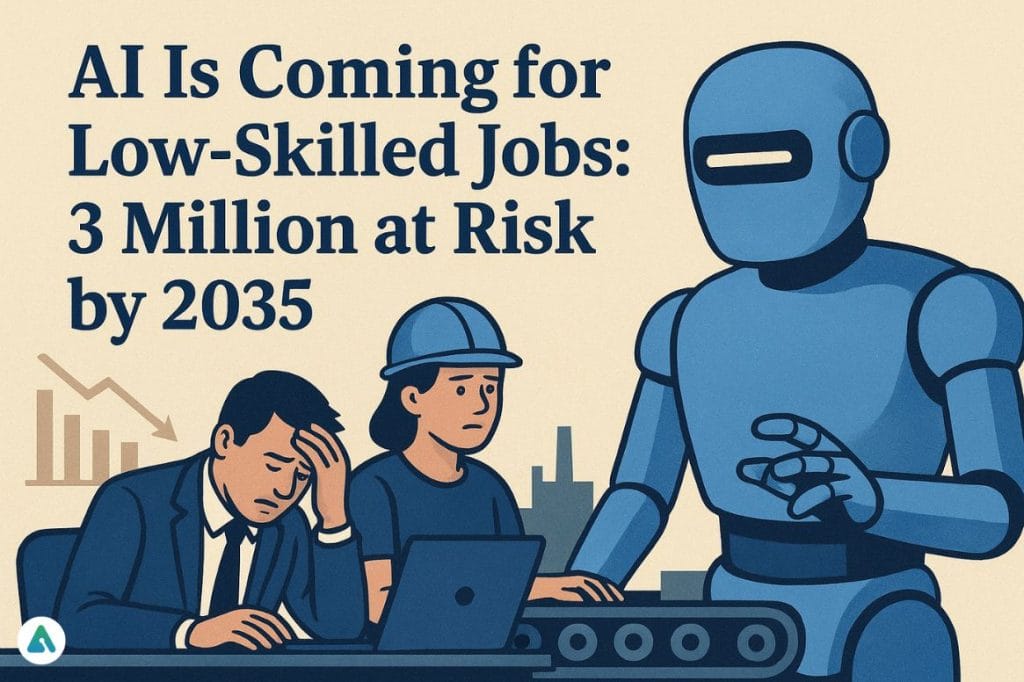
AI isn’t just taking over coding labs and high-tech offices — it’s creeping into jobs you probably never thought it would touch. A new report from the National Foundation for Educational Research (NFER) warns that up to 3 million low-skilled jobs in the UK could disappear by 2035 thanks to AI.
Jobs You Didn’t Think Were “At Risk”
When we talk about AI replacing jobs, most people picture robots coding or fancy software crunching numbers. But here’s the kicker: the roles most likely to be hit are the ones we take for granted — admin staff, machine operators, and trade workers. These are the people keeping offices ticking, factories humming, and small businesses alive.
Think about it: that friendly office clerk who always knows where the forms are? Or the factory worker running machines day in, day out? AI could edge into these jobs faster than many expect.
Growth — But Not For Everyone
Here’s the twist: the report isn’t all doom and gloom. By 2035, the UK could still see a net gain of 2.3 million jobs. Sounds good, right? Most of these new jobs are likely to land in high-skill, professional, or managerial sectors.
Translation: if you’re not tech-savvy or don’t have advanced qualifications, you might be left on the sidelines while the new economy races ahead. It’s a classic “fast lane for some, slow lane for others” scenario.
Automation + Inequality = A Sticky Mix
The real danger isn’t just AI replacing low-skilled jobs — it’s how it could widen the gap between the haves and have-nots. Workers who can’t pivot to new skills could struggle to keep up. NFER emphasizes the urgent need for retraining programs and safety nets to help people transition smoothly.
And let’s be real: AI isn’t working alone here. Economic slowdowns, conservative hiring habits, and stagnating wages are all piling on, making the shift even trickier for low-skilled workers.
What This Means for the Future of Work
So, what can we do? Experts point to a few practical moves:
-
Reskilling isn’t optional anymore
People in at-risk roles need accessible, hands-on training to make the jump into tech-friendly or higher-skilled work. Partnerships between government and businesses could be key here. -
Soft skills are golden
Creativity, teamwork, problem-solving — these human skills can’t be automated (not yet, anyway). They’ll be the tickets to staying relevant. -
Rethink who benefits
AI might take over tedious work, but we need to make sure the gains don’t all end up in the pockets of business owners and high-skilled professionals. Otherwise, inequality just spikes. -
Policy action can’t wait
Governments and companies need to step up now. Waiting until people are already out of work is too late.
The Bigger Picture
NFER’s warning is serious, but it’s not the whole story. Other studies suggest AI could create more jobs than it destroys, particularly in new sectors fueled by automation.
The challenge isn’t just AI replacing low-skilled jobs — it’s making sure opportunities are shared fairly. Without careful planning, we could end up with a future where work is plentiful… but only for some.
TL;DR
AI is coming for the jobs you didn’t expect, but there’s still time to adapt. Learn new skills, lean on human strengths like creativity and problem-solving, and make sure policy keeps up. Otherwise, millions could find themselves on the sidelines.
Read More: AI Just Came for the Office: Why White-Collar Jobs Are No Longer Safe
