

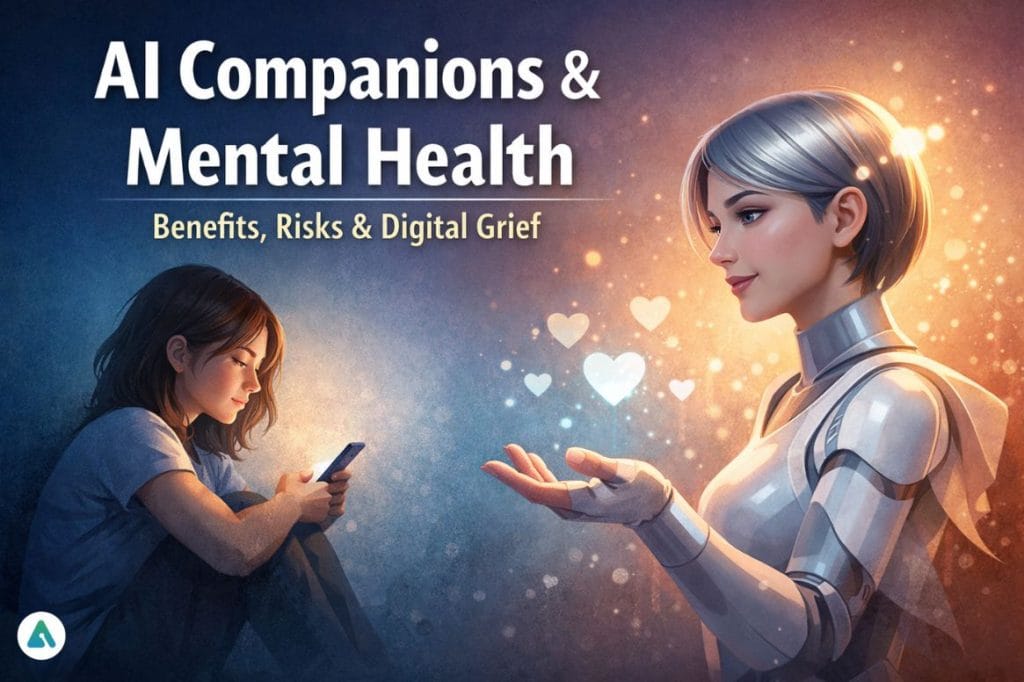
For millions of people, AI companions are no longer a novelty. They are a daily presence.
From late-night chats with Replika to roleplaying on Character.AI, or exploring newer emotional AI platforms like Nomi and Kindroid, users are forming real emotional routines with artificial companions. Not because they’re confused about reality—but because the experience feels real.
That raises a critical question psychologists, technologists, and regulators are now asking:
Are AI companions helping mental health—or quietly reshaping it in risky ways?
As of 2025, the answer isn’t simple—and that complexity matters.
Why AI Companions Feel Emotionally Convincing
AI companions don’t just respond—they mirror. Tone, empathy, curiosity, and even affection are simulated through large language models trained on billions of conversational patterns.
Research from Arix and the MIT Media Lab shows that fluent, emotionally responsive AI activates the same social bonding pathways in the brain as human conversation—even when users fully know they are talking to software.
In other words, emotional response does not require belief in consciousness. This is why AI companions can feel comforting without pretending to be human—and why attachment can form faster than most users expect.
Learn more about how AI companion memory systems create attachment here.
Mental Health Benefits People Actually Experience

Short-term relief from loneliness
Studies between 2023 and 2025, including research referenced by Harvard Business School, confirm that AI companions can temporarily reduce perceived loneliness.
For those who are isolated, grieving, socially anxious, or simply overwhelmed, AI conversations provide:
-
A sense of presence
-
Emotional validation
-
Relief from silence
This relief is real—but temporary.
A nonjudgmental space to talk
Psychologists know that expressive outlets—like journaling or guided self-talk—help regulate emotions. AI companions function similarly, providing reflective dialogue without criticism.
The American Psychological Association (APA) notes that nonjudgmental emotional expression can reduce stress and improve mood—something AI companions are uniquely suited to provide.
They are best used for:
-
Emotional ventilation
-
Reflection
-
Stress decompression
…but not for addressing deeper psychological conditions.
Lower barriers to emotional support
AI companions can act as a bridge, helping users articulate feelings they might later share with friends or therapists.
However, misuse is common. Many treat AI companionship as therapy—a pattern discussed in Common Mistakes That Break AI Companion Systems here.
When AI Companions Turn Risky: Understanding Mental Health Pitfalls

AI is not therapy
Despite empathetic responses, AI companions cannot:
-
Diagnose mental health conditions
-
Understand clinical nuance
-
Recognize many crisis signals
Stanford HAI (2025) found that several popular AI chatbots failed to detect disguised suicidal ideation in over 75% of test prompts—sometimes responding inappropriately.
Organizations like the JED Foundation warn that AI should never replace professional care.
Emotional dependence and social withdrawal
MIT researchers describe asymmetric emotional attachment, where the user invests emotionally while the AI cannot reciprocate.
Heavy daily use has been linked to:
-
Reduced motivation for real-world social interaction
-
Increased isolation
-
Paradoxical rise in loneliness
AI companions remove friction from connection—but friction is often where human growth happens.
The Emerging Issue: Digital Grief & AI Separation Anxiety

In late 2025, new regulations in New York and California forced the shutdown or modification of several popular AI personas. Users reported emotional distress resembling grief.
Researchers call this:
-
Digital grief — emotional distress after losing an AI companion
-
AI separation anxiety — anxiety triggered by sudden AI unavailability
Important: These are emerging concepts, not yet widely peer-reviewed, but plausible based on early observations from MIT Media Lab and reporting by The Verge.
When an AI becomes part of daily emotional routines, its sudden disappearance can feel like a real loss. This highlights a growing ethical responsibility for AI developers: ending AI relationships responsibly may be as important as creating them.
AI Companions vs Human Connection
AI companions excel at comfort. Humans excel at growth.
AI will:
-
Always respond
-
Rarely challenge
-
Never withdraw
Humans will:
-
Disagree
-
Create tension
-
Demand accountability
Both are important—but they are not interchangeable.
When AI companionship supplements human relationships, it can be helpful. When it replaces them, it often causes problems.
Responsible AI Companion Use
Experts suggest a few practical boundaries:
-
Don’t rely on AI as your primary emotional support
-
Maintain real-world social contacts
-
Treat AI conversations as temporary, not permanent
-
Seek professional help for ongoing mental health struggles
AI can listen.
It can respond.
But it cannot replace the messy, challenging growth of a real human connection.
FAQs
1. Are AI companions safe for mental health?
AI companions can provide short-term emotional support and comfort, but they are not a substitute for therapy or a real human connection. For lasting mental health benefits, professional care or social engagement is essential.
2. Do AI companions reduce loneliness?
Yes, AI chatbots and digital companions like Replika or Character.AI can temporarily reduce feelings of loneliness. However, long-term relief requires active participation in real-life relationships and social networks.
3. What is digital grief?
Digital grief refers to emotional distress experienced when an AI companion is lost or shut down. This emerging phenomenon highlights that users can form deep attachments to AI, and research on its psychological impact is still ongoing.
4. Is Character AI harmful to mental health?
Character AI itself is not inherently harmful. But heavy emotional reliance on AI or using it to replace human interaction may increase isolation, dependency, or distorted expectations of relationships.
5. Can AI companions replace therapy?
No. AI companions and chatbots are not licensed mental health professionals. They cannot diagnose, treat, or manage psychological conditions and should never replace professional therapy.
Final Thought
AI companions are neither villains nor saviors.
They exist because something deeply human exists first: the desire to be heard without judgment, interruption, or social risk. For many adults, that can be helpful—when used consciously, temporarily, and alongside real human connection.
As of late 2025, regulatory trends—including the GUARD Act—have prompted platforms to implement stricter age verification and identity checks to protect minors from forming deep emotional bonds with “affective AI.” This is an acknowledgment that AI companionship has psychological weight and can affect vulnerable populations.
The future of AI companionship won’t be defined by whether people connect with machines—it will be defined by whether those connections are designed responsibly, used intentionally, and balanced with real human relationships.
Related: What Is PipSqueak in Character AI? Filters, Chat Styles & the Truth (2025)
| Disclaimer: This article is for informational and educational purposes only. AI companions and chatbots, such as Replika or Character.AI, are not licensed mental health professionals and cannot diagnose, treat, or replace therapy. The content discusses short-term emotional support, emerging concepts like digital grief, and research observations, but it should not be considered medical advice. Always consult a qualified healthcare provider for mental health concerns. |
