

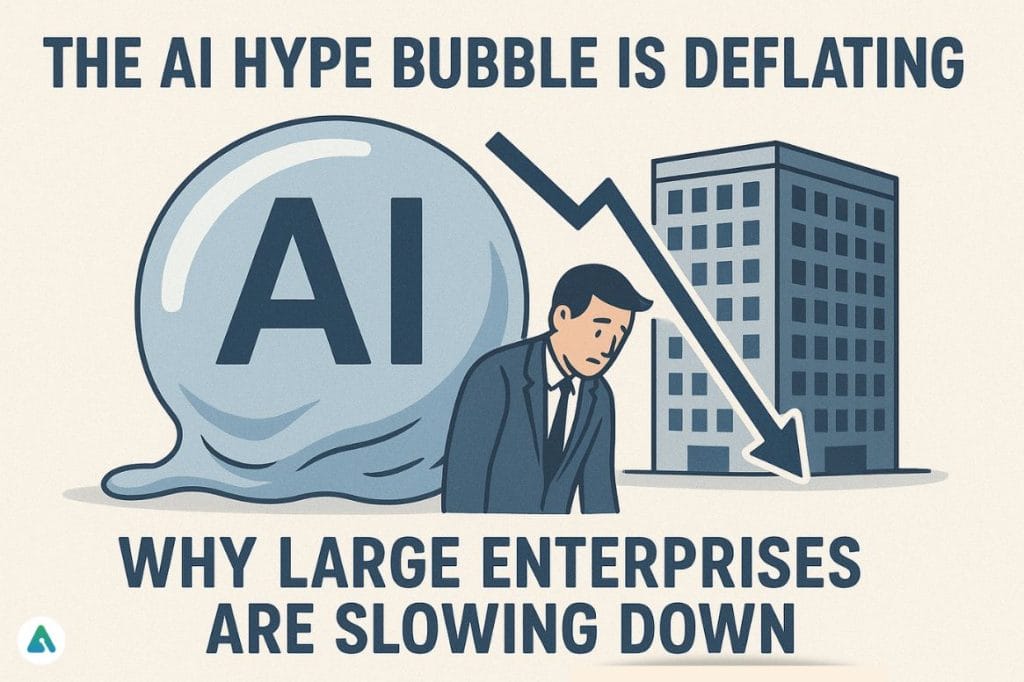
The AI frenzy that once promised to “revolutionize” every office and factory is hitting an inconvenient truth: it’s harder, messier, and slower than anyone pretended. Recent Apollo Academy data shows that large enterprises — those with 250+ employees — aren’t leading the charge anymore. In fact, AI adoption is leveling off, and in some cases, slightly declining. The giant, well-resourced companies that pundits assumed would dominate AI are realizing it’s not all glitter and gold.
The Hard Limits Behind the Hype
1. Data Is a Mess
AI depends on clean, structured data. Large companies have decades of fragmented, siloed, and inconsistent data. Feeding this chaos into fancy models produces shaky outputs at best — and biased, misleading results at worst. Many early wins have evaporated once the messy reality hit.
2. Legacy Systems Are a Straightjacket
Modern AI tools weren’t designed for the clunky infrastructure of giant enterprises. Integrating them often means painful rewrites, brittle middleware, or expensive overhauls. The promise of “plug-and-play AI” is just that: a promise.
3. Infrastructure Costs Are Brutal
Scaling AI isn’t cheap. Generative models and advanced algorithms demand massive cloud power, GPUs, and secure storage. Even firms flush with cash are discovering that the ongoing costs are crushing — the ROI is far from guaranteed.
4. Talent Shortages Expose the Gap
Skilled AI engineers and MLops experts are scarce, and existing teams often lack the chops to deploy and maintain models safely. The “AI gold rush” runs into a human reality: you can’t scale what you can’t staff.
5. Oversight and Ethical Headaches
AI isn’t magic. Hallucinations, bias, and errors require constant human supervision. Boards and compliance teams are imposing layers of oversight — slowing adoption and cutting into promised efficiency gains.
6. Organizational Resistance
AI isn’t just a tech problem — it’s a cultural one. Staff pushback, workflow disruption, and accountability conflicts add friction. Many “AI champions” have learned that enthusiasm alone cannot overcome entrenched corporate inertia.
From Hype to Reality Check
The early AI rush was all pilots, experiments, and flashy dashboards. Now the reality bites: executives are demanding measurable ROI, repeatable results, and reliability. “Pilot purgatory” is ending, and AI is facing the brutal test of real-world operations.
This is the classic S-curve of technology adoption: explosive hype, followed by a plateau as the messy work of scaling collides with organizational complexity. For AI, the plateau isn’t failure — it’s a reckoning.
The Takeaway: AI Isn’t the Miracle Solution
Large enterprises are learning the hard way that AI hype rarely matches the real world. The plateau in adoption reflects limits in infrastructure, talent, data, and governance — the “trust tax” that AI imposes. The era of breathless predictions and “AI will solve everything” headlines is over.
The real winners won’t be the ones chasing shiny tools, but the ones willing to slog through the messy, expensive, and human-intensive work of making AI actually function reliably. In other words, AI is entering adulthood — and it’s less glamorous, more grounded, and far more constrained than the hype suggested.
Related: The $Trillion Question: Is the 2025 Spending Boom Building the Future—or a Bubble?
