

Character AI doesn’t feel like a typical tech product. It feels more like a world users step into — where conversations stretch for hours, and AI characters start to feel genuinely present.
That’s exactly why people keep asking: how does Character AI make money if most of it is free?
Running this platform isn’t cheap. Every message, every response, every long conversation costs real money in compute and infrastructure. With millions of users spending 75–120 minutes a day on the platform, those costs compound quickly. The real question isn’t just how they make money — it’s how they survive while doing it.
This guide gives a clear 2026 breakdown of Character AI’s business model: the actual revenue streams, the impact of the Google licensing deal, why subscriptions alone don’t work, the rise of ads and microtransactions, and where the platform is heading next.
The Simple Answer: How Does Character AI Make Money?
Character AI makes money through a hybrid model combining subscriptions, advertising, microtransactions, and large licensing deals.
Free users drive engagement. Paid users improve margins. Ads monetize attention. Partnerships fund survival. This mix exists because AI platforms don’t behave like normal SaaS products — usage creates cost, not just value.
The 4 Main Revenue Streams of Character AI

1. How Character AI Makes Money from Subscriptions (c.ai+)
Character AI’s subscription tier runs approximately $9.99/month and gives subscribers faster replies, priority access during peak usage, and early access to new features through c.ai Labs.
Subscriptions help — but they don’t come close to sustaining the platform on their own. With conversion rates under 2% of the free user base, subscription revenue alone can’t cover the infrastructure costs of running billions of AI conversations.
2. How Character AI Uses Advertising Without Breaking Immersion
Character AI introduced feed-based ads, discovery page promotions, and early in-chat ad testing. Users spend 75–120 minutes daily on the platform — that’s premium ad inventory by any measure.
One important nuance most guides miss: ads in 2026 primarily trigger during character navigation — the moment when users switch between bots — rather than interrupting an active conversation mid-session. This is deliberate. Inserting ads between character switches minimizes the immersion cost while still capturing attention at natural transition points. The goal is to push users toward the ad-free paid tier without destroying the experience that keeps them on the platform.
3. Microtransactions: The Fastest-Growing Revenue Stream in 2026
Small payments for specific in-app actions represent the fastest-growing part of the revenue model. Users pay to regenerate responses, unlock premium interactions, or enhance character experiences. The mechanic feels like gaming rather than software — optional, immersive, and graduated. It converts free users gradually without requiring a full subscription commitment.
This is where the biggest 2026 growth is happening, and it’s not accidental. The shift toward Fortnite-style and Roblox-style monetization — paying for better experiences rather than just access — changes the psychological dynamic entirely. Users don’t feel locked out; they feel like they’re upgrading.
4. Licensing Deals: How the Google Partnership Changed Everything
The multi-billion-dollar licensing deal with Google in 2024 redefined Character AI’s financial position entirely. Rather than being acquired, the company struck an arrangement where it shared technology and infrastructure access while maintaining independence. This is the critical distinction:
| Model | What It Means | Character AI Reality |
|---|---|---|
| Acqui-hire | Talent absorbed into the acquirer | ❌ Not what happened |
| Licensing Deal | Tech + infrastructure shared | ✅ Correct |
The deal reduced Character AI’s reliance on building proprietary models, lowered inference costs, and provided immediate financial runway. Some 2026 industry analysis suggests the deal pushed the platform’s effective valuation closer to $10B by eliminating the burn-rate risk that had threatened the company’s survival.
What Changed After the Founders Left Character AI?
The shift toward more aggressive advertising didn’t happen in a vacuum. It accelerated after Noam Shazeer and Daniel De Freitas — the founders who built Character AI’s original product philosophy — returned to Google as part of the licensing arrangement. Their departure handed the monetization roadmap to a leadership team under pressure to hit revenue targets without the founders’ product instincts pulling against commercial friction.
Understanding this context makes the advertising strategy make more sense as a business decision, even if users find it frustrating. The platform’s current direction reflects a company that survived an existential funding crisis and is now optimizing for sustainability rather than pure product vision.
The New Era: Social Feed over Research
Under the leadership of CEO Karandeep Anand (formerly of Meta), the platform has shifted its primary focus. While the founders were deeply rooted in the “research” of large language models, the current leadership treats Character AI more like a social discovery platform. This explains the recent push toward high-engagement features like the discovery feed, native sharing, and “sponsored characters”—shifting the product from a tech experiment into a fully monetized social ecosystem.
c.ai Labs Explained: New Monetization Features in 2026
Character AI launched c.ai Labs in early 2026 as an experimental feature layer — and it’s become the clearest signal of where the revenue model is heading.

Two features inside Labs represent meaningful revenue opportunities:
Voice Calls are now one of the primary mobile revenue drivers. The model is hybrid — limited free usage with a c.ai+ or token-based upsell for extended sessions. [Does Character AI charge for voice calls? Yes, partially. Free users get limited access; extended voice interaction requires either a c.ai+ subscription or token spend.] The voice chat feature on Character AI works differently from standard text interaction and carries its own cost structure.
Imagine Gallery monetizes AI-generated visuals within chat — a direct response to competitors like Candy AI and Talkie, who have built image generation into the conversation experience. This feature sits behind the Labs paywall and gives the platform a microtransaction anchor that doesn’t depend on text engagement alone.
The 2026 “Charms” Update: Turning Users into Creators
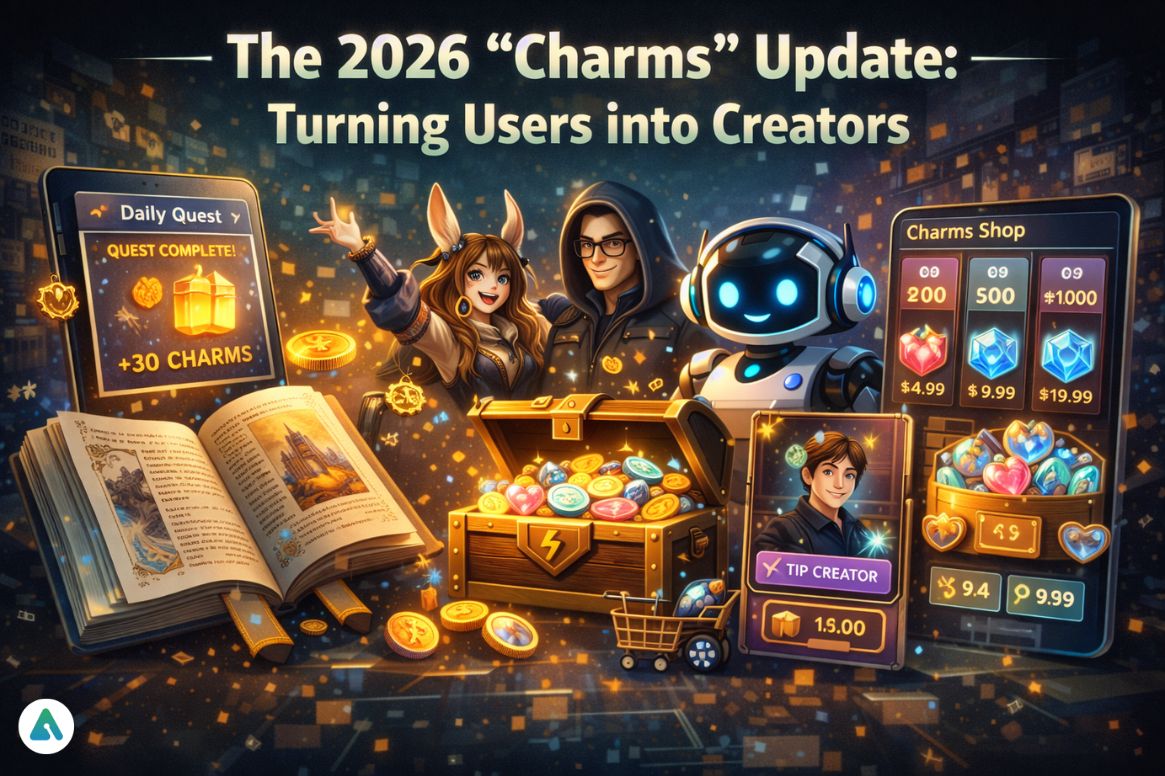
In early 2026, Character AI shifted from a pure subscription/ad model to an internal virtual economy with the launch of Charms. This was the “Roblox-ification” moment for the platform, moving it away from simple software and into a digital marketplace.
The Charm Economy: Users earn Charms through “Daily Quests” (logging in, interacting with new bots) or by purchasing bundles. These are used to “tip” creators, unlock premium voice styles, or bypass slow-mode restrictions without a full c.ai+ subscription.
Lorebooks for Lore-Keepers: One of the most significant 2026 updates is the Lorebook feature. It allows creators to build massive, persistent “world bibles” for their characters to prevent memory drift. Currently, access to advanced Lorebook tools is a major driver for c.ai+ signups, as it’s a non-negotiable tool for serious roleplayers and world-builders.
Creator Monetization Signals: While there isn’t a direct “cash-out” system yet, the infrastructure of Charms and Lorebooks suggests a future Creator Marketplace. By letting users build and potentially “sell” access to complex worlds, Character AI is positioning itself as an entertainment ecosystem rather than just a chat app.
Compute Arbitrage: The Hidden Way Character AI Reduces Costs

Profit for Character AI doesn’t just come from earning more — it comes from spending less per message.
Before the Google deal, Character.AI was running on a high cost-per-message infrastructure, where every increase in user activity directly scaled operational losses. This made growth expensive and financially constrained.
After the acqui-hire agreement with Google (Alphabet) in August 2024—valued at $2.7 billion for a non-exclusive licensing deal and talent acquisition—the underlying economics shifted significantly. Lower inference costs and improved infrastructure access changed the unit economics of the platform.
As a result, a company generating $50M in 2025 revenue is now projected to trend toward ~$60.1M in 2026, with expectations of near doubling growth compared to earlier forecasts—while operating with reduced infrastructure pressure and more scalable AI deployment costs.
At roughly $130K–$150K revenue per employee, the platform is lean but not yet highly efficient by SaaS standards — strong SaaS companies typically exceed $300K per employee. The gap reflects infrastructure costs that still dominate the cost structure. Compute arbitrage — getting better inference efficiency from the Google infrastructure deal, rather than building proprietary — is the real mechanism closing that gap over time.
Scaling Without Crashing: Third-Party Efficiency
One of the most effective moves in this “arbitrage” strategy has been the selective use of third-party models (such as Llama-based integrations) for less complex tasks. By offloading simpler interactions to external models while leveraging Google’s infrastructure for deep character roleplay, the platform has managed to scale to over 20 million Monthly Active Users (MAUs). This allows them to maintain a massive user base without the valuation-crushing server costs that plague smaller AI competitors.
Why Character AI Has a Low Conversion Rate Problem
20M+ users. Under 2% subscribe. That math forces diversification.
Most users never pay directly, which means the platform can’t rely on subscriptions as its primary margin driver. This reality pushed Character AI toward the current hybrid model — ads, microtransactions, and licensing alongside subscriptions — because any single revenue stream is insufficient at scale with this conversion rate.
The broader dynamics of how AI companion apps build sustainable revenue show this isn’t unique to Character AI. The entire category struggles with the gap between engagement depth and willingness to pay. Character AI’s engagement metrics are exceptional; its conversion rate is not.
Why Character AI Does Not Use NSFW Monetization
Competitors like Janitor AI and Chai AI allow fewer content restrictions and monetize more aggressively through that openness. Character AI maintains strict moderation and avoids NSFW monetization entirely.
The tradeoff: less immediate revenue, but a safer brand position for advertising partnerships and the Google relationship. This is also why the platform’s content policies matter commercially, not just ethically — the advertising model requires brand-safe inventory. A platform running adult content can’t sell standard display advertising to mainstream brands.
This forces heavier reliance on subscriptions, tokens, and licensed infrastructure to compensate for the revenue ceiling that strict moderation creates.
User Backlash: Ads vs Immersion in C.AI
Roleplay users treat immersion as non-negotiable. Any interruption — any moment where the conversation breaks — damages the core product experience.
The community response to in-chat ad testing has been consistent: complaints, frustration over paywalled features, and movement toward alternatives. Character AI’s response has been to experiment with native ads and sponsored characters — formats that aim to monetize without a hard break in the conversation flow.
The character-switching ad trigger represents the current equilibrium. It’s not invisible, but it’s less destructive than mid-conversation interruption. Whether users accept that equilibrium long-term, or whether it accelerates migration to Character AI alternatives that don’t carry advertising friction, is one of the platform’s genuine strategic risks.
How Much Money Does Character AI Make in 2026?

The estimated 2026 revenue is trending toward ~$60.1 million, nearly double the 2024 baseline of roughly $30 million. However, despite strong top-line growth, Character.AI is not consistently profitable yet. Infrastructure and compute costs remain high, and the margin structure continues to depend on sustained growth in microtransactions and advertising revenue to reach profitability at scale.
Character AI vs Competitors: Monetization Comparison
| Platform | Revenue Model | NSFW | Primary Strategy |
|---|---|---|---|
| Character AI | Ads + Subs + Tokens | ❌ No | Entertainment platform |
| Replika | Subscription-heavy | Limited | Emotional AI |
| Janitor AI | API-based | ✅ Yes | Power users |
| Chai AI | Token system | ✅ Yes | Roleplay-first |
Common Misconceptions About Character AI Revenue
“It’s free, so it doesn’t make money” — False. Free users generate ad revenue and microtransaction conversions.
“Subscriptions are enough” — Not at under 2% conversion from a free user base.
“AI companies are highly profitable” — Rarely, and Character AI is not yet in that category.
“They sell your data” — No confirmed evidence of direct data selling; data informs model improvement.
Frequently Asked Questions
Q. How does Character AI make money in 2026?
Character AI makes money through a hybrid monetization model that includes c.ai+ subscriptions, advertising (mainly during character switching), microtransactions for premium interactions, and a major licensing deal with Google. This approach allows the platform to monetize both free and paid users at scale.
Q. Is Character AI profitable in 2026?
No, Character AI is not consistently profitable as of 2026. While annual revenue is estimated to be approaching $60 million, high infrastructure and AI compute costs continue to limit overall profitability.
Q. Does Character AI charge for voice calls?
Yes, Character AI partially charges for voice calls. Free users get limited access, while extended voice interactions require either a c.ai+ subscription or token-based payments through the Labs feature system.
Q. Does Character AI sell user data?
There is no confirmed evidence that Character AI directly sells user data. However, like most AI platforms, it uses conversation data to improve its models in line with its privacy policy.
Q. How much revenue does Character AI generate?
Character AI is estimated to generate around $60 million in annual revenue in 2026, nearly double its 2025 revenue of approximately $30 million. These figures are based on industry estimates, as official numbers are not publicly disclosed.
Q. Why is Character AI free to use?
Character AI uses a freemium business model. Free users are monetized through advertising and optional microtransactions, while a small percentage convert to paid subscriptions (c.ai+), allowing the platform to scale its user base while generating revenue.
Q. What is c.ai Labs in Character AI?
c.ai Labs is an experimental feature layer launched in 2026. It includes advanced features like voice calls and AI-generated images (Imagine Gallery), many of which are tied to monetization through subscriptions or token-based access.
Q. Can you make money using Character AI?
No, Character AI does not currently offer any creator monetization or revenue-sharing program. Users cannot earn money directly from creating or interacting with AI characters on the platform.
2026 Trends: The Future of Character AI Monetization
Microtransactions will continue to dominate growth. Ads will become more native and less interruptive. Voice and avatar interactions — already visible in Labs — will expand into primary revenue drivers. B2B integrations represent an underexplored revenue layer that the Google relationship potentially accelerates.
The larger shift: Character AI is becoming less like software and more like a fully monetized digital world. The psychological dynamics of AI attachment that drive 90-minute daily sessions are the platform’s real economic asset — the challenge is monetizing that engagement without destroying what creates it.
Related: Character AI Old Site: Can You Still Access It in 2026?
| Disclaimer: This guide is meant to give you a clear, helpful overview based on the best available information as of 2026. Since Character AI is a private company, some numbers and details are based on industry estimates and may change over time. Treat this as a general guide, not financial or professional advice. |
