
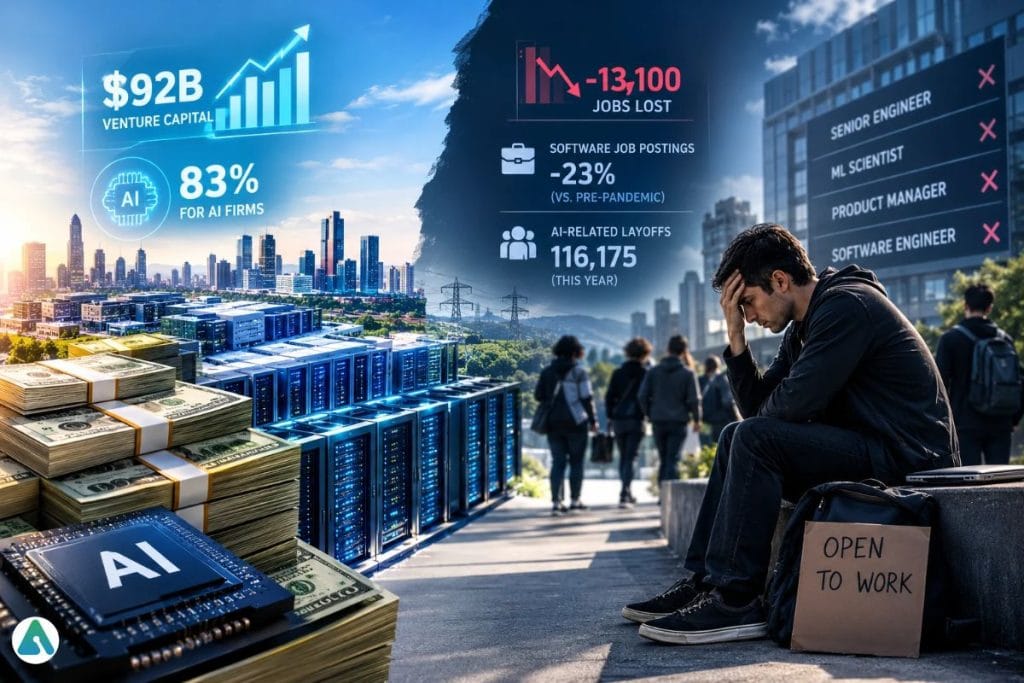
Silicon Valley has never had so much cash. It also has a growing crowd of senior engineers who can’t get a callback.
The New York Post profiled several of them this week. Their stories point to a strange break in the old rule that money in means jobs out.
Money up, jobs down
Start with the numbers. Silicon Valley took in $92 billion of venture capital last year, 83% of it for AI firms, yet lost 13,100 jobs, according to Joint Venture Silicon Valley’s 2026 Index. The group behind that report, Joint Venture Silicon Valley, titled it “Hot Engine, Stalled Growth.” Hard to argue with that.
The national data tells the same story. Indeed shows software job postings sitting 23% below their pre-pandemic level. Employers have blamed AI for 116,175 job cuts this year.
Layoffs aren’t slowing down at the top, either. US employers announced 108,000 job cuts in January 2026 alone, a record for a single month, according to figures reported by Implicator.
Where the money actually lands
Older tech booms put funding straight into payroll. A startup closed a round, then hired fifty people by spring.
This one works differently. Today’s AI money buys chips, data centers, and power contracts. It also buys a handful of superstar researchers. The mid-level engineer, the product manager and the sales lead mostly watch from the sidelines.
Those servers aren’t free to run, either. The energy and water bill of AI infrastructure climbs every quarter, and it eats the same budget that used to fund headcount.
| Earlier tech booms | The AI boom | |
|---|---|---|
| Where new funding goes | Hiring and product teams | Compute, chips, energy |
| Who gets hired | Mid-level engineers, in bulk | A few elite researchers |
| Funding-to-jobs link | Tight | Loose |
| Hiring speed | Fast | Slow, with long interview loops |
A barbell market
The picture gets stranger once you look at the top end. In March, Fortune reported that some startups pay tech-savvy grads more than $300,000 in base salary. One recruiter told the Wall Street Journal he had never seen base pay that high at seed-stage companies.
So the market has split in two. A few people get offers that would have sounded like a joke five years ago. Thousands of seasoned veterans can’t land a single interview. Call it feast or famine, with very little in between.
The people behind the numbers
These workers weren’t scraping by. Until recently, many earned between $310,000 and $340,000. Now they live off savings and a spouse’s paycheck, with Google, Amazon and a PhD on the résumé.
Basem Istanbouli worked at Google. He says people assume every laid-off tech worker left with a golden parachute. His package was small. Without a partner, he says, he couldn’t have stayed in the Bay Area. He later asked on Reddit whether anyone else between jobs wanted to hike on a weekday. That post grew into a hiking group for the unemployed.
Another case hits harder. A former Amazon machine-learning scientist with a PhD quit to launch a startup, and the startup folded. He then sent out 120 applications in two months and got zero offers. One company ran him through six interview rounds before it passed.
He has a kid and a mortgage. About a year of savings is left. His wife’s job covers the family’s health insurance, and she has floated applying for social assistance. He won’t post “open to work” on LinkedIn. That banner would tell the whole industry his company died.
He isn’t alone in the grind. A longtime Indeed engineer told the Washington Post she sent 160 applications and heard nothing back. She now considers selling her house and retiring early.
The founder penalty
Here’s the part that stings. For years, the Valley cheered founders. It sold the myth of the risk-taker who bets on a big idea.
Now a failed startup can sink a résumé. The scientist says running a company counts against you, because hiring managers fear you won’t settle back into a normal engineering role.
Read that again. In an industry built on risk, the people who took one get the cold shoulder. Employers want order-takers right now, and with this many applicants, they can afford to be picky.
Employers hold all the cards
Recruiters say hiring cycles keep stretching. A manager can take up to six months to fill one full-time role. Candidates sit through round after round of interviews. The salaries on offer keep slipping.
When the pool of talent is this deep, nobody rushes. Companies wait for the perfect fit, and the clock keeps ticking for the people on the other side of the table.
There’s another wrinkle. Sam Altman has said some companies blame AI for layoffs they planned anyway. He calls it “AI washing.” If he’s right, the headline count of AI job losses overshoots what the technology really did.
So two things overlap. Real automation takes some jobs. Plain old cost cutting with an AI label takes others. Workers can’t tell which one hit them, and honestly, neither can the statisticians.
A labor market stuck in neutral
Zoom out and the whole market looks frozen. The Bureau of Labor Statistics JOLTS report tracks openings, quits, and layoffs. Voluntary quits sit near a six-year low. Payrolls grew by only about 80,000 a month this year, and last year’s pace barely cleared 10,000.
Workers hang on to what they have. Employers hold back. Nobody moves.
That freeze clashes with the forecasts. McKinsey Global Institute estimates that 11 million Americans may need a new occupation by 2035. That means roughly 770,000 switches a year, against a long-run average near 215,000. A market with almost no churn can’t deliver that pace.
Fear feeds the stall. Workplace anxiety tied to AI makes people grip their desks tighter. Fewer people leave, so fewer seats open up. It’s a vicious circle.
Don’t blame AI for everything
Hold on before you pin it all on the robots. Rate hikes, pandemic overhiring and plain cost pressure all pushed hiring down.
Research backs a more mixed view. A Yale School of Management study found that demand dropped for some AI-exposed jobs and grew for others, since AI made certain workers more productive.
Automation also hits a cost wall. Anthropic economists recently measured the gap between what robots can do and what makes economic sense. Being able to do a job and being cheaper than a person are two different things.
That said, companies keep pushing. Amazon’s warehouse automation push aims to grow output without growing headcount. The writing’s on the wall for any role that looks like routine task work.
Where displaced workers go next
Some find a side door. Xingtao Zhao, a former Google engineer, now runs a quantitative trading operation after his layoff. A biotech PhD laid off in 2024 sent dozens of applications and went nowhere.
New fields are opening, though. Demand for roles in responsible AI keeps growing as regulators and auditors show up. Those jobs need policy sense and technical depth. Few laid-off coders can jump in without retraining.
What to watch
Keep an eye on three things:
- Funding turning into hiring. If AI cash keeps flowing to compute, the payroll gap stays wide.
- Shorter interview loops. Faster hiring would mean employers feel real demand again.
- Rising quits. People only quit when they trust the market. A climbing quits rate would show that trust coming back.
Until then, the AI boom keeps minting billions and very few jobs. For a laid-off engineer burning through savings with a mortgage to pay, that gap is the whole story.
FAQs
Q. Why can’t senior tech workers find jobs during an AI boom?
Most AI funding buys compute and a few elite researchers. It doesn’t create mid-level roles the way earlier booms did.
Q. Is AI the main cause of Silicon Valley layoffs?
Not always. Cost-cutting, overhiring corrections, and AI-labeled restructuring all play a part. Altman says some firms blame AI for cuts they had already planned.
Q. Does a failed startup hurt a job search?
Some candidates say it does. Employers may worry that a former founder won’t stick with a standard role.
Related: Human Skills in the AI Era: 6 Skills That Matter Most in 2026
