
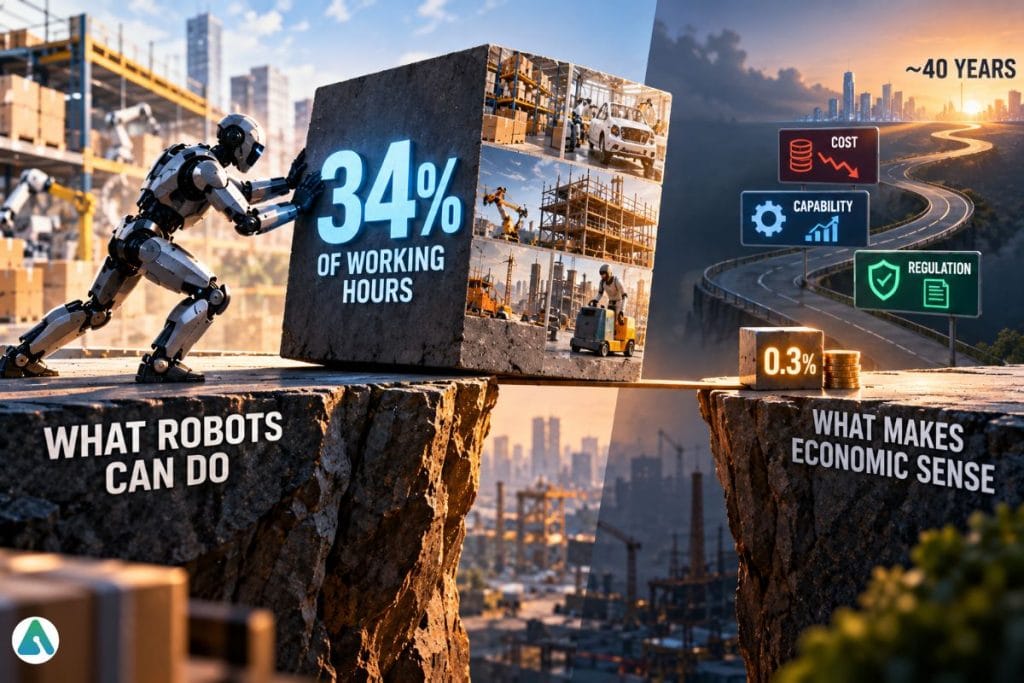
Anthropic economists just measured the distance between what robots can do and what robots can afford to do. The distance is wide. It changes how to read the AI jobs debate.
Most coverage splits into two camps. One says humanoids arrive next year. The other says nothing changes. This study sits between them, and it puts numbers on the middle.
What the study found
The paper, What work can robots do?, starts with capability. Robots can handle about three-quarters of physical job tasks in the US. Those tasks fill 34% of all working hours.
Then comes the price tag. Robots cost less than human labor for just 0.3% of work. Most of them also need tightly structured settings.
Robot prices have fallen about 3% a year since the 1990s. Keep that pace, and the study says robots need 40 years to undercut people on 10% of work.
How the paper counts cost
The method matters, because it explains the tiny 0.3% figure.
The authors compare robots and people task by task, not job by job. For each occupation, they take the share of time spent on robot-exposed tasks. They multiply that share by total compensation. That gives the labor cost a robot must beat.
They then weight each task by its time demands and by employment in the occupation. The curve in the paper plots the share of all job tasks where a robot costs less than the human doing them.
This changes the question. A robot doesn’t have to replace a whole job. It has to beat the wage on one slice of work. Most slices still fail that test.
Three clocks, not one
Most forecasts run a single clock: how fast the technology improves. This study points to three. The labels are mine.
- Capability. Fine manipulation still trips robots up. The paper’s example is untangling wires.
- Cost. Hardware gets cheaper slowly. A robot that works but costs more than a person loses the purchase decision.
- Permission. Human preferences and regulation block a large share of tasks, even where a robot could do the work.
A job falls only when all three clocks strike together. That explains the gap between 34% and 0.3%.
The clocks also run at different speeds. Capability can leap after one research breakthrough. Cost moves with factories and supply chains. Permission moves with politics and public comfort. The slowest clock sets the pace.
Where robots win first
Warehouses show the pattern. The floors are controlled, the tasks repeat, and the volume is huge. That fits Amazon’s reported plan to automate most of its warehouse operations. It does not fit a messy job site.
The same logic applies to factories and fulfillment centers. Structure lowers the capability bar. Volume spreads the hardware cost across millions of items.
A home, a hospital room, or a construction site flips both conditions. Every setting differs, and every task needs judgment. The robot’s cost advantage disappears.
Even the bull case stops at 2050
Robotics optimists expect prices to crash. Jensen Huang promised a “ChatGPT moment” for robotics at CES in January 2026. Morgan Stanley forecast a $5 trillion humanoid market by 2050.
The Anthropic team modeled that optimism. In their fast scenario, costs fall up to four times faster than the historical rate. Robots also learn new tasks twice as quickly.
Robots still don’t beat human labor on half of today’s physical work until 2050.
Apollo chief economist Torsten Sløk reached the same verdict. He wrote that displacement takes decades even under aggressive projections. He pointed to fine-manipulation limits, regulation, and human preferences as extra brakes.
“Decades” doesn’t mean “never,” though. Robots would need record price drops and quality gains. Nobody has delivered those yet.
Why office work moves faster
Software copies for almost nothing. A robot needs new hardware every time. That asymmetry has no robot equivalent.
Companies already act on it. Some bosses now push staff toward documenting their own workflows so AI agents can copy them. The copying costs little once the instructions exist.
The authors estimate that about half of all work tasks have exposure to LLMs, meaning a model could cut the time those tasks take in half. Exposure doesn’t equal replacement, and the paper says so.
| Factor | LLM-based software | Physical robots |
|---|---|---|
| Cost to copy | Low | High, new hardware per unit |
| Main brake | Accuracy, workflow fit | Cost, dexterity, structured settings |
| What exposure measures | Capability to speed up tasks | Capability plus cost |
| Implied pace | Faster | Slower |
Faster doesn’t mean frictionless. McKinsey estimates that 11 million US workers may need new occupations by 2035. Bloomberg’s coverage of the report puts the range at 6 million to 16 million workers.
The same coverage notes that yearly occupation switches historically run around 215,000. That number may triple. Moving that many people takes time, money, and retraining.
What the labor data shows so far
Anthropic’s earlier work sounds calmer than the headlines. A March paper from economists Maxim Massenkoff and Peter McCrory found no systematic rise in unemployment for highly exposed workers since late 2022. It did find hints that hiring of younger workers has slowed in those jobs.
In July, McCrory said on X he doesn’t expect noticeably higher unemployment a year from now, at least not because of AI.
CEO Dario Amodei sounds louder. He has warned that AI could wipe out half of entry-level white-collar jobs within five years. His own researchers sound more measured.
The two views can coexist. Slower hiring at the entry level doesn’t show up as mass layoffs. It shows up as fewer first jobs.
The safest jobs mix touch and trust
Personal care and service jobs show about 40% task exposure. Physical contact and in-person interaction anchor that work. Both LLMs and robots struggle there.
Installation and repair, healthcare support, and community and social service follow the same pattern. Their exposure runs relatively low.
The paper’s takeaway is that highly interpersonal work, or work needing delicate manipulation, looks less vulnerable in the near term. Each trade combines two hard problems. The worker handles a physical task while managing a person’s trust.
What this means in practice
This section is my reading, not the paper’s.
For employers: Robots pay off where tasks repeat in controlled settings at high volume. Outside those settings, the math rarely works yet. Track the cost clock before you plan a rollout.
For workers: Roles that blend hands-on skill with human contact carry the most near-term shelter. Entry-level desk work faces the more immediate squeeze.
For investors: The 0.3% figure argues for patience on physical-labor displacement stories. Software-driven change looks closer than hardware-driven change.
What to watch next
Each clock offers a signal.
- Capability: Dexterity milestones, like robots handling cables or fabric reliably outside labs.
- Cost: Unit prices for robots. A sustained drop well past 3% a year would break the study’s baseline.
- Permission: Safety rules and workplace regulations for robots near people.
If all three move at once, the 40-year estimate shrinks fast. So far, they haven’t.
One caveat
Anthropic sells LLMs. Treat its economists’ findings with the same scrutiny you’d give any vendor-adjacent research. The method is transparent, and the authors flag their own limits. Still, test the cost-curve assumptions before you treat the 40-year figure as settled.
The takeaway
Robots can do much of the work. The hard part is doing it at a price people will pay, in messy settings, with regulators and customers on board. That takes far longer than a demo reel suggests.
FAQs
Q. How much physical work can robots do today?
Robots can perform about three-quarters of physical job tasks in the United States, according to Anthropic’s research. Those robot-capable tasks account for roughly 34% of total US working hours.
Q. What percentage of work is cheaper for robots than humans?
Only about 0.3% of work is currently cheaper to perform with robots than with human labor. The study compares robot costs with the human compensation associated with each task.
Q. How long will it take robots to become cheaper than humans for 10% of work?
At the historical rate of robot cost declines—about 3% per year—it could take roughly 40 years for robots to become cheaper than human workers for 10% of work.
Q. What happens if robot costs fall much faster?
Even in a faster adoption scenario where robot costs fall up to four times faster and robots learn new tasks twice as quickly, robots would not become cheaper than humans for half of today’s physical work until around 2050.
Q. Why are robots economically viable for only 0.3% of work?
Robots may be technically capable of many tasks, but they are still expensive to buy, deploy, maintain, and operate. The study compares robot costs against the labor cost of individual tasks, and humans remain cheaper for most of them.
Q. Which jobs are least likely to be automated by robots?
Jobs involving physical contact, fine manipulation, unpredictable environments, and human interaction appear less exposed in the near term. These include personal care, installation and repair, healthcare support, and community and social service roles.
Q. Are white-collar jobs more exposed to AI than physical jobs are to robots?
Many white-collar tasks could face faster AI disruption because software can be copied and deployed at much lower cost than physical robots. Robots require new hardware for each deployment, while AI software can scale across many users and workflows.
Q. Has AI caused higher unemployment so far?
Anthropic’s earlier labor-market research found no systematic increase in unemployment among highly AI-exposed workers since late 2022. However, the researchers found signs that hiring may have slowed for younger workers in some highly exposed occupations.
Q. Why can robots perform 34% of working hours but replace only 0.3% economically?
The gap comes from the difference between technical capability and economic viability. Robots may be able to perform tasks covering 34% of US working hours, but only a small fraction currently costs less to automate than to pay a human worker.
Q. What are the biggest barriers to robot job automation?
The main barriers are robot cost, dexterity, reliability in unstructured environments, safety requirements, regulation, and human preferences. Automation becomes more attractive when tasks are repetitive, predictable, and performed at high volume.
Q. Which industries are most likely to adopt robots first?
Warehouses, factories, logistics, and fulfillment centers are among the strongest candidates because their environments are structured and their tasks are repetitive. High volumes also make it easier to spread the cost of robotic hardware across many operations.
Q. Will robots replace most human workers by 2050?
The study does not conclude that robots will replace most workers by 2050. Even under its aggressive cost and capability assumptions, robots only become economically competitive with humans for about half of today’s physical work by that point.
