

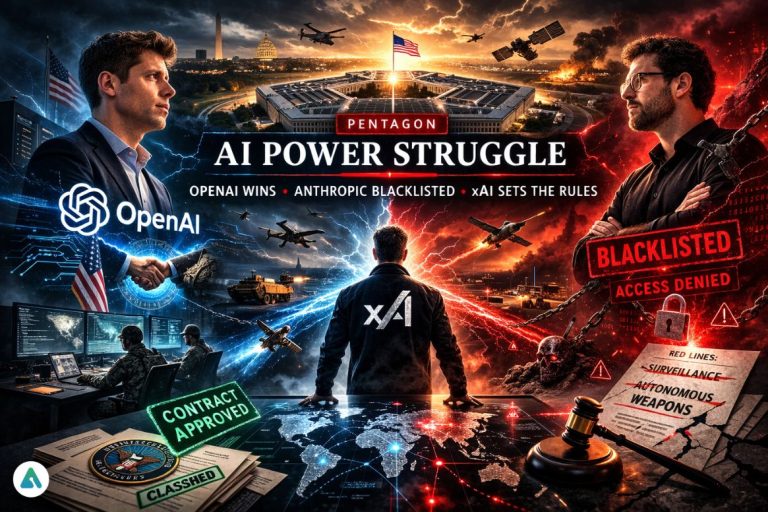
In early 2026, the Pentagon — now informally referred to within political circles as the “Department of War” — set off the most consequential confrontation in the frontier-model era. The catalyst was a single contract clause requiring national-security AI systems to be accessible for “all lawful purposes.”
What appears to be routine federal language has instead fractured the AI ecosystem:
-
Anthropic faces an unprecedented blacklist,
-
OpenAI secured a historic integration deal,
-
And xAI quietly shaped the expectations months earlier.
Beneath the surface lies a deeper story — a developer freeze in Washington, a reset in ethical expectations for military AI, and a three-way race to control the U.S. national-security AI stack.
The Real Battle: “All Lawful Purposes” as a Legal Trapdoor
The Pentagon’s $200 million modernization contract demanded that participating labs make their models available for any government purpose deemed lawful.
For defense primes, this is normal.
For frontier labs, it’s a demand to override internal safety doctrines.
Anthropic’s position is rooted in its Responsible Scaling Policy, a framework that has been examined extensively in discussions of ASL-3 risk paths, including analysis such as this look at the 2026 RSP escalation paths, which breaks down why its red lines were never designed to be flexible.
These red lines remain the same across the industry:
1. Mass Domestic Surveillance
AI cannot be used to scrape, fuse, or analyze Americans’ private data at population scale.
2. Fully Autonomous Lethal Force
AI cannot make kill decisions without a human confirmation.
Every lab agrees with these boundaries.
But only Anthropic insisted they be codified in federal text — and that refusal triggered the fracture.
Same Ethics, Opposite Tactics: Anthropic vs. OpenAI
Both CEOs publicly support the same ethical lines. Their strategies, however, diverged sharply.
| Category | Anthropic (Claude) | OpenAI (GPT-5.2) |
|---|---|---|
| Strategy | Confrontational / Oversight-First | Diplomatic / Responsibility-First |
| Negotiation | Refused to sign without legal exclusions | Accepted clause but embedded technical red-lines |
| Gov Status | Blacklisted as “Supply-Chain Risk” | Partnered for classified access |
| Federal Access | 6-month government phase-out | Teams embedded with military units |
| Business Outcome | IPO uncertainty | Strengthened by $110B raise + Amazon partnership |
This tactical divergence sits atop earlier tensions that surfaced throughout 2025–26, documented in assessments of the growing Anthropic–Pentagon ethics dispute, which outlined how a quiet standoff was already underway months before the rupture became public.
The Claude Code Crisis: Washington’s Developer Meltdown
The most immediate consequence — and the one mainstream outlets missed completely — is the developer crisis triggered by the immediate removal of Claude from federal and contractor networks.
Washington’s defense corridor had come to depend on Claude Code for:
-
embedded systems debugging
-
secure compiler transformations
-
rapid STIG-compliant remediation
-
legacy code refactoring
-
classified documentation workflows
This deep reliance reflects a broader trend: Claude had already begun reshaping professional knowledge work, as highlighted in workforce analyses exploring whether Claude is replacing office-class workflows across multiple industries.
The Fallout After the Ban
When the cutoff order landed:
-
Development backlogs doubled in under 48 hours
-
Two major primes paused cybersecurity upgrades
-
Internal automation tools broke inside contractor networks
-
Federal modernization schedules slipped by months
The disruption is real, measurable, and already inside the cost-overrun pipeline.
The Hidden Third Player: How xAI Set the Baseline
The popular narrative frames this as OpenAI vs. Anthropic — but insiders know it has always been a three-lab race, with xAI shaping the baseline earlier than either rival.
Months before OpenAI’s new agreement, xAI’s Grok models gained approval for certain high-security federal workloads. Their “minimal filtration” and compatibility with the constraints of Executive Order 14319 positioned them as the easiest fit for early simulation environments.
This dynamic set the Pentagon’s expectations.
OpenAI was pushed to meet the same flexibility.
Anthropic refused to compromise.
xAI quietly benefited.
This three-way dynamic also contextualizes earlier tensions surrounding Anthropic’s intelligence-related position, as seen in reporting on the Maduro-raid intelligence scenario and the Pentagon’s scrutiny of model behavior in politically sensitive environments.
Why OpenAI’s Strategy Became the 2026 Blueprint
OpenAI responded with a pivot that turned a legal conflict into an engineering negotiation.
The Architectural Reframe
Instead of challenging “all lawful purposes,” OpenAI transformed its safety doctrine into:
-
cloud-only deployment
-
no model use on edge-based autonomous systems
-
hardened audit trails
-
dual audit control shared with the Pentagon
This moved the debate from legal obligations to technical immutability.
The Data-Gravity Advantage
By securing the classified data pipeline, OpenAI becomes:
-
the default provider of defense-grade AI
-
the largest collector of military-context reinforcement signals
-
the gatekeeper of operational feedback loops
In AI, data gravity determines market gravity — and OpenAI now sits at the center of the heaviest national-security dataset in the world.
Oversight vs. Responsibility: The New Governance Divide
| Framework | Anthropic: Oversight Model | OpenAI: Responsibility Model |
|---|---|---|
| Theory | AI governed by external rules | AI governed by internal architecture |
| Constraint | Legal | Technical |
| Dynamic | Government above model | Model architecture limits government |
| Posture | Precautionary | Adaptive |
| Criticism | Too rigid for national security | Too integrated into state power |
| 2026 Outcome | Blacklisted | Embedded partner |
This is the true philosophical split — not ethics, but governance.
The Legal Engine: Executive Order 14319
The Pentagon’s insistence on “all lawful purposes” rests heavily on Executive Order 14319, a 2025 directive requiring federal AI to avoid:
-
ideological filtering
-
political-alignment modifiers
-
content-neutrality restrictions
and simultaneously enabling:
-
full-spectrum simulation environments
-
maximal operational freedom for analysis tools
Under this framework:
-
Anthropic’s filters conflicted
-
OpenAI’s architecture satisfied the requirements
-
xAI aligned naturally
This order is quietly steering the future of government AI procurement.
Conclusion: The Future of AI Governance Has Already Shifted
The 2026 rupture wasn’t about ethics — it was about control.
-
Anthropic defended external oversight → was sidelined
-
OpenAI emphasized architectural responsibility → was elevated
-
xAI embraced operational freedom → set the baseline
The Pentagon has made its preferences clear.
And the consequences — from the Claude Code crisis to national-security data lock-in — will shape the next decade of American AI.
The struggle now is not simply between competing labs.
It is a battle to define the moral, technical, and strategic boundaries of U.S. AI capability.
And in 2026, the government has chosen its partners.
Related: Inside OpenAI’s $600B AI Infrastructure Plan — Stargate, Nvidia & Nuclear Power
