

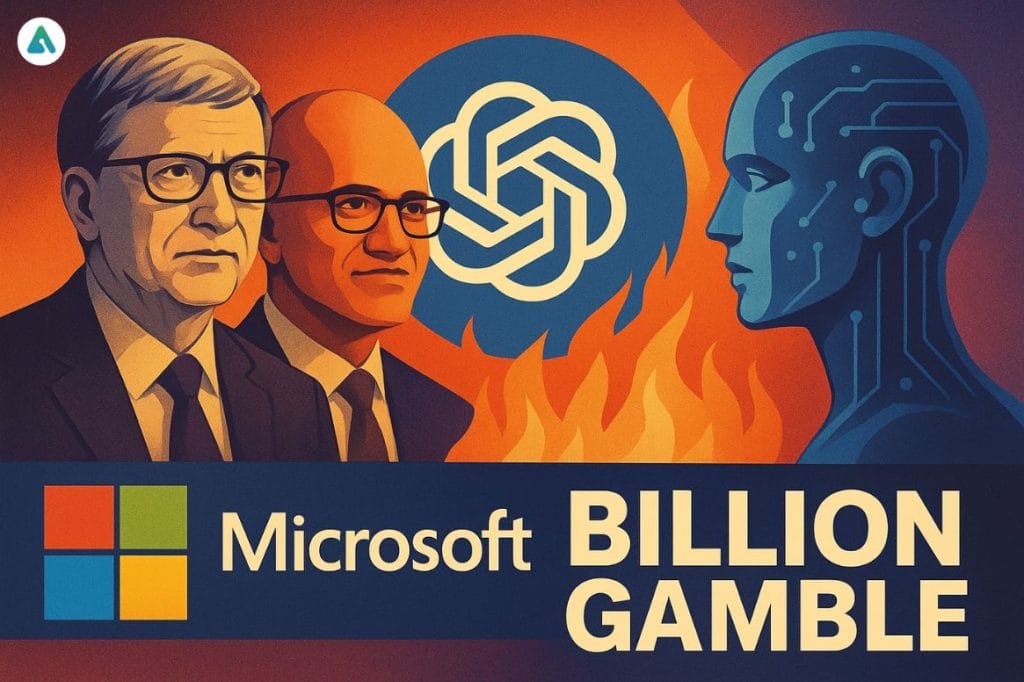
When Satya Nadella first proposed pouring a billion dollars into a small, idealistic lab called OpenAI, even Bill Gates — the man who built Microsoft from dorm-room code to global empire — shook his head.
“Satya, you’re going to burn this billion dollars,” he warned.
That was 2019 — a time when artificial general intelligence was still a philosophical thought experiment, not a trillion-dollar industry. Fast forward to 2025, and that “billion-dollar bonfire” has become a $135 billion stake in the company now defining what AI means to the world.
What once looked like hubris now looks like clairvoyance.
The Gamble That Rewired Microsoft
When Nadella took the CEO seat in 2014, Microsoft was a giant showing its age — steady, profitable, but missing the pulse of modern innovation. Google had a search. Apple had the iPhone. Amazon had the cloud.
Microsoft? It had legacy software and nostalgia.
Then came a spark — a bet on intelligence itself.
OpenAI was, at that time, a nonprofit research collective chasing a distant dream: machines that could reason, learn, and evolve autonomously. Its founders weren’t talking about apps or ad revenue — they were talking about humanity’s future.
For Nadella, that idealism wasn’t a deterrent. It was a challenge.
He saw something bigger — a fusion of Microsoft’s muscle with OpenAI’s imagination.
So in 2019, the company invested $1 billion into OpenAI’s vision — and locked in an exclusive partnership that would make Azure the backbone of its AI infrastructure.
It was a bold, almost reckless move. But Nadella understood something the market didn’t yet: the next platform shift wasn’t mobile or cloud — it was intelligence.
Bill Gates’ Skepticism and the Bonfire of Doubt
Bill Gates had seen his share of technological revolutions. But he was also a master of restraint — a man who’d watched entire industries collapse under their own hype.
When Nadella briefed him on the plan, Gates didn’t hesitate. “You’re going to burn it,” he said bluntly.
And at the time, he was right to doubt. OpenAI had no business model, no product pipeline, no proof of scalability. Its goal wasn’t profit — it was safety, alignment, research. In other words, everything that doesn’t pay bills on Wall Street.
But Nadella was betting on something far more abstract — the inevitability of intelligence as infrastructure.
That single decision would later transform Microsoft from a software maker into the central nervous system of global AI.
OpenAI’s Reinvention: The Two Souls of the Machine
In 2025, OpenAI announced a major transformation — not just of structure, but of philosophy.
It would become a hybrid entity, with two intertwined bodies:
-
The OpenAI Foundation — a nonprofit guardian that ensures the company’s actions align with its founding mission to “benefit all of humanity.”
-
OpenAI Group PBC — a for-profit public-benefit corporation designed to scale innovation and attract the capital required to keep pace with global AI expansion.
This structure, detailed in OpenAI’s statement “Built to Benefit Everyone,” wasn’t just a legal adjustment — it was an existential choice.
It recognized a hard truth: building world-class intelligence systems costs billions, but trust costs even more.
To maintain both, OpenAI would have to balance moral gravity with market speed — a task few companies in history have managed.
The Foundation, seeded with $25 billion, will fund projects in healthcare, education, and climate resilience — the “public good” counterpart to the commercial juggernaut driving the for-profit arm.
In a world where AI increasingly shapes economies, politics, and even human relationships, that dual model may be the only sustainable blueprint for progress.
Microsoft’s Masterstroke: Building the AI Operating System
By aligning itself so tightly with OpenAI, Microsoft didn’t just buy a stake — it bought the future of computing.
-
Every ChatGPT query, every DALL·E image, every Copilot code suggestion — it all runs through Azure’s supercomputing network.
-
Microsoft’s enterprise tools, from Word to GitHub, are now infused with OpenAI’s large-language models.
-
Its cloud division has become the silent engine powering the AI boom — earning while others experiment.
The synergy is staggering: OpenAI innovates, Microsoft industrializes. One dreams, the other delivers.
This partnership turned Microsoft from a bystander in the innovation race to the architect of the AI era — while rivals like Google and Amazon scrambled to reframe their own strategies.
Gates’ Bubble Warning — and the Coming Reality Check
Even as Microsoft soars, Bill Gates remains the sober voice in the room.
He recently warned of an AI bubble, comparing today’s excitement to the dot-com boom of the 1990s. “Not every company will make it,” he said. “But the ones that do will change everything.”
It’s classic Gates: half-warning, half-prophecy.
His caution underscores a growing industry concern — that AI’s gold rush could breed overconfidence and unsustainable spending.
But for Nadella, the logic is simple: you don’t wait for the future — you build it.
Profit Meets Purpose: The Tension That Defines AI’s Next Chapter
OpenAI’s restructuring isn’t just a governance shift — it’s a moral experiment in real time.
Can a company chase AGI — technology that could rival human cognition — while promising to serve humanity’s best interests?
It’s a tightrope walk between philanthropy and power, mission and margin, ethics and efficiency.
The world will soon find out.
As the Foundation channels billions into global good, the for-profit side continues to commercialize the very tools that could reshape work, communication, and creativity.
The question isn’t whether OpenAI can scale — it’s whether it can stay aligned while doing so.
A Human Story Behind the Machines
Strip away the technical jargon and market valuations, and this story is deeply human.
It’s about trust and fear, vision and doubt, ambition and restraint.
Nadella saw a horizon no one else dared to chase.
Gates, the pragmatic mentor, tried to shield the company from a potential inferno.
And somewhere between them, OpenAI grew from a lab of dreamers into the defining force of 21st-century technology.
Their tension — between innovation and caution — mirrors the paradox of AI itself: brilliant, dangerous, inevitable.
The Future: Built to Benefit Everyone — Or Just a Few?
As OpenAI’s Foundation begins deploying billions into global initiatives, its for-profit sibling accelerates commercialization at unprecedented speed.
The hope: that both halves of this machine can coexist — one keeping humanity in mind, the other keeping the lights (and GPUs) on.
But the stakes have never been higher.
If the balance holds, OpenAI’s model could redefine what “responsible capitalism” looks like in the intelligence age.
If it doesn’t, it could prove Gates right — that even the brightest fire can still burn too fast.
Either way, the story isn’t over.
It’s only begun to train on its next prompt.
Visit: AIInsightsNews
