

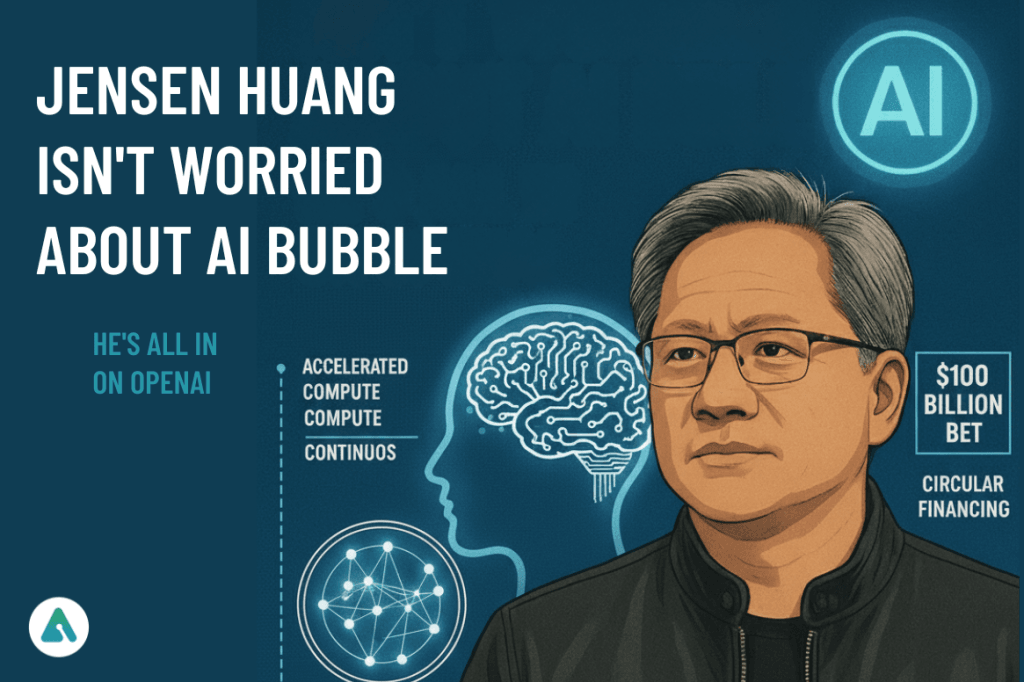
Talk of an AI bubble is everywhere in Silicon Valley. Yet Nvidia CEO Jensen Huang doesn’t seem to care. On a recent podcast with Bill Gurley and Brad Gerstner, Huang said it plainly: OpenAI is on track to become the world’s first “multitrillion-dollar hyperscale company.” While some worry about hype and overvaluation, Huang focuses on the technology that he believes will truly reshape industries.
The Shift From General-Purpose to Accelerated Computing
“General-purpose computing is over,” Huang said. For him, the future is accelerated computing—machines designed to handle AI’s unique demands. Unlike traditional systems that process tasks in bursts, AI runs constantly: reasoning, learning, and producing outputs. Every chatbot prompt, recommendation, or AI-generated video is sucking up GPU cycles in real time.
“The longer you think, the better the answer you get—and thinking requires compute,” Huang explained. This continuous activity, unlike training jobs that happen in short bursts, suggests AI could avoid the boom-and-bust cycles of past tech trends.
It’s not just technical—it’s cultural. AI is moving beyond being a mere assistant. Generative models are becoming co-workers, helping humans manage complex workflows in real time. Huang sees a world where humans and AI collaborate, not compete.
A Bold $100 Billion Bet on OpenAI
Nvidia isn’t just talking—they’re putting their money where their mouth is. The company recently announced a $100 billion investment in OpenAI, funding massive data centers and next-gen AI infrastructure. Analysts call this “circular financing”: Nvidia invests in its customers, who then spend billions on Nvidia GPUs.
“This is one of the smartest investments we can imagine,” Huang said. The scale mirrors OpenAI’s $115 billion funding round, showing just how fast this partnership is moving compared to past tech collaborations.
Still, there’s caution. Deutsche Bank warns that even carefully structured deals could resemble bubbles if growth slows. Nvidia’s stock, critics note, is “priced for perfection,” leaving very little room for error.
Voices of Caution
Not everyone shares Huang’s optimism. OpenAI CEO Sam Altman has warned about the frenzy of cash flowing into AI, while Meta’s Mark Zuckerberg compared today’s investment spree to past bubbles, from railroads to the dot-com era. Analysts also caution that high expectations can amplify AI hallucination risks, leading to errors in generative outputs.
Even Federal Reserve Chair Jerome Powell is paying attention, noting unusually large economic activity in AI. Regulators are watching closely—but Huang remains focused on scaling laws, efficiency, and performance per watt, rather than hype.
AI as a Co-Worker, Not Just a Tool
Huang envisions AI evolving beyond prompts and simple recommendations. Generative models are being integrated into real-time workflows, managing tasks, analyzing data, and assisting humans in decision-making. For him, this is not just a technical leap—it’s an industrial revolution. Nvidia and OpenAI aren’t just participating in AI growth—they’re laying the infrastructure for an entirely new economy, where machines work alongside humans.
Talent and Policy: A Long-Term View
Huang’s perspective extends beyond technology. Talent and policy are critical. On immigration, he called President Trump’s $100,000 H-1B visa fee “a good start” but warned that steep costs could discourage top global talent from contributing to the AI boom. For Huang, strategic planning in human capital and technology is just as important as building the chips and systems themselves.
Beyond the Hype: Huang’s Vision for AI and the Future of Computing
For Jensen Huang, the AI bubble chatter misses the point. This isn’t hype—it’s an opportunity to build infrastructure, scale AI systems, and integrate AI into the real economy. Nvidia isn’t just selling GPUs; it’s powering the foundation of an AI-driven world, where humans and machines collaborate as equals.
Whether AI adoption triggers a market frenzy or a lasting transformation, Huang is betting on the latter. From GPU cycles to global talent, he sees a once-in-a-generation chance to redefine computing, productivity, and industry itself.
Key Takeaways
- Nvidia CEO Jensen Huang predicts OpenAI could become a trillion-dollar company, focusing on long-term AI infrastructure.
- AI workloads are continuous, creating steady GPU demand and avoiding typical tech boom-and-bust cycles.
- Nvidia invests $100B in OpenAI, generating a “circular financing” loop that benefits both companies.
- Experts like Altman, Zuckerberg, and Deutsche Bank caution about bubble risks and AI errors.
- AI is evolving from assistant to co-worker, integrating into real-time workflows across industries.
Visit: AIInsightsNews
