

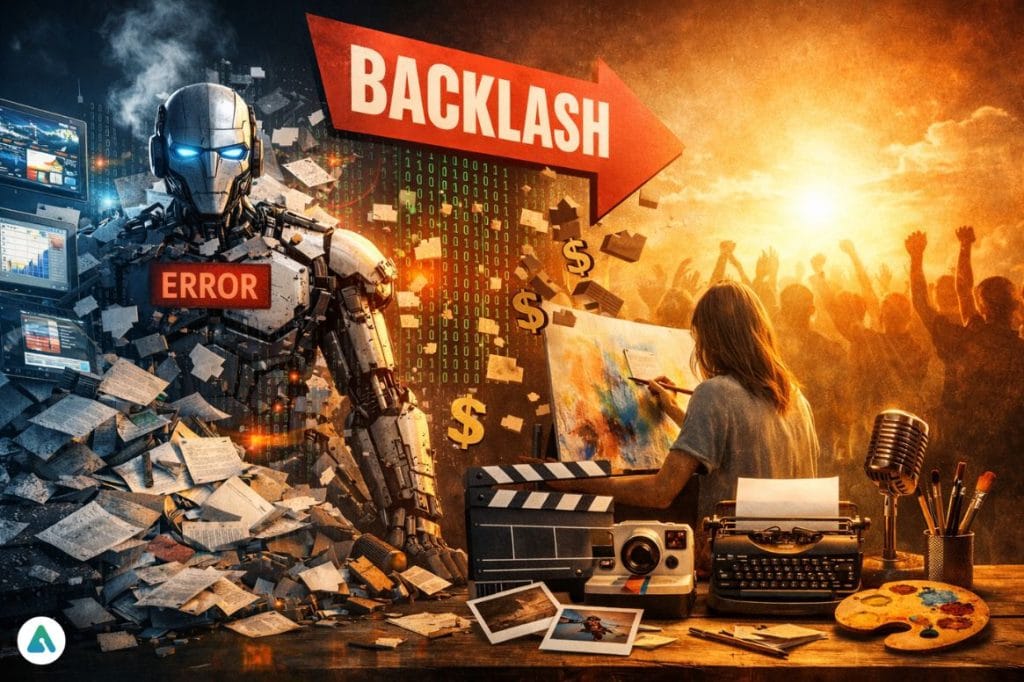
For years, artificial intelligence was marketed as the inevitable engine of progress. Corporate boardrooms praised its efficiency. Venture capitalists poured billions into its promise. Meanwhile, marketers embraced it as a cheap shortcut to creativity.
However, that narrative has now cracked.
Across industries, the very technology once positioned as the centerpiece of the future is confronting an unprecedented anti-AI backlash — a revolt driven not only by technologists or artists, but by everyday consumers and the brands that depend on them. Audiences now label once-celebrated innovation as slop—mechanized, low-quality content that feels hollow, soulless, and untrustworthy.
AI “Slop” Is Everywhere — And People Hate It
According to CNN Business, the anti-AI backlash is rapidly evolving into a broad cultural movement, fueled by growing dissatisfaction with what critics call “AI slop.” The term describes generative content — text, images, and videos — that flood digital platforms with uninspired, boilerplate output lacking depth, originality, or emotional nuance.
Notably, Merriam-Webster even named “slop” its 2025 Word of the Year, underscoring how AI-generated filler now oozes across slide decks, social feeds, news articles, and online listings.
As a result, consumers no longer view AI slop as a novelty. Instead, they see it as a nuisance. Its ubiquity has commodified digital spaces, congesting them with repetitive, hollow material that steadily erodes trust in brands and platforms alike. Where AI was once associated with ingenuity, it is now widely perceived as factory-style content — automation replacing artistry.
Brands Pivot to “Human-Made” as a Strategic Stand
In response to this mounting anti-AI backlash, marketing leaders are recalibrating their strategies. Rather than doubling down on generative tools, many major brands are openly embracing anti-AI positioning by emphasizing human creativity in their campaigns.
Consequently, labels like “human-made” are no longer quaint marketing flourishes. Instead, they have become strategic differentiators, designed to restore audience trust in an era of digital fatigue.
Importantly, this shift is not isolated. Global brands such as Heineken, Aerie, Polaroid, and Cadbury have launched campaigns celebrating the unpredictability and emotional depth of real human creativity — even as competitors continue to churn out AI-generated material. Advertising executives increasingly view authentic imperfection as a premium asset that resonates with consumers tired of AI’s sterile gloss.
For example, Aerie’s high-engagement Instagram posts promoting a no-AI promise have become case studies in audience connection. Similarly, Polaroid’s viral “AI can’t generate sand” campaign succeeded precisely because it mocked the limitations of machine creativity.
The Backlash Isn’t Just Cultural — It’s Economic
Crucially, this shift has economic consequences. Analysts now suggest that 2026 could usher in the era of “100% human” marketing — where brands explicitly market the absence of AI as a value proposition. In effect, marketers are exploring labels similar to organic food certifications, positioning human involvement as a marker of authenticity and trust.
At the same time, consumers aren’t simply expressing nostalgia. Surveys show growing skepticism toward synthetic content, with many people preferring work they believe is directly authored by humans. Research further indicates that this preference is already influencing purchasing decisions and long-term brand loyalty.
Consumer Revolt Meets Strategic Realignment
More broadly, the anti-AI backlash reflects deeper unease with the technology’s pervasive reach. Artists warn of the devaluation of craft. Workers fear automation and job displacement. Meanwhile, regulators face mounting pressure over ethical AI use, misinformation, and intellectual-property disputes (neuron.expert).
One striking example of accelerating public skepticism emerged from marketing itself. A fully AI-generated McDonald’s Netherlands Christmas advertisement, intended to be playful, instead triggered widespread backlash. Viewers criticized the ad as cold, unsettling, and inauthentic, prompting its removal after being labeled “creepy” online.
Taken together, these reactions reveal a central truth: while corporations may still chase efficiency through automation, audiences increasingly associate AI with inauthenticity and social detachment. Brands that ignore this sentiment risk alienating the very consumers they seek to engage.
A New Competitive Landscape: Humans as the Premium Brand
Ultimately, authenticity has become a scarce commodity. Brands that highlight human involvement are not merely resisting automation — they are strategically reclaiming emotional resonance, credibility, and trust. The growing anti-AI backlash is forcing companies to rethink not just how AI tools are used, but why they are used and who they truly serve.
As 2026 approaches, the technology once expected to revolutionize creativity and communication is instead fueling a movement toward human supremacy in storytelling and brand identity. For consumers overwhelmed by synthetic sameness, human-made is no longer nostalgic — it’s revolutionary.
