

Artificial intelligence has gone from a buzzword to a full-blown economic juggernaut. Walk through Wall Street, Silicon Valley, or even Main Street coffee shops, and one topic dominates: AI. Everyone wants in — hedge funds, venture capitalists, tech giants, and even mom-and-pop investors who don’t want to miss “the next internet.”
But behind the headlines of trillion-dollar valuations and billion-dollar deals, a tougher question is surfacing: are we fueling the next industrial revolution, or just inflating the biggest bubble since the dot-com bust?
The Money Flood: Who’s Spending What
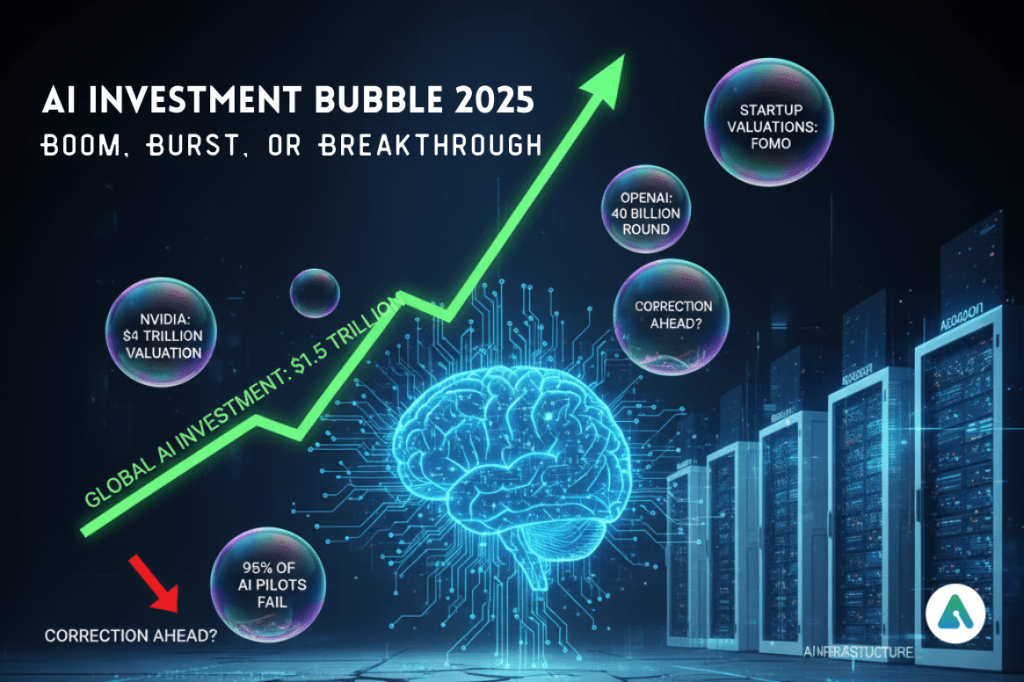
Let’s start with the staggering sums. According to Gartner and other market data, global investment in AI is on track to hit $1.5 trillion in 2025 — a jump of nearly 50% from the $988 billion spent in 2024. The numbers read like Monopoly money:
- Microsoft has already poured more than $13.75 billion into OpenAI, making ChatGPT the poster child of the AI race. That’s nearly the same as what it spent acquiring LinkedIn back in 2016.
- Google (Alphabet) is going all-in with an eye-watering $75 billion in total capital expenditures for 2025, the vast majority of which is earmarked for AI infrastructure, data centers, and Gemini’s future.
- Amazon has completed its $8 billion commitment to Anthropic, tying the safety-first AI startup tightly to AWS.
- Apple — usually quiet during hype cycles — is projected to spend more than $33 billion on R&D in 2025, with a rapidly growing share directed at AI and on-device intelligence.
- Venture capitalists aren’t slowing down either. AI startups have already raised about $118 billion in 2025, surpassing the full-year total for 2024, with mega-deals like OpenAI’s $40 billion round dominating the landscape.
And then there’s the hardware war. Nvidia, the chipmaker behind the GPUs that power these models, has seen its stock rocket. Its valuation tripled to $3 trillion in just 18 months — briefly making it the most valuable company on earth. One top-of-the-line Nvidia GPU costs around $30,000, and training a frontier model can swallow billions of dollars in computing power.
The Cracks Beneath the Hype
Not everyone’s buying the dream. Legendary hedge fund manager David Einhorn calls AI “the most tremendous capital misallocation since the late 1990s.” In plain English: we’re shoveling money into a story that might not deliver profits fast enough to justify the spending.
A sharp Reuters Breakingviews column argued that the bubble is being inflated by what it calls a “trio of dilemmas”:
- Sky-High Costs – Training models requires supercomputers worth billions, and cloud infrastructure costs keep climbing. Some insiders quietly admit it’s becoming a treadmill: keep buying chips, or fall behind.
- Uncertain Demand – Sure, AI can write code, draft emails, and spit out business plans. But will enterprises actually pay billions for these tools at scale? Many companies are experimenting, but few have turned pilots into permanent, profit-driving workflows.
- Regulatory Overhang – From Washington to Brussels to Beijing, regulators are sharpening their knives. Safety, copyright, and data-privacy rules could add compliance costs that eat directly into already thin margins.
The Psychology: FOMO Runs the Show
If this feels like déjà vu, it should. Remember the dot-com boom, when every company slapped “.com” onto its name and saw its stock price skyrocket? Or the crypto boom, where tokens with dog memes hit billion-dollar valuations overnight?
AI has that same energy — except the stakes are bigger. The Guardian summed it up perfectly: investors aren’t just chasing profits, they’re terrified of missing out. Nobody wants to be the fund manager who skipped on “the next internet.” That herd mentality is what keeps pouring gasoline on the fire.
Winners, Losers, and the Messy Middle
- Winners (for now): Nvidia is the undisputed king, selling chips faster than they can produce them. Microsoft’s stock has hit all-time highs, thanks largely to its OpenAI partnership. Google and Amazon are still in the fight.
- Losers: Smaller startups without real business models. Many raised huge rounds in 2023–24, but their burn rates are brutal, and revenues don’t match the hype. Several “AI unicorns” are already rumored to be cutting staff or pivoting products.
- The Messy Middle: Enterprises testing AI but hesitating on full-scale adoption. If businesses don’t flip from testing to paying, the growth narrative could unravel.
The Bigger Picture
AI is no gimmick. It’s diagnosing diseases, designing new drugs, drafting contracts, even generating code that powers apps millions of people use. The technology is real.
But there’s a difference between powerful technology and profitable business models. Right now, the hype is outrunning the bottom line.
The Casino Vibe
Here’s the human way to put it: the AI bubble boom in 2025 feels like being at a casino table where the chips are flying, the crowd is cheering, and nobody’s looking at the clock. Some players will walk away millionaires. Others will leave broke.
History tells us bubbles don’t last forever — but revolutions sometimes survive their bubbles. The internet bubble burst in 2000, but it still gave us Amazon, Google, and Facebook. Maybe AI’s bubble will pop too. The real question is: which companies survive the crash and go on to shape the future?
Visit: AIInsightsNews
