

The Shift from Trial and Error to Predictive Modeling
Rapid prototyping used to run on brute force. Engineers modeled a part, sent it to the printer, and hoped for the best. A thin wall would collapse, an overhang would warp, and someone would tweak the slicer settings and start the whole cycle again. That loop burned machine hours and engineering time in roughly equal measure.
AI software rewrites the front end of that process. Machine learning models analyze a CAD file’s geometry before the printer even warms up, cross-referencing the design against prior print outcomes to flag where thermal stress or gravity is likely to cause failure. The software orients the part for the highest success rate and generates support structures only where the physics actually demands them. Digital twin platforms built on this kind of predictive modeling now cut failed prints by 70 to 90 percent, according to a 2026 analysis of automated design optimization tools — a number that changes the math on how much material and labor teams budget per prototype. Less time gets spent scraping failed prints off the build plate. More time goes toward testing parts that actually work.
Thermal Management and Material Behavior
High-performance industrial materials like PEEK or carbon-fiber-reinforced nylon are notoriously hard to print well. They shrink heavily as they cool, and traditional slicing software applies a single uniform instruction set across the whole build volume — even though a dense base layer cools at a completely different rate than a thin vertical wall.
AI-driven thermal management fixes that mismatch layer by layer. The software models expansion and contraction as the print progresses, then adjusts print-head speed, cooling-fan intensity, and extrusion temperature in real time as the toolhead moves across the part. That prevents residual stress from building up inside the component and warping it off the plate. High-temperature filament spools can run hundreds of dollars each, so predictive thermal modeling isn’t just a quality feature — it protects the material budget by getting the part dimensionally right on the first attempt.
Speeding Up Complex Component Integration
Prototypes rarely stand alone. Most are housings, brackets, or enclosures built to hold other subsystems together, and when an assembly needs tight tolerances for internal electronics, getting the physical fit right the first time matters.
Take a vehicular center console as an example. If an automotive wire harness manufacturer is supplying the electrical backbone, the printed prototype needs exact routing channels and precise connector clearances. Unexpected shrinkage during printing means connectors won’t seat and retention clips snap under stress. AI optimization compensates for that shrinkage by adjusting the G-code geometry before the print starts, so channels come out at the dimensions the design actually called for and heavy-gauge wiring seats without binding. Teams can evaluate the physical layout immediately instead of losing an afternoon to filing down plastic edges by hand.
Physical Validation and Environmental Testing
Functional testing means putting parts through the real conditions they’ll eventually face. Enclosures built for outdoor industrial or marine use have to keep dust and moisture away from sensitive circuit boards, and that’s a harder bar to clear than it sounds.
A sealed sensor housing usually gets paired with a Waterproof Wire Harness to test the whole system’s ingress protection rating. Standard FDM printing is inherently porous — microscopic gaps between printed lines are just a byproduct of how the process lays down material. AI-guided slicers work around this by calculating toolpaths that overlap internal perimeters and increasing the extrusion multiplier on outer shells so the plastic bonds more aggressively. Grooves designed for rubber O-rings come out smooth enough to seal properly. The result is a functionally watertight barrier straight off the machine, ready for the test tank without a secondary coat of sealing epoxy.
Real-Time Error Detection on the Shop Floor
Older 3D printers offer no feedback loop at all. If a print fails overnight, the machine keeps pumping filament into the air until someone walks in the next morning and cancels the job — wasted material, and a production schedule pushed back by a day or more.
Modern AI platforms use onboard cameras and, increasingly, LiDAR to watch the build plate continuously. Computer vision systems running on edge hardware now catch failures like layer adhesion problems, spaghetti prints, and warping with better than 90 percent accuracy, and entry-level setups built around a camera and an open-source monitoring agent can run for under $100. When the system spots a corner lifting off the bed or a support structure cracking, it intervenes — sometimes adjusting bed temperature to save the job, sometimes just halting the machine and pinging the operator’s phone.
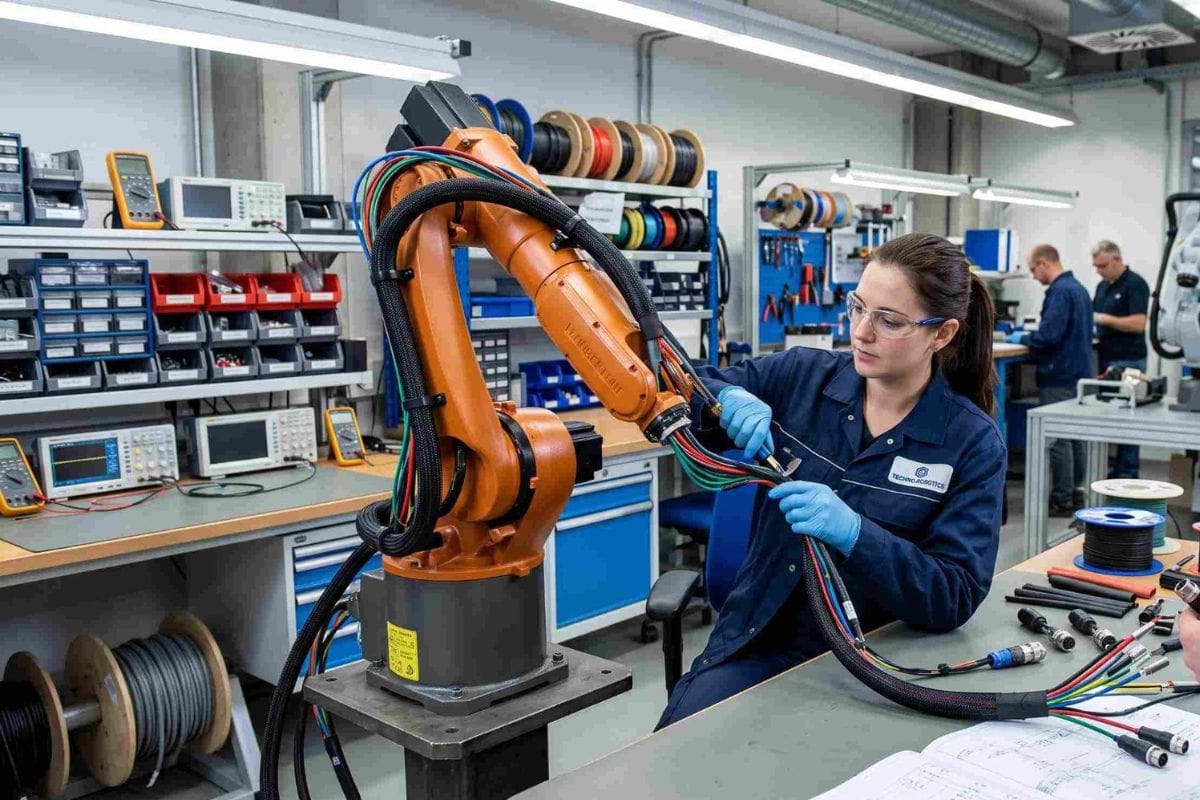
That kind of automated oversight becomes close to mandatory when printing large mechanical assemblies for a robotics cable assembly manufacturer. Internal geometries built to accommodate continuous rotation in robotic joints can take dozens of hours to print, and catching a failure at hour two instead of hour thirty saves the entire weekend’s schedule.
Moving from Prototypes to Bridge Production
The reliability that AI monitoring brings is blurring the line between rapid prototyping and low-volume manufacturing. Push first-time print success above roughly 95 percent and a fleet of printers starts to look less like a prototyping tool and more like a production line — a farm of thirty machines producing the first couple hundred units for a field beta instead of a single proof-of-concept for a client meeting.
That shift changes how companies plan tooling budgets and product launches. Steel injection molds can wait until a product is already in early adopters’ hands. If a customer asks for a tweak to a mounting bracket, the CAD file gets updated and the predictive software works out the new print variables for the next batch — no re-tooling required. It’s worth saying plainly that this isn’t a fix for every use case; regulated industries and safety-critical parts still need documented validation on top of whatever the AI predicts. But for the broad middle of rapid prototyping work, the technology has moved from a fragile design tool to something teams can actually build a manufacturing process around.
Related: AI 3D Printing in 2026: Can Hi3D Turn AI Models Into Printable Objects?
