

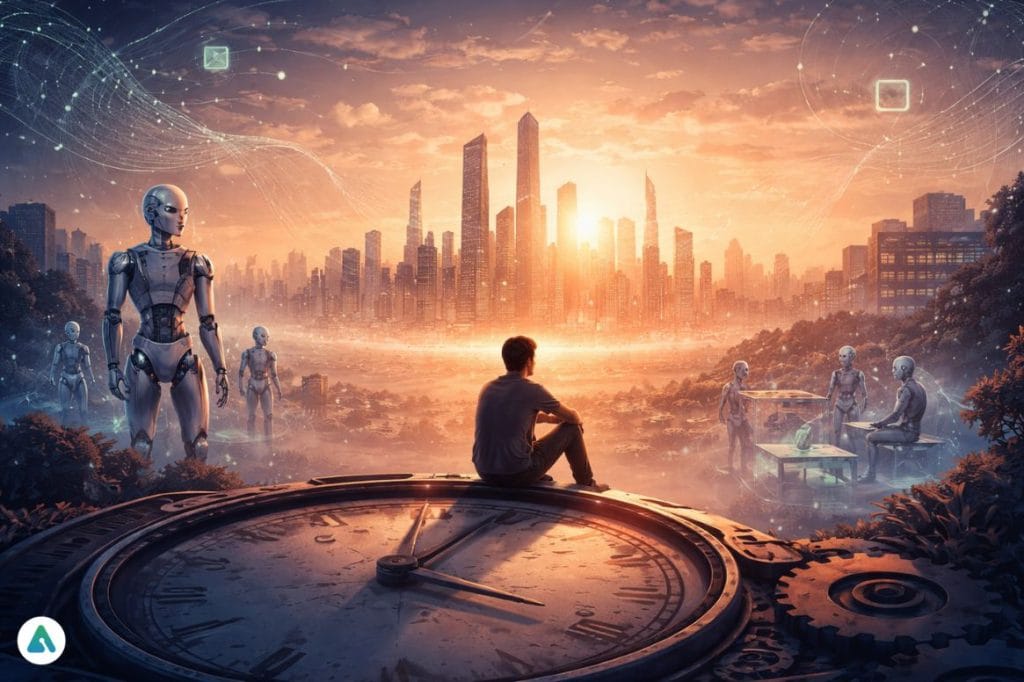
For decades, technology debates have revolved around one question: How many jobs will be lost or created?
Artificial intelligence is forcing a more uncomfortable conversation — what happens when work itself stops being the center of economic life?
The discussion around AI and the future of work is often reduced to automation statistics or job displacement headlines. But beneath those numbers lies a deeper shift. AI is not just changing what we do — it is challenging why work exists at all.
This is not a distant science-fiction scenario. It is a structural transformation already unfolding across industries.
From Automation to Abundance
Previous technological revolutions replaced physical labor or increased speed. AI is different. It targets cognitive work — reasoning, pattern recognition, writing, analysis, and decision-making.
Economists increasingly describe this shift as a move toward AI-driven abundance, where productivity is no longer constrained by human effort. Reports from institutions like the World Economic Forum and OECD suggest AI could automate or augment tasks across more than 40% of current job roles over time.
In theory, this creates enormous wealth.
In practice, abundance without redistribution creates inequality.
The real disruption is not job loss tomorrow — it is the slow erosion of labor’s economic centrality.
The Impact of AI on Jobs Is Uneven — and That’s the Risk
History shows that technology does not affect everyone equally. While AI boosts productivity, the benefits tend to concentrate among system owners, investors, and high-skill workers.
Current AI adoption trends reveal three patterns:
-
Knowledge work is becoming increasingly automated
-
New AI-related roles employ fewer people than the jobs they replace
-
Wages are decoupling from productivity growth
Research from the International Labour Organization (ILO) and McKinsey Global Institute shows that while AI creates new job categories, they often require advanced skills and are geographically concentrated.
This leaves large segments of the workforce facing instability rather than opportunity.
Why Work Is More Than a Paycheck
Most discussions about the impact of AI on jobs focus on income. That framing misses the deeper issue.
Work provides:
-
Identity
-
Social structure
-
Routine and purpose
-
A sense of contribution
In a post-work society, material needs may be met through mechanisms like a universal basic income or AI dividends. But income alone does not replace meaning.
Without new social institutions, reduced reliance on work risks widespread alienation rather than freedom.
This is a cultural challenge — not a technical one.
“AI Will Create New Jobs” Is Only Half the Story
AI indeed creates demand for new roles: system designers, auditors, governance specialists, and ethicists. However, evidence from past technological shifts suggests three limitations:
-
Fewer total jobs are created
-
Jobs require higher education and adaptability
-
Access is uneven across regions and demographics
AI systems do not need mass participation to function. That breaks the traditional social contract: work to earn, earn to belong.
Without deliberate policy intervention, this shift risks creating a permanent class of economically irrelevant workers.
A Political Question Disguised as a Technical One
The future of work under AI is often framed as an engineering challenge. It is not.
It is a political and economic decision shaped by:
-
Ownership of AI systems
-
Taxation of automated productivity
-
Redistribution mechanisms
-
Investment in human-centered roles
Policy papers from organizations like The Brookings Institution, OpenAI policy research, and WEF AI governance initiatives consistently highlight the same conclusion: technology outcomes depend on governance, not inevitability.
The Choice Ahead
AI does not force a world without work.
It makes it possible.
The real question is whether societies:
-
Share AI-generated wealth or concentrate it
-
Redesign the meaning beyond employment or ignore the vacuum
-
Adapt institutions or let inequality harden
A post-work world could be the most humane society ever built — or the most divided.
The technology is already here.
The future depends on the choices we make next.
Related: AI Just Came for the Office: Why White-Collar Jobs Are No Longer Safe
