
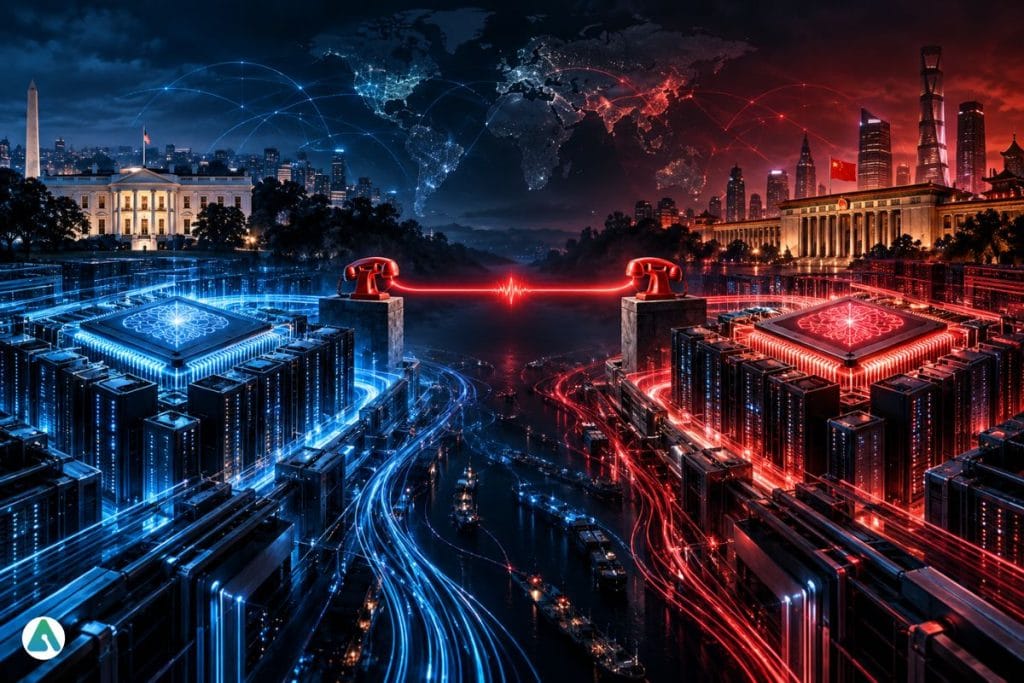
Every arms race eventually gets a red phone. The AI race just got one, but it came before the near-miss, not after.
Today’s White House summit puts AI at the center of the world’s most important relationship. The biggest idea on the table is also the smallest: a direct line for emergencies. That gap between the stakes and the proposal tells you where this race is heading.
The Pitch: Transparency, Not Restraint
Treasury Secretary Scott Bessent laid the groundwork in New York last weekend. He proposed a US-China AI dialogue that would include a notification system for incidents serious enough to threaten national security.
Read the fine print, though. US Trade Representative Jamieson Greer said export controls on advanced AI chips and chip-making equipment were not part of the proposed mechanism.
So the hotline covers what happens when something breaks. It leaves out what actually decides who wins, which is compute.
Insiders aren’t impressed either. Some people familiar with the plan are already dismissing it. China hasn’t publicly accepted the idea, though state media confirmed the talks touched on AI.
Two Leaders, One Shared Goal: Go Faster
Here’s the uncomfortable truth. Trump and Xi disagree on almost everything except the pace.
Trump declared on Sept. 13 that whoever wins AI, wins. He has also claimed on Truth Social that AI could eventually reach as much as 25% of US GDP.
Beijing isn’t slowing down either. Brookings fellow Kyle Chan called a mutual slowdown very unlikely, arguing that both leaders want to accelerate.
Washington’s Odd Split Screen
The timing is awkward for the White House. Public anxiety about AI has spilled into midterm politics.
Trump just announced an “AI Force,” modeled on the Space Force, and plans for an “AI Czar,” while still opposing regulation or any slowdown. The branding points to safety, while the policy still points to speed.
The administration’s own rules show the same pattern. A June executive order asks AI companies to voluntarily work with the government on safety within 30 days before releasing new models, down from an originally planned 90-day review.
The White House puts the burden on the labs themselves. Science adviser Michael Kratsios argued that companies worried about an unsafe model can simply stop it.
The labs send mixed signals of their own. After a former researcher’s public warnings sparked a national debate, Anthropic’s Dario Amodei called for a slowdown and government regulation, and Sam Altman and Elon Musk agreed. Yet none of them has paused their own company’s pace.
Beijing Plays a Different Governance Game
China’s approach looks nothing like Washington’s “stop it yourself” model. Beijing regulates hard and fast at home.
This summer, a new law forced ByteDance and Alibaba to switch off companion features in their chatbots overnight. We covered how China’s AI companion shutdown showed a state that won’t wait for companies to police themselves.
China also sees American AI as a political threat. Its minister of state security warned last week that US AI models could threaten the Communist Party’s rule.
So one country treats safety as a market choice. The other treats it as regime security. A hotline can’t bridge that gap.
The Real Battlefield: Compute
Strip away the diplomacy, and the numbers tell the story. Epoch AI data shows the US holds nearly three-quarters of the world’s AI computing power, while China holds just over 14 percent.
That lead looks solid on paper. But models are converging fast. As we reported earlier this year, the “China is months behind” narrative has largely collapsed as Chinese labs match Western benchmarks with cheaper open-source releases.
Usage data backs this up. On OpenRouter, which ranks models by real-world use, Chinese models dominate the leaderboard.
Export controls also leak. One policy researcher told CNBC that US controls cover physical chips but not remote access to them. A bill to close that gap passed the House in January but hasn’t passed the Senate.
That’s why chips stayed off the hotline agenda. They’re the one lever Washington won’t trade.
Why the CEOs at the State Dinner Matter
Look at the guest list, not the communiqué. Attendees at tonight’s state dinner reportedly include Jeff Bezos, Elon Musk, Sundar Pichai, and Michael Dell. Jensen Huang, Sam Altman, and Tim Cook are also reportedly expected.
That’s a show of strength. It’s also a reminder of who actually builds the technology, and who profits from access to China’s market.
For companies operating across both economies, the real risk is regulatory friction, not a hotline. If you’re weighing that exposure, our look at how AI is reshaping China market entry explains why AI-speed planning still runs into ground-level rules.
Our Take: Talks About Talks Still Count
Don’t expect a breakthrough today. Harvard’s Rana Mitter expects “talks about talks” on AI, and says the missing ingredient in the relationship is trust.
Still, small channels matter. Bessent said the two sides formalized the AI dialogue and agreed to meet again in roughly two months in Shenzhen.
The Cold War hotline didn’t end the arms race. It kept a misunderstanding from turning into a catastrophe. If this AI channel does even that much, it’s worth having.
Just don’t mistake it for brakes. Both drivers still have their feet on the gas
Related: How AI Is Reshaping China Market Entry for Foreign SMEs in 2026
