
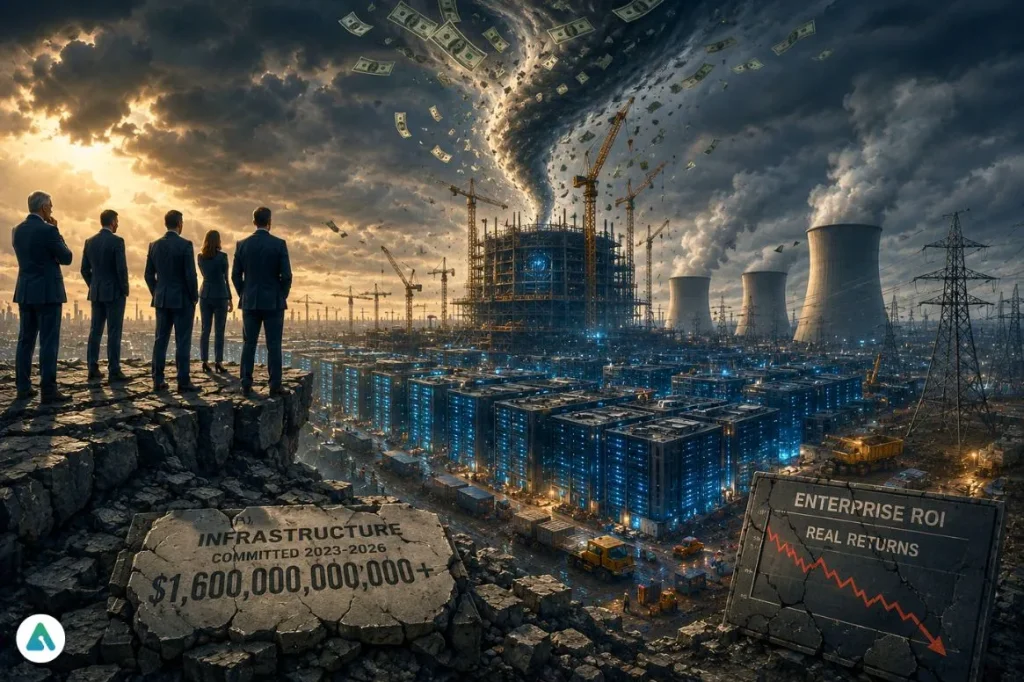
The railroad barons laid track before demand existed. The fiber boom buried cables before the internet caught up. Both were eventually proven right — just not on schedule.
That distinction matters now.
Because the AI boom isn’t short on conviction. It’s short on timing.
A recent analysis from The Guardian highlights the scale: roughly $1.6 trillion is being funneled into AI infrastructure between 2023 and 2026. That figure has become a shorthand for the current cycle. But zoom out, and the number shifts in meaning. According to Goldman Sachs’ longer-range models, annual AI capital expenditure alone could approach $1.6 trillion by 2031, with cumulative spending pushing toward $7 trillion.
In other words, what looks enormous today may just be the front-loaded phase of something much bigger.
Or much earlier than it should be.
The market is no longer diversified — it’s concentrated risk
Strip away the index labels, and the story gets narrow fast.
A small cluster of companies — Microsoft, Alphabet, Amazon, Meta, and Nvidia — is now responsible for an outsized share of equity market performance. Call them “AI-exposed megacaps” if you want. Functionally, it’s one trade.
Jim Bianco of Bianco Research has been blunt about it: markets aren’t pricing incremental adoption anymore. They’re pricing a fully realized AI economy.
That’s a problem, because the income statement hasn’t caught up to the narrative.
The buildout is real. The bottlenecks are physical.
For a while, AI felt like a software story. That phase is over.
The constraints have broken through into the physical world.
- Traditional cloud infrastructure costs hovered around $10 million per megawatt
- Next-generation AI facilities are pushing $15–20 million per MW
- Rack density is jumping from ~15kW to well over 100kW in advanced clusters
This isn’t incremental scaling. It’s a different industrial category.
And the shortages are getting specific.
Not GPUs — transformers.
Not compute — megawatts.
Not storage — cooling systems that can handle sustained thermal loads.
Hyperscalers are now negotiating back-of-the-meter energy deals, including nuclear-linked supply agreements, because grid access alone isn’t enough. In some regions, water usage for cooling has quietly become the gating factor for new data center approvals.
The digital economy has run into the limits of the physical one.
Why spending is accelerating anyway: the agentic shift
If returns look weak today, why is spending still rising?
Because the industry isn’t building for chatbots anymore.
It’s building for what comes next: autonomous, continuously running AI systems — often described as “agentic AI.” These systems don’t wait for prompts. They operate in the background, executing tasks, coordinating workflows, and consuming compute persistently.
That changes the economics.
Internal estimates from multiple industry reports suggest agentic workloads can consume 10x to 100x more compute and energy than standard prompt-response models. Some projections go higher.
From that perspective, the current infrastructure isn’t excessive. It’s preemptive.
The bet is simple: when these systems go mainstream, demand won’t scale linearly. It will spike.
Inside the enterprise: why the ROI still isn’t there
Talk to a CIO instead of a strategist, and the tone shifts quickly.
The issue isn’t whether AI works. It does. The issue is whether it integrates.
Most enterprise environments are still dealing with:
- Fragmented, poorly labeled internal data
- Expensive, brittle API layers
- Security and compliance constraints are slowing deployment
- Customization costs that wipe out scale advantages
A 2026 working paper from the National Bureau of Economic Research captured the mood bluntly: the majority of firms experimenting with LLMs have seen little to no measurable impact on overall productivity.
The tools are useful. They are not yet transformative.
That gap — between capability and deployment — is where the current cycle gets fragile.
The part nobody likes to say out loud: demand is being… assisted
There’s another dynamic here, and it’s subtle but important.
Companies like Microsoft and Google are investing heavily in AI startups — OpenAI, Anthropic, CoreWeave — which then turn around and spend significant portions of that capital on cloud compute.
The money leaves. Then it comes back.
It’s not artificial in the sense of being fake. But it does create a kind of internal velocity that can look like external demand.
Growth, in other words, is partially feeding itself.
That works — until it doesn’t.
Hardware is booming. Software is hesitating.
Market performance tells the story cleanly.
Semiconductors and infrastructure players have seen massive upside since 2023. Meanwhile, the application layer — where AI is supposed to generate real business value — has lagged.
That divergence isn’t random.
It reflects conviction in supply, and uncertainty in demand.
The “picks and shovels” are selling. The gold is still theoretical.
The timing mismatch no one can model cleanly
Here’s the core tension.
Markets price innovation on a 2–3 year horizon. Infrastructure pays back on a 5–10 year cycle.
That gap is survivable — if capital stays patient.
Goldman Sachs has framed 2026 as the inflection point: the transition from infrastructure buildout to revenue realization. If that shift doesn’t start to show up in earnings, the narrative has to adjust.
And markets are not good at gradual adjustments.
So what happens if revenue doesn’t show up on time?
Probably nothing dramatic at first.
Then something very dramatic.
Because the technology itself isn’t the weak point. Model capability is improving rapidly, with performance gains outpacing historical benchmarks like Moore’s Law.
The risk sits elsewhere — in expectations.
This entire cycle is built on the assumption that demand will arrive before patience runs out.
Maybe it does.
But if there’s one consistent pattern across past infrastructure booms, it’s this:
The system usually works in the end.
The investors don’t always make it to the end with it.
Related: AI Was Supposed to Cut Prices. Instead, It’s Driving a New Wave of Inflation
