
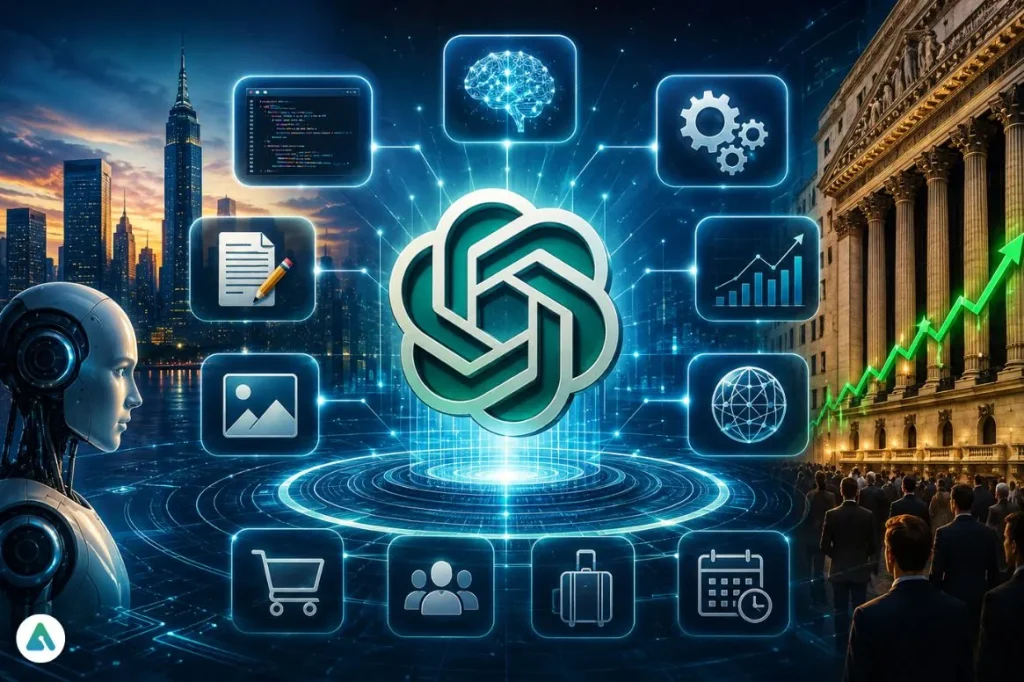
The transformation of ChatGPT is no longer being framed as a product update. It is increasingly being interpreted as a structural shift toward a platform business — one designed for enterprise scale, agentic automation, and ultimately, public-market readiness.
According to reporting from Reuters and the Financial Times, OpenAI is preparing a major redesign that turns ChatGPT into a unified “superapp” layer combining coding, productivity workflows, and third-party integrations. The rollout is expected in the coming weeks.
But the real story is not the interface.
It is what the interface is being built to justify.
From Chatbot to Execution Layer
The new direction places greater emphasis on tools like Codex, alongside deeper integrations with external platforms such as design, travel, and productivity services.
This shift reflects a broader industry transition toward agentic systems — AI models that do not simply respond, but execute multi-step tasks across software environments.
In practice, the goal is simple:
Not just answers. Actions.
Not just prompts. Workflows.
Not just chat. Execution.
And that shift fundamentally changes what ChatGPT is.
The Real Strategy: Consolidation, Not Expansion
At the surface level, this looks like feature expansion.
In reality, it is consolidation.
OpenAI is gradually merging its product surface into a single environment where coding, writing, research, and automation coexist inside one interface.
That matters because fragmentation is the enemy of platform economics.
Every additional tool integrated into ChatGPT reduces user exit points — and increases system dependency.
This is the first signal of a broader ambition: turning ChatGPT into an operating layer for digital work.
The Enterprise Gravity Problem
The shift toward enterprise is no longer optional.
Consumer subscriptions — even at massive scale — do not produce the kind of predictable revenue Wall Street rewards at IPO scale.
Enterprise customers do.
That is why OpenAI’s business mix is quietly moving toward higher-value organizational deployments across software engineering, knowledge work, and internal automation systems.
This is also where pricing power begins to matter more than user growth.
And where platform lock-in becomes the defining metric.
The Microsoft Tension Beneath the Surface
The most important competitive dynamic is not external.
It is structural.
Microsoft is simultaneously OpenAI’s largest partner and one of its most direct enterprise competitors through Copilot.
Both companies are converging on the same target:
- AI integrated into workflows
- AI embedded inside productivity stacks
- AI as the default interface for enterprise software
This creates an unusual dynamic: shared infrastructure, competing endpoints.
The question is no longer who has the best model.
It is who owns the user’s workflow layer.
Why “Superapp” Is a Financial Narrative, Not Just a Product Term
The “superapp” framing is not simply descriptive. It is structural messaging aimed at redefining how investors value the company.
A chatbot company trades on usage.
A platform company trades on dependency.
A workflow OS trades on retention, integration depth, and switching costs.
That distinction matters far more than feature lists.
It is also why the IPO narrative increasingly depends on repositioning ChatGPT from a consumer tool into an enterprise infrastructure layer.
Competitive Pressure: Anthropic and the Enterprise Split
Competition is accelerating on the enterprise front.
Anthropic, through its assistant Claude, has been steadily gaining traction in knowledge-heavy industries such as legal analysis, healthcare documentation, and financial reasoning workflows.
Its advantage is not scale — it is focus.
While OpenAI expands horizontally into a unified platform, Anthropic is positioning itself vertically inside high-value enterprise tasks.
This creates a strategic split in the market:
- Platform generalists vs domain specialists
Both models can win — but in different segments.
The Structural Question Behind the IPO Narrative
OpenAI is widely expected to move toward a public listing in the coming years, though timing remains unconfirmed.
But the more important shift is not the IPO itself.
It is what must exist before an IPO becomes viable:
- predictable enterprise revenue
- reduced product fragmentation
- Higher retention through workflow integration
- and a clear platform identity
The superapp strategy aligns directly with those requirements.
Whether intentional or not, it creates the conditions investors typically associate with large-scale software valuations — similar in structure (not function) to companies like Salesforce or Microsoft.
Conclusion: The Platform Transition Has Already Started
OpenAI’s evolution of ChatGPT is not simply a product redesign.
It is a transition from conversational AI to execution infrastructure.
The chatbot era did not end abruptly.
It expanded — and then folded into something larger.
A system that no longer just responds to users, but increasingly participates in their workflows.
And that shift, more than any single feature, is what defines the next phase of the AI economy.
Related: AI Agent vs Chatbot: Don’t Buy the Wrong AI in 2026
