Is Gemini Better Than ChatGPT? 2026 Comparison, Benchmarks & Pricing
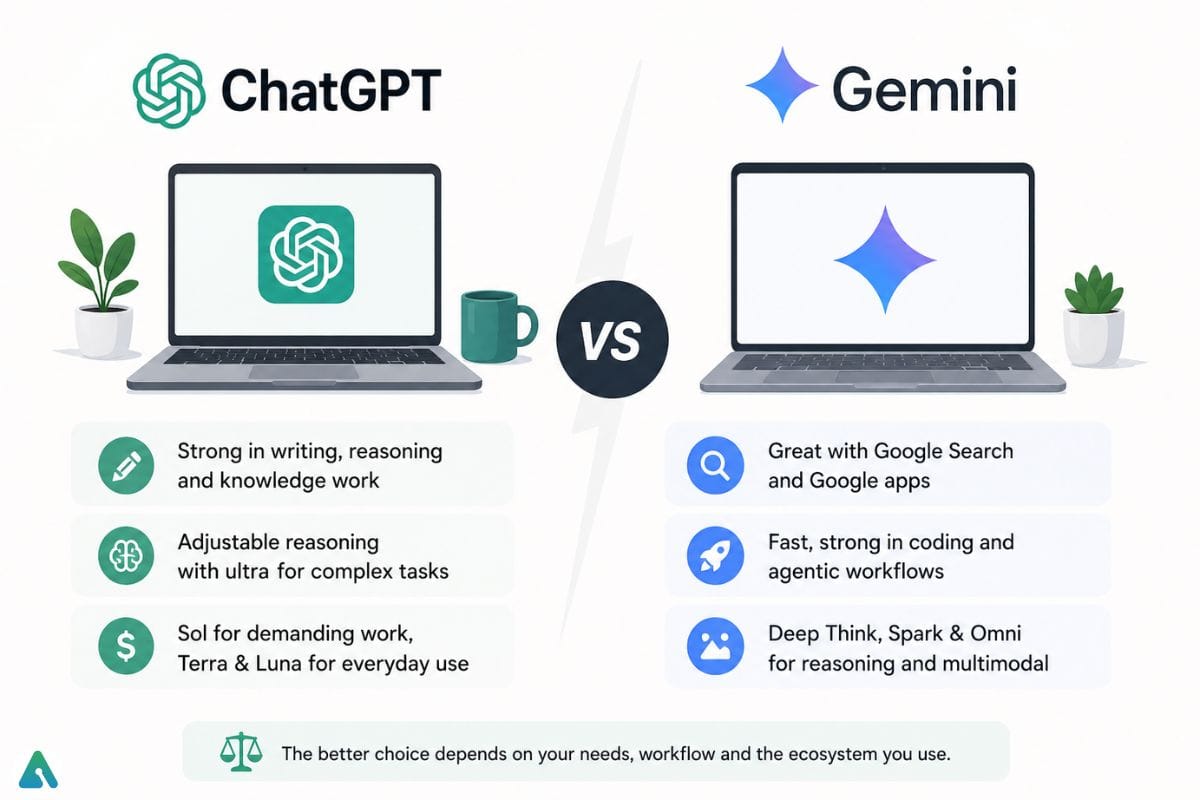
No single winner exists in 2026. ChatGPT is better overall for writing, coding, and agentic workflows; Gemini is better for Google Workspace, native video/audio understanding, and very large-context tasks. For most users without a strong ecosystem preference, ChatGPT is the recommended default. Choose Gemini instead if your work already revolves around Gmail, Docs, Drive, Android, or Google’s AI ecosystem.
GPT-5.6 Sol leads independent reasoning and coding-agent benchmarks.
Gemini leads native video/audio understanding, Workspace access, and per-token pricing on several tiers.
Both now offer computer-use automation — but only at the developer/API level for Gemini right now. See the section below for why that distinction matters.
Best for: writers, developers, Google Workspace users, students, and businesses all get different answers here — jump to the section that matches you using the table of contents above.
Is Gemini Better Than ChatGPT? (Quick Answer)
Gemini wins for: Google Workspace integration, native multimodal input, and web-grounded research.
ChatGPT wins for: coding-agent work, general-purpose writing, and desktop automation through Codex and computer use.
Your workflow decides this more than any single benchmark score. If you’re weighing more than two options, Claude vs. ChatGPT and Grok vs. ChatGPT cover the same evaluation for those pairs.
Overall Scorecard
Category
Winner
Why
General AI assistant
ChatGPT
Stronger all-round workflow
Writing
ChatGPT
Better long-form consistency
Coding
ChatGPT
Leads the top coding-agent index; has Codex
SEO/content production
ChatGPT
More consistent structured output
Research
Gemini
Deep Research + native search grounding
Long documents
Gemini
Larger stated context window
Google Workspace
Gemini
Native Gmail, Docs, Drive integration
Multimodal (video/audio)
Gemini
Native understanding in the base model
Computer use (consumer app)
ChatGPT
More mature rollout today
API cost
Depends
Model and workload decide it
Students
Depends
Ecosystem fit vs. writing/tutoring needs
Business
Depends
Existing infrastructure matters most
Overall winner: ChatGPT — narrowly, and only for users without a strong Google ecosystem preference. Swap that preference in, and Gemini becomes the better day-to-day pick despite trailing on benchmarks.
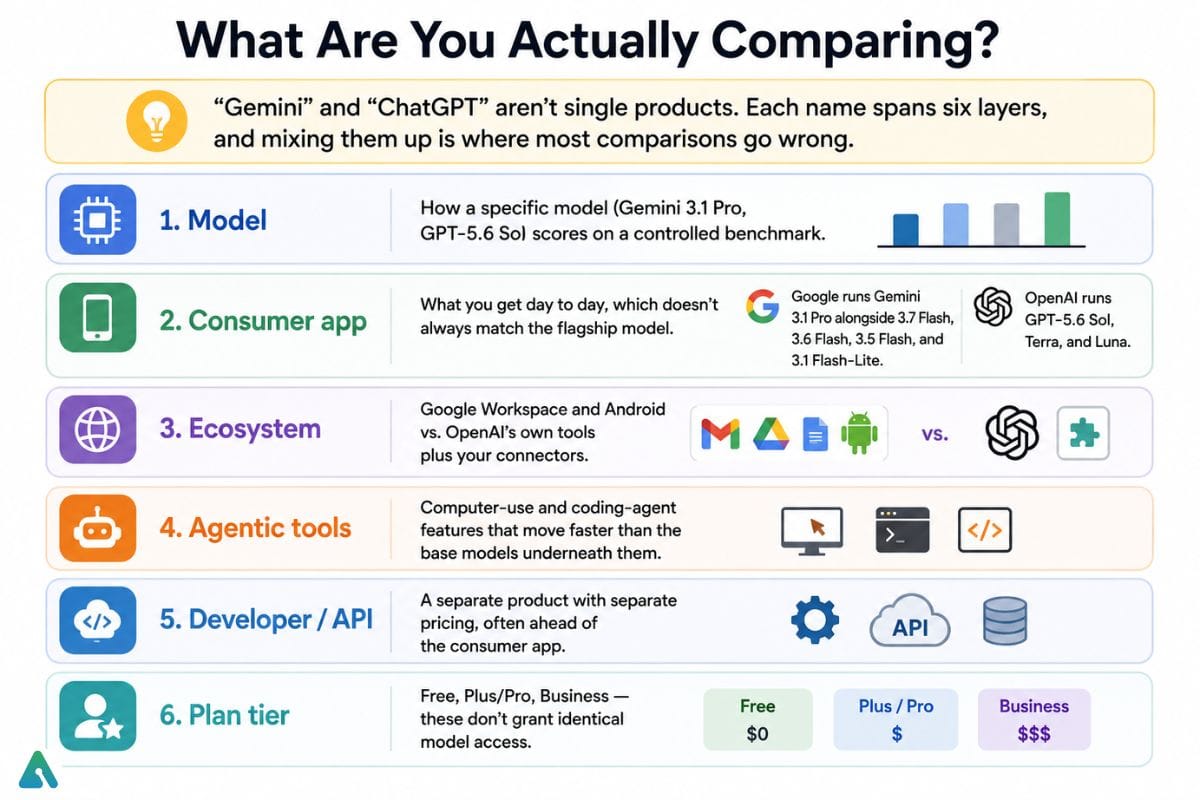
“Gemini” and “ChatGPT” aren’t single products. Each name spans six layers, and mixing them up is where most comparisons go wrong.
Model — how a specific model (Gemini 3.1 Pro, GPT-5.6 Sol) scores on a controlled benchmark.
Consumer app — what you get day-to-day, which doesn’t always match the flagship model. Google runs Gemini 3.1 Pro alongside 3.7 Flash, 3.6 Flash, 3.5 Flash, and 3.1 Flash-Lite. OpenAI runs GPT-5.6 Sol, Terra, and Luna.
Ecosystem — Google Workspace and Android vs. OpenAI’s own tools plus your connectors.
Agentic tools — computer-use and coding-agent features that move faster than the base models underneath them.
Developer/API — a separate product with separate pricing, often ahead of the consumer app.
Plan tier — Free, Plus/Pro, Business — these don’t grant identical model access.
From here on, this article names the specific model, product, or plan behind each claim instead of saying “Gemini” or “ChatGPT” as if each were one thing.
Which AI Wins on Independent Benchmarks?
GPT-5.6 Sol outscores Gemini 3.1 Pro Preview on the Artificial Analysis Intelligence Index at every reasoning-effort setting tested, but the exact gap moves depending on which Sol effort level you compare it to — don’t treat any single pair of numbers as fixed.
Benchmark
GPT-5.6 Sol
Gemini 3.1 Pro Preview
Winner
Intelligence Index (Sol “high” effort)
57
48
GPT-5.6 Sol
Intelligence Index (Sol “max” effort)
59
46
GPT-5.6 Sol
Coding Agent Index
Leads
Competitive
GPT-5.6 Sol
Output speed/latency
Slower
Faster
Gemini
Note the two Gemini scores above (46 and 48) come from two different Artificial Analysis comparison pages, benchmarked against two different Sol reasoning-effort tiers — that’s Artificial Analysis’s own published data, not a typo, and it’s a useful illustration of why “the score” for either model isn’t a single fixed number. Earlier in 2026, Gemini 3.1 Pro briefly led the same index outright.
Benchmark scores aren’t neutral head-to-head evidence. They depend on the reasoning-effort setting used, the harness, the tool access granted, and the exact evaluation suite — Artificial Analysis’s own index mixes nine different tests, from Terminal-Bench to GPQA Diamond and Humanity’s Last Exam.
A benchmark winner isn’t automatically the better product for your task: it tells you about model capability, not about whether that model saves you more time inside Gmail, GitHub, or your company’s existing workflow. Claude models have also placed at or near the top of the same index during 2026 — this isn’t a two-model race; it’s the two most-searched options.
Why the winner keeps changing
Artificial Analysis’s own Intelligence Index led with Gemini 3.1 Pro at points earlier in 2026, before GPT-5.6’s release moved OpenAI ahead. Six labs now score above 50 on the index, up from two in early June 2026, and rankings have reshuffled with nearly every major release since. The real question isn’t “which company has the smartest model this week” — it’s which AI fits your workflow right now, because that answer changes less often than the leaderboard does.
Which AI Wins for Coding?
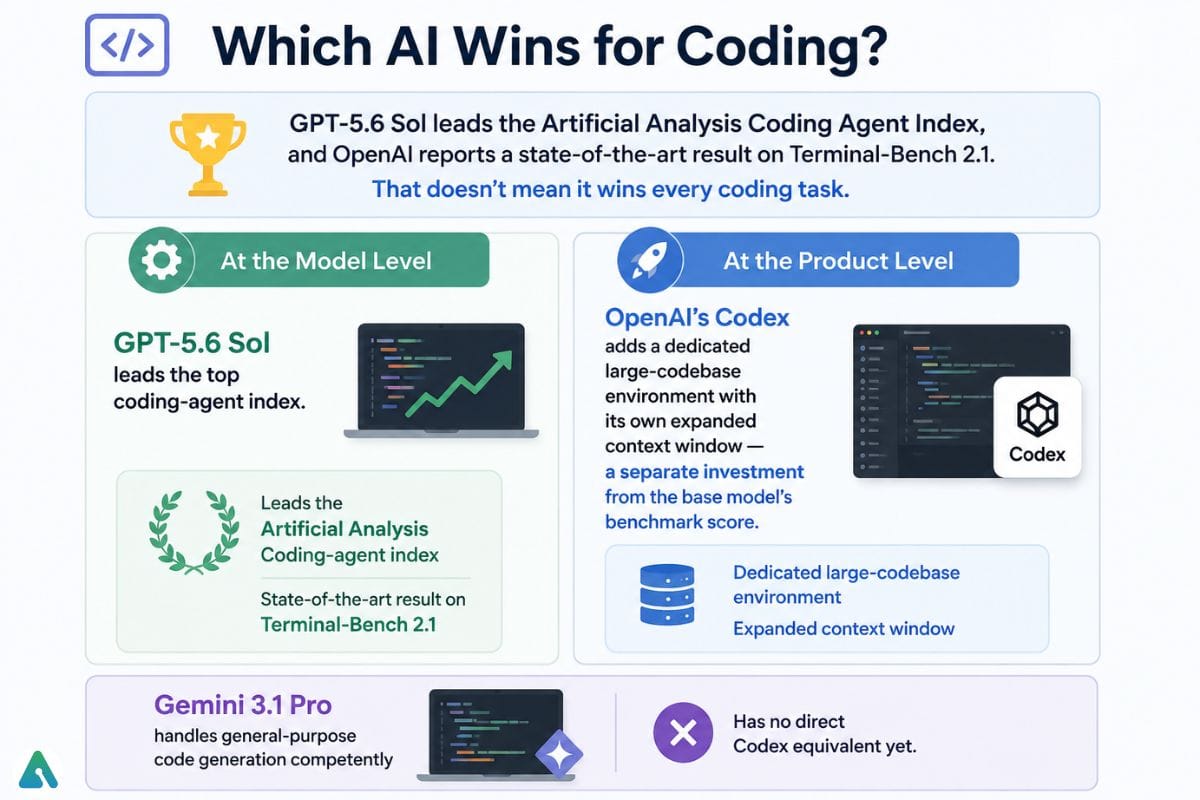
GPT-5.6 Sol leads the Artificial Analysis Coding Agent Index, and OpenAI reports a state-of-the-art result on Terminal-Bench 2.1. That doesn’t mean it wins every coding task.
At the model level, GPT-5.6 Sol leads the top coding-agent index. At the product level, OpenAI’s Codex adds a dedicated large-codebase environment with its own expanded context window — a separate investment from the base model’s benchmark score. Gemini 3.1 Pro handles general-purpose code generation competently but has no direct Codex equivalent yet.
ChatGPT vs. Gemini for SEO and Content Work
ChatGPT tends to win for structured content production; Gemini tends to win for live-search-anchored research.
For content briefs, meta titles, schema generation, and controlled formatting, ChatGPT’s more consistent output style holds up better across a production workflow. For SEO tasks anchored in current information — competitor analysis, SERP checks, entity research — Gemini’s search-grounded answers pull an advantage from Google’s own index. Neither model replaces dedicated SEO tools or real ranking data; both are drafting and research aids, not a Search Console substitute.
Winner for SEO content production: ChatGPT
Winner for live search and Google-ecosystem research: Gemini
Which AI Writes Better?
Reviewers through 2026 generally describe ChatGPT’s output as more consistent across long, multi-turn drafts. Gemini competes closely on shorter, single-pass writing, especially pulling from Google Docs or Drive.
This is a qualitative pattern from hands-on reviewer testing, not a benchmark score — hold it loosely. It’s also the claim in this article most likely to flip with either company’s next release.
Which AI Wins for Research?
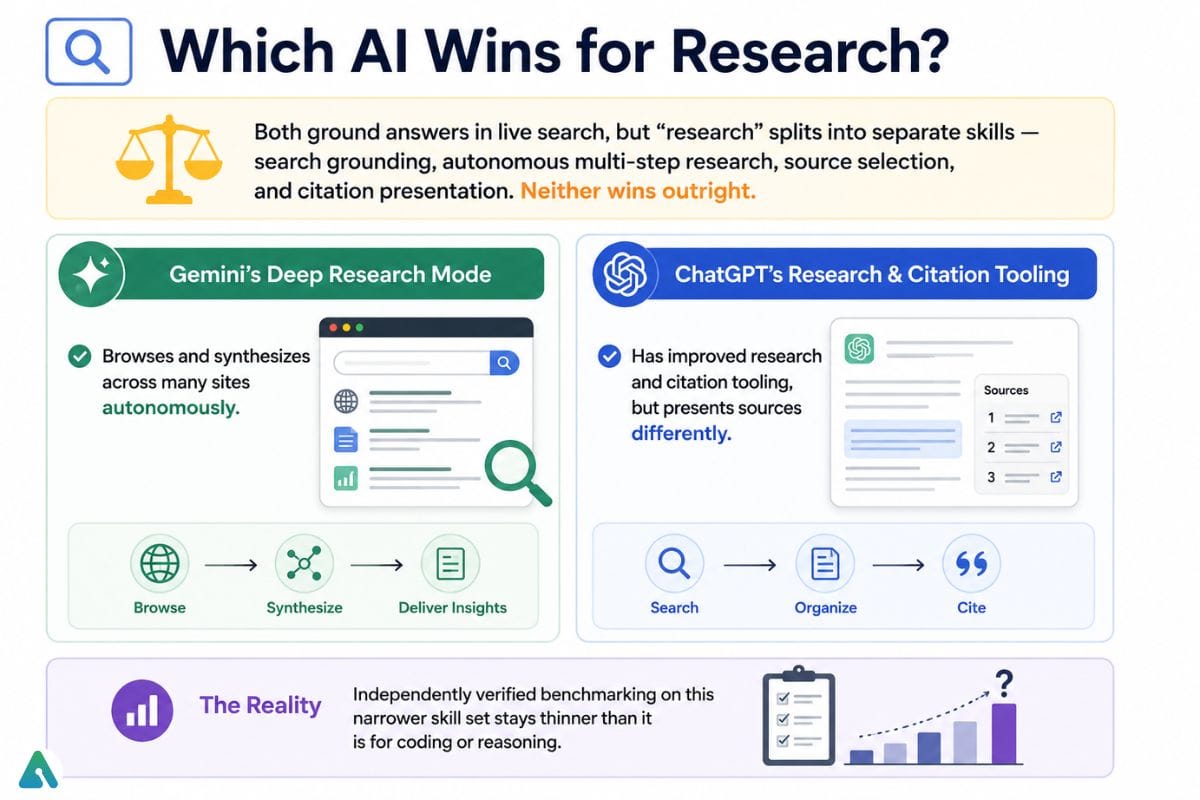
Both ground answers in live search, but “research” splits into separate skills — search grounding, autonomous multi-step research, source selection, and citation presentation. Neither wins outright.
Gemini’s Deep Research mode browses and synthesizes across many sites autonomously.
ChatGPT’s research and citation tooling has improved but presents sources differently.
Independently verified benchmarking on this narrower skill set stays thinner than it is for coding or reasoning.
Which AI Handles Long Documents Better? (Context Window ≠ Recall)
Gemini 3.1 Pro officially supports a 1,048,576-token input window. ChatGPT’s limit depends on the specific model and product surface, so check the current number for whichever version you’re using.
Here’s the part most comparisons skip: context window size doesn’t equal retrieval quality, reasoning quality, or recall. A model can accept a million tokens and still lose track of details buried in the middle of that input. Independent “needle in a haystack” testing and user reports on both Gemini and GPT-class models describe accuracy dropping well before the stated maximum — commonly somewhere past a few hundred thousand tokens, depending on the task and how the prompt is structured.
A bigger number on a spec sheet tells you what a model can accept, not how well it reasons across all of it. If very large or highly structured documents matter to your workflow, test retrieval accuracy at the token count you actually need rather than trusting the headline figure. What tokens actually measure in AI models goes into this in more depth.
Which AI Has Better Multimodal Capabilities?
Gemini understands video and audio natively inside the base model — no tool-switching required. Google’s documentation confirms text, image, video, audio, and PDF input support in Gemini 3.1 Pro.
That’s a separate claim from video generation: Google’s Veo model generates video, while Gemini’s reasoning model understands it — Gemini’s Omni Flash video-editing tools cover the generation side. On the OpenAI side, don’t assume the video stack has settled into a stable form; Sora’s shutdown and pivot are worth checking for the current status. ChatGPT’s multimodal handling covers image, audio, and vision competently but hasn’t matched Gemini’s native video reasoning.
Which AI Has Better Computer Use?
Both support computer-use workflows now — implementation and maturity separate them, not availability. Google’s Gemini API documentation confirms computer-use support across browser, mobile, and desktop environments, built natively into Gemini 3.5 Flash since June 2026. OpenAI has invested longer in this space through ChatGPT and Codex.
The developer/consumer split matters more here than anywhere else in this article:
API/developer level: Google’s computer-use tool has been generally available since June 2026 and runs inenterprise deployments today.
Consumer app level: independent reporting from TestingCatalog shows Google was still testing computer-use inside the Gemini app in limited form, with traces spotted in mid-August 2026. A broader rollout looks likely but isn’t confirmed.
ChatGPT’s consumer tooling has reached more users for longer and generally runs more smoothly today.
A third player handles this differently: Claude’s computer-use agent uses a separate implementation worth comparing against both.
Bottom line: developers get real computer-use options on both platforms today. Everyday consumer users get a more finished experience from ChatGPT right now, while Gemini’s consumer rollout catches up.
Which AI Wins for Google Workspace Users?
Gemini wins decisively if your work lives in Gmail, Docs, Drive, or Android. It reads and acts on that content natively. ChatGPT needs manual uploads or third-party connectors to do the same.
Google owns both the assistant and the services it works across, so Gemini’s Workspace access is a design feature, not an add-on. A model can score lower on reasoning tests and still save more time for someone who lives in Gmail and Docs all day — that’s an ecosystem advantage, not a benchmark one. ChatGPT’s access to the same data depends on whichever connectors your account currently supports.
Which AI Handles Privacy and Work Data Better?
Gemini’s Workspace integration gives it access to more of your personal data by design, which raises the stakes on permission review. ChatGPT’s memory, custom Projects, and computer-use features create a different risk — a model operating your desktop directly. Both companies publish policies on how they process, retain, and review conversations, and the exact rules differ by product and account type. Check each company’s current privacy documentation directly rather than trusting a summary.
Consumer data use: both companies let you opt out of training use in the consumer apps; defaults have changed more than once in 2026.
Business/enterprise accounts: Workspace and ChatGPT Enterprise/Business both offer stronger retention and admin controls than free tiers — verify these directly if you handle client or company data.
Connected accounts: Gemini’s risk surface stays broader by default because it reads your Google account data; ChatGPT’s depends on which connectors you enable.
Agentic risk: a model operating your desktop unsupervised can make a costly mistake faster than a text-only model can.
Which AI Is Better for Students?
It depends on whether you already use Google Classroom and Workspace. Gemini removes friction there. For iterative writing help and coding assignments, ChatGPT’s tone control and dedicated tools tend to fit better.
Gemini’s native Drive access saves real steps for research built from PDFs and lecture notes already stored there. ChatGPT tends to come up more often for draft-and-revise writing and debugging-heavy coursework — though this comes from available reviewer commentary, not a systematic study, so treat it as directional. Cost runs close to a wash at the free and $20/month tiers, so ecosystem fit should decide it, not price.
Which AI Is Better for Business?
Google Workspace shops get more from Gemini’s native integration. Microsoft or independent-tool shops generally get more value from ChatGPT’s broader connector ecosystem and agentic tooling.
Compare admin controls, data-retention policy, single sign-on support, and compliance certifications on the business tier — not the consumer plan. Verify three things directly with the vendor before signing:
Current data-retention terms
Audit-log availability
Compliance certifications relevant to your industry
Which AI Is Cheaper?
The mainstream tier costs almost the same — ChatGPT Plus at $20/month, Google AI Pro at $19.99/month, as of August 2026. Prices below are U.S. list prices excluding tax; free and light tiers run a smaller model than the flagship, not Gemini 3.1 Pro or GPT-5.6 Sol.
Neither free tier gives you the flagship model, so treat this as a trial rather than a real decision. Gemini’s free tier includes Workspace access that ChatGPT’s free tier can’t match without a connector. ChatGPT’s free tier gives a smoother writing and coding experience for casual, everyday use.
If you’re choosing between the two free tiers specifically — rather than the paid flagships — pick based on whether you need Gmail/Docs/Drive access (Gemini) or general writing and coding help (ChatGPT).
API (Developer) Pricing
Keep consumer subscriptions and API pricing separate — they run on different rate cards.
GPT-5.6 Sol: $4 input / $20 output per million tokens, a promotional rate OpenAI confirms runs at least through November 21, 2026, down from a $5/$30 standard rate.
Terra: $2/$12 per million tokens. Luna: $0.20/$1.20.
Gemini 3.1 Pro: roughly $2/$12 per million tokens under 200,000 tokens of input, $4/$18 above that threshold, per Google’s developer pricing documentation.
Prompt caching changes the real bill.
OpenAI’s cache-read discount cuts roughly 90% off the input rate for repeated prompt prefixes, while cache writes cost about 1.25x the standard input rate. Gemini’s implicit context caching offers a comparable discount on repeated long-document calls. For high-volume agentic apps that reuse the same system prompt or document context across many calls, caching — not the headline per-token rate — usually decides the real monthly cost. Model the exact input/output mix and cache-hit rate for your workload before assuming either platform is cheaper.
What Gemini Does Better
Native Google Workspace access (Gmail, Docs, Drive)
Native video and audio understanding
Long-context input (1M+ tokens)
Search-grounded, current-events answers
Per-token API pricing on several tiers
What ChatGPT Does Better
Coding-agent benchmarks and dedicated tooling (Codex)
Consistency in long-form writing
Consumer-ready computer-use and desktop automation
Don’t pick Gemini just because it has a bigger context window, Google integration, one benchmark win, or a lower price on one API tier — check whether that specific advantage applies to your actual task.
Don’t pick ChatGPT just because it wins a benchmark, everyone recommends it, or you’re already familiar with it — familiarity isn’t the same as fit.
Match the tool to the workflow layer (model, app, or API) that actually matters for what you’re doing.
Who Should Choose Gemini?
You live inside Google Workspace day to day
You work with long documents, large codebases, or video/audio content
You want current-events answers grounded in live search
You run a high-volume, multimodal API workload and want to optimize spend
Who Should Choose ChatGPT?
You do agentic or terminal-based software development regularly
You want the most consistently polished long-form writing
You want a more mature computer-use and desktop-automation experience today
You want broad third-party connector support without needing Google’s ecosystem
Should You Use Both?
If different tasks in your work genuinely favor different tools, yes — coding-heavy work plus long-document or multimodal research is a common case where using both makes sense. It also buys redundancy if one product changes or degrades unexpectedly. Try the free tier of both for a week with your actual work before paying for either; that tells you more than any benchmark score. Getting comfortable with multiple AI tools can also make it easier to choose the right one for each task. For those looking to develop these practical skills in a more structured way, Coursiv offers guided learning focused on using AI tools effectively in everyday work.
Should You Choose Gemini or ChatGPT? (Decision Tree)
Do you live inside Google Workspace day to day? → Yes: Gemini. → No: continue.
Do you primarily code or run AI agents? → Yes: ChatGPT. → No: continue.
Do you work with huge documents, video, or audio? → Yes: Gemini. → No: continue.
Do you mainly write or edit content? → Yes: ChatGPT. → No: continue.
Want the broadest general-purpose experience with no strong preference either way? → ChatGPT.
What Should You Watch Out For?
Hallucination risk exists on both sides. Verify specific numbers, quotes, or citations from either tool before you rely on them.
Default models change without notice. Both companies swapped which model powers their free tier multiple times in 2026.
Data access and permissions differ by design. Check your own account settings rather than trusting either company’s defaults.
Agentic features carry real operational risk. Test computer-use or agent features in a low-stakes environment before trusting them with anything sensitive.
Frequently Asked Questions
Q. Is Gemini free to use?
Yes. Both Gemini and ChatGPT offer free tiers with usage limits on their strongest models. Full flagship access generally requires a paid plan.
Q. Is Gemini better than ChatGPT in 2026?
It depends on the model and task. Independent benchmarks currently favor OpenAI’s flagship on reasoning and coding-agent scores. Gemini leads on speed, cost per token on several tiers, and native video/audio understanding.
Q. Does ChatGPT have computer use?
Yes, and it’s currently more mature at the consumer level than Gemini’s. ChatGPT’s computer-use and agentic tooling has reached more users for longer through the ChatGPT app and Codex.
Q. Does Gemini have computer use like ChatGPT?
Yes, at the API/developer level — Google’s documentation confirms support across browser, mobile, and desktop environments, built into Gemini 3.5 Flash since mid-2026. In the consumer Gemini app, computer use remained in limited testing as of mid-August 2026.
Q. Gemini vs. ChatGPT — which has the larger context window?
Gemini 3.1 Pro officially supports roughly 1 million tokens of input. ChatGPT’s limit varies by model and product surface. A larger number doesn’t guarantee better recall — see the context-window section above.
Q. Which is cheaper for API use?
Gemini 3.1 Pro runs roughly $2/$12 per million tokens under 200K tokens; GPT-5.6 Sol runs $4/$20 on its current promotional rate. Prompt caching can change this significantly depending on your workload — model your actual input/output mix before deciding.
Q. Can Gemini use ChatGPT’s features, or vice versa?
No — they’re separate products from separate companies with no shared feature access. Some third-party tools let you route between multiple AI APIs, but that’s a developer-side integration, not a native feature of either product.
Q. Can I use Gemini and ChatGPT together?
Yes. For genuinely different needs — coding-heavy work plus long-document or multimodal research, for example — using both makes sense, since their strengths differ rather than one being a strictly worse version of the other.
Q. Can ChatGPT use Google Drive?
Not by default. Access depends on whichever connectors are available to your ChatGPT account, which is narrower and more variable than Gemini’s native Drive integration.
Q. Which is better for privacy?
Neither wins categorically. Gemini’s risk surface runs broader by design because of Workspace integration; ChatGPT’s depends on which connectors and agentic features you enable. Review each platform’s current privacy settings for your account type.
Final Verdict
ChatGPT is currently the stronger general-purpose choice for coding, agentic tooling, and polished writing if you have no strong ecosystem preference. Gemini is the more useful day-to-day product if your work already lives inside Google, even in categories where benchmarks favor OpenAI, because the integration removes friction no benchmark measures.
Both companies changed enough within 2026 alone to make this verdict a snapshot, not a guarantee. Weigh model capability, ecosystem fit, and price against how you actually work — not against a leaderboard.
Methodology & Disclaimer: This comparison is based on independent benchmarks, official model documentation, release notes, and publicly available product information. Since Gemini and ChatGPT frequently update their models, features, pricing, and rankings, this article reflects a 2026 snapshot. Information may change over time, so verify current details before making purchasing or business decisions. This article is for informational and educational purposes only and is not an endorsement of either AI tool.
Tags:
Sebastian Vale
Sebastian Vale reviews the latest AI tools and tech innovations, breaking down complex concepts into clear, actionable insights. He also creates step-by-step guides, helping readers make smarter decisions and stay ahead in a fast-moving digital world.