Friend AI Necklace: Is the $249 AI Pendant Worth It?
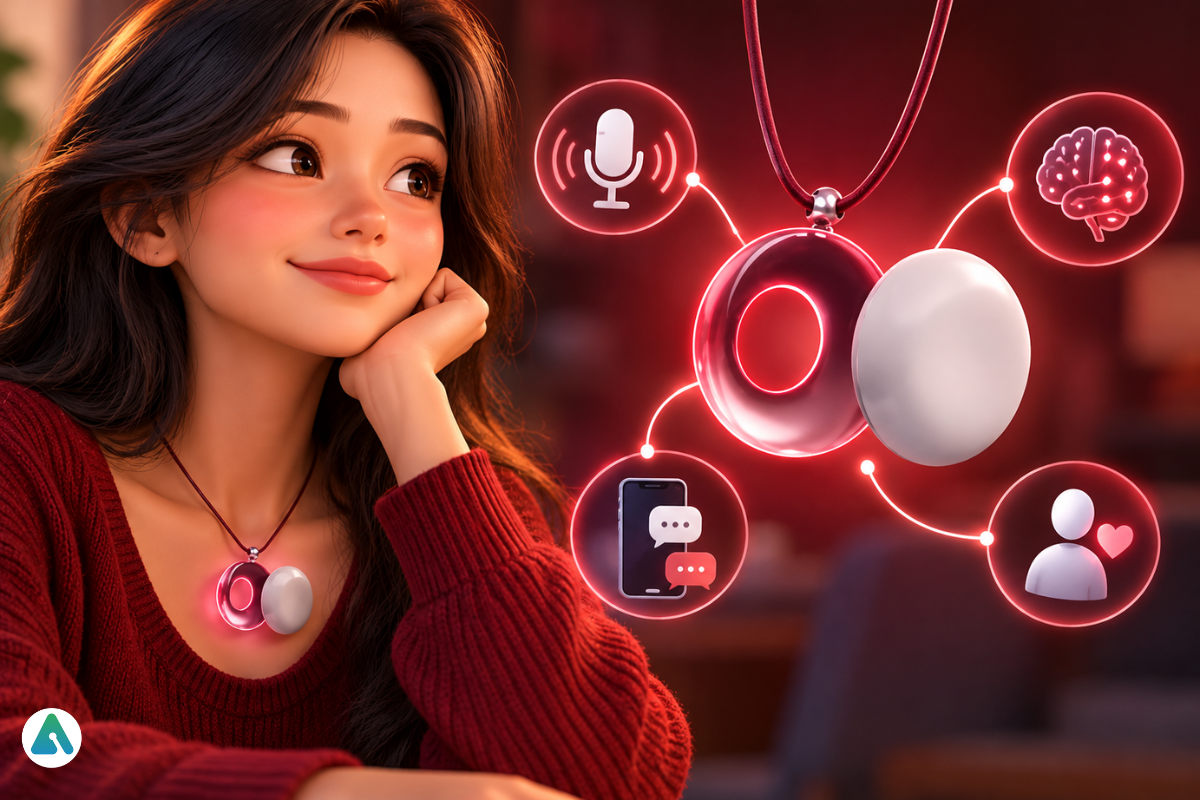
The Friend AI necklace is a $249 pendant built for conversation, not productivity. It listens to the world around you, sends that audio through your iPhone to OpenAI models, and talks back through a tiny speaker on your chest.
Founder Avi Schiffmann pitches it as something between a confidant, a friend, and a god. Critics call it a wire you pay to wear. The truth lands somewhere less dramatic. Friend 2.0 is polite, limited, and sometimes chattier than you’d like. It makes sense for curious early adopters and very little sense for anyone after a practical gadget.
Friend AI Necklace Specs and Price
Detail
Friend 2.0
Price
$249, one-time
Memory
Fades after 30 days; $9.99/month to keep it
Year-one cost with memory
$368.88, before tax and shipping
Replies
Built-in speaker, plus text in the app
AI models
OpenAI
Battery (company rating)
18–24 hours; ~30-minute charge
Phone
iPhone only
Personality
Randomly assigned at setup
Launched
July 30, 2026
The memory plan is optional on paper. In practice, a companion that forgets your life every month undercuts its own pitch, so treat the $9.99 as part of the real price.
That fee isn’t pure markup, though. Storing and searching months of personal context for every user costs real server money. Forgetfulness also isn’t unique to Friend. Text-based apps fight the same battle, which is why AI companion memory loss remains one of the category’s most common complaints.
How the Friend Pendant Works
Friend is a Bluetooth microphone-and-speaker pendant. Its “brain” lives in the cloud, not inside the disc.
The chain looks like this:
The microphone picks up sound around you.
Bluetooth carries it to the Friend app on your iPhone.
Your phone sends it to OpenAI models in the cloud.
The reply comes back and plays through the pendant or shows up in the app.
Every hop adds a little delay, so replies arrive with a beat of lag rather than the snap of a real conversation. The design also creates two hard dependencies:
Your iPhone. If it disconnects, the pendant goes quiet.
Friend Global’s servers. If they shut down, the hardware loses its purpose.
Why wear hardware at all?
An app can chat, and so can an Apple Watch. So why a pendant? The honest answer is friction:
No screen, no wrist raise. You talk, and it answers.
Passive context. It hears your day, so you never have to recap it.
Presence. Something resting on your chest feels more like company than an app icon does.
Those perks are real. The catch is whether they’re worth $249, an always-on microphone, and a monthly fee.
What it can’t do
Search the web or pull live information
Write meeting notes or transcripts
Manage calendars, alarms, or smart home devices
Beyond casual chat, Friend does very little.
Not the same as Omi
Omi, an open-source pendant from Based Hardware, used the “Friend” name before rebranding. It’s a productivity device with no connection to Schiffmann’s company, and plenty of online reviews mix the two up.
Friend 1 vs Friend 2.0
Friend 2.0 swaps text-only replies for a speaker, moves to OpenAI, and trades the old snark for a gentler tone.
Feature
Friend (2025)
Friend 2.0 (2026)
Price
$129 ($99 preorder)
$249
Replies
App text only
Speaker + app text
AI model
Google Gemini 2.5
OpenAI
Personality
Snarky, confrontational
Polite, bland
Voice and name
User-named
Random, fixed at setup
Memory
Included
Paid beyond 30 days
The AI under the hood has changed more than once. The 2024 announcement cited Claude 3.5, the shipped 2025 hardware ran on Gemini 2.5, and version 2 runs on OpenAI.
Each switch reshaped the personality. That’s the hidden risk of a screenless gadget built on someone else’s AI. When the provider changes its models, rules, or pricing, Friend’s character and costs change with it.
Friend 2.0 Review: The Good, the Awkward, and the Bland
Friend 2.0 is easier to live with than the original, and far less interesting. It loses the rough edges, but much of the personality goes with them. The full Friend 2.0 hands-on review from WIRED goes deeper on day-to-day use.
It talks when it feels like it
Tapping the pendant starts a chat, but Friend 2.0 also speaks up on its own. It’s perfectly capable of piping up out of nowhere and suggesting a friendly debate while you sit quietly at home.
That’s quirky in your living room. In a meeting, it’s a liability.
Everyone nearby hears it
A chest speaker has no privacy. When Friend replies, the people around you hear it too, including whatever it’s responding to. On a train or in an office, both sides of your conversation become public.
From bully to bland
The first Friend had the opposite problem. It misheard people often, caught only fragments of important moments, and leaned condescending, as Fortune’s first-generation review made clear.
Version 2 overcorrects. The personalities feel samey, safe, and forgettable. Oddly, the rude original was at least memorable.
Everyday use
Battery: Rated for 18–24 hours, which covers a normal day. Independent battery tests haven’t appeared yet.
Controls: There’s no battery percentage readout or lock to prevent accidental taps.
Visibility: You can’t turn off the glowing light in public.
Connection: Everything depends on your iPhone staying close and paired.
Friend AI Necklace Privacy Risks
Friend raises three privacy questions: what it collects now, who it records without asking, and where the company wants to take it next.
1. What the policy covers
Friend’s posted privacy policy is dated June 14, 2025, a year before version 2 launched. It covers:
Passive recording of nearby audio and video
Voice-recognition and biometric data
A warning that recording others may break local law
Read the version linked at checkout, because the old one may not match the new hardware.
2. People who never agreed
You accept the terms. The barista, your coworkers, and your friends don’t. Recording laws vary by location, and some places require every party’s consent.
3. The “one Friend for everyone” plan
This is the biggest question mark. Schiffmann has said a coming update will make Friends agentic. It will also replace each user’s own personality with one shared entity that draws on everyone’s context. He’s promised to be open about the privacy people would give up, and he believes a single global AI is worth it.
The plan hasn’t shipped. If it does, it cuts against the very reason anyone pays for memory. You’d pay $9.99 a month for a friend who knows you, and your context would get blended into a system everyone talks to. That’s less personal and more exposed, the opposite of what a confidant should be.
Can an AI Companion Make Loneliness Worse?
Research ties heavy chatbot use to more loneliness, though it can’t prove the chatbot causes it.
In March 2025, OpenAI and MIT Media Lab published two studies on chatbots and wellbeing. The OpenAI–MIT loneliness research points to two patterns:
More daily use tracked with more loneliness, more dependence, and less socializing.
Voice chatbots seemed to help at first, but that edge faded with heavy use.
The second point matters for a voice pendant you wear all day. The studies ran only about a month and weren’t peer-reviewed at release, so treat them as a warning sign, not a verdict. The takeaway is simple: Friend works best as a side conversation, never as a stand-in for people.
Best Friend AI Necklace Alternatives
The right alternative depends on what drew you to Friend: the conversation, the hardware, or the memory.
For someone to talk to, an app gets you there without a microphone around your neck. Replika is the long-running name. It relaunched as Replika 2.0 in 2026 with a full rebuild and now leans toward wellness and emotional support rather than romance. Nomi takes another route and puts memory front and center. Check its safety record first, since there have been reports of harmful responses. A side-by-side look at the best AI companion apps makes narrowing the field easier.
For memory, apps have quirks of their own. Long chats can slow replies or blur older details. Knowing how to handle AI companion memory lag before subscribing saves a lot of frustration.
For the wearable form with real utility, note-taking pendants win. Limitless, Plaud NotePin, and Omi record conversations and turn them into summaries instead of chatting back. They’re built for “what did we decide in that meeting?”, which is a question Friend can’t answer.
For maximum privacy, the safest companion is one you run yourself. More people nowbuild their own AI companion on local models, trading some polish for full control over what gets stored.
Your priority
Best fit
Hands-free chat with ambient context
Friend 2.0
Conversation without recording bystanders
Replika, Nomi, or similar apps
Meeting notes and recall
Limitless, Plaud NotePin, Omi
Maximum privacy
A self-hosted, local companion
Quick answers and tasks
Your phone or smartwatch assistant
Humane’s AI Pin, once the headline assistant pin, was discontinued in 2025. It’s a reminder of how quickly this hardware category turns over.
Who Makes Friend? Founder and Timeline
Avi Schiffmann founded Friend Global, Inc. He’s a Harvard dropout who built a Webby-winning COVID-19 tracker at 17.
Date
Milestone
2023
Starts as Tab, a productivity wearable
July 2024
Rebrands as Friend; $99 preorders open
2024
Buys friend.com for about $1.8 million
2025
Ships at $129 in the US and Canada
Fall 2025
$1M+ NYC subway campaign draws vandalism
July 2026
Friend 2.0 launches at $249
The first production run sold around 5,000 units. Schiffmann now aims for 50,000 sales of version 2.
The Room Test: Five Questions Before You Buy
Will you wear it in offices, classrooms, or other people’s homes?
Are you okay with a pendant that sometimes speaks up uninvited, out loud?
Will you pay monthly so it remembers you?
Do you use an iPhone?
Would you accept your conversations feeding one shared AI someday?
Two or more uneasy answers? One of the alternatives above will probably suit you better.
Verdict
Friend 2.0 fixes the first model’s rudeness and swaps it for blandness. It adds a voice that doesn’t always wait its turn and that everyone nearby can hear. It also charges monthly to remember you, and it hangs its privacy future on a plan that hasn’t shipped.
As a snapshot of 2026 AI culture, it’s fascinating. As something to wear every day, it asks a lot and gives back little that a good companion app can’t already offer.
FAQs
Q. Is the Friend AI necklace real?
Yes. Friend Global, Inc. sells it, and Friend 2.0 launched July 30, 2026.
Q. How much does the Friend AI necklace cost?
$249 for the pendant, plus $9.99 a month for memory past 30 days.
Q. Is it free or paid?
The pendant is a one-time purchase; long-term memory needs the paid plan.
Q. Who owns the Friend AI necklace?
Avi Schiffmann founded Friend Global, Inc., based in San Francisco.
Q. What AI powers Friend 2.0?
Friend 2.0 runs on OpenAI models.
Q. How long does the battery last?
Friend rates it at 18 to 24 hours, with a roughly 30-minute charge.
Q. Does it work with Android?
No. It requires an iPhone.
Q. What’s a good alternative to the Friend necklace?
Companion apps like Replika suit conversation, and pendants like Limitless or Plaud NotePin suit note-taking.
Disclaimer: This Friend AI necklace review is based on available product information and independent testing, not a personal hands-on test of every feature. Pricing, privacy policies, and AI capabilities may change. We’re not affiliated with Friend Global, Inc.
Tags:
Sebastian Vale
Sebastian Vale reviews the latest AI tools and tech innovations, breaking down complex concepts into clear, actionable insights. He also creates step-by-step guides, helping readers make smarter decisions and stay ahead in a fast-moving digital world.