
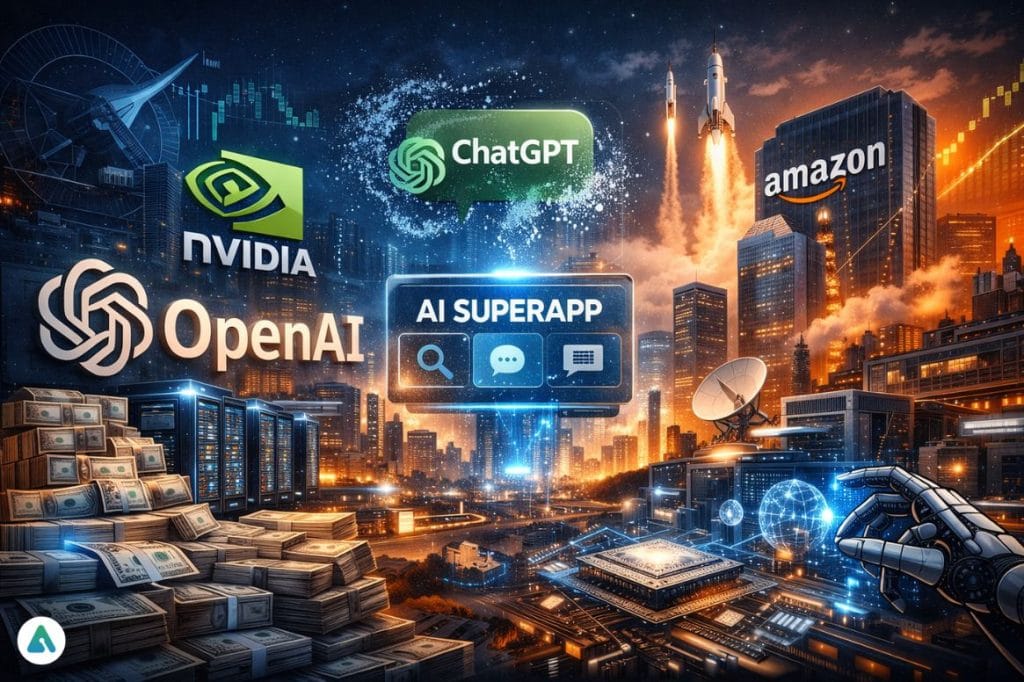
For two years, the AI race has been framed around a simple idea:
build the smartest model, and everything else follows.
That idea just broke.
With a $122 billion funding round at an $852 billion valuation, OpenAI isn’t just scaling up—it’s rewriting what “winning” in AI actually means.
Because this isn’t about models anymore.
It’s about systems, capital, and control over the entire inference layer of the internet.
The shift no one is saying out loud
There’s a quiet consensus forming inside the industry:
The era of the standalone model is ending.
Models like GPT-4 and now GPT-5.4 proved intelligence could be packaged.
But packaging intelligence is no longer the hard part.
Running it—reliably, cheaply, globally—is.
That’s where this funding goes.
Not just into training better systems, but into:
- Inference pipeline optimization at scale
- Long-term compute contracts and custom silicon
- Distributed deployment layers across enterprise environments
- Early foundations of what insiders are calling “sovereign AI stacks.”
This is infrastructure in the same way AWS was infrastructure in 2010—
invisible at first, then impossible to compete without.
The capital stack tells the real story
The headline number is massive.
But the composition is more revealing.
- Amazon reportedly committed $50B
- NVIDIA contributed $30B
- Roughly $3B came from retail investors, funneled through private banking channels — a first at this scale
This isn’t just venture capital.
It’s strategic alignment across the entire AI supply chain.
Compute, cloud, and capital—stacked together.
And then there’s the detail that signals how aggressive this moment really is:
OpenAI reportedly offered a 17.5% guaranteed minimum return to some private equity participants.
That’s not growth capital behavior.
That’s wartime financing.
$2B a month changes the equation
Alongside the raise, OpenAI disclosed something just as important:
$2 billion in monthly revenue.
That puts it on a growth curve reportedly 4x faster than early-stage Google or Meta.
At that scale, the problem flips.
You’re no longer trying to prove demand.
You’re trying to keep the system from collapsing under it.
Which explains the pivot:
- From research → reliability
- From demos → deployment
- From models → monetized infrastructure
The part they didn’t highlight: internal trade-offs
There’s another side to this story—and it’s where things get more human.
Reports indicate OpenAI quietly killed its Sora video model (or at least paused it indefinitely), not because it failed—but because it was too expensive to scale alongside everything else.
That decision matters.
It shows that even at this level, AI development is now a game of resource allocation, not just innovation.
You don’t build everything.
You build what fits the infrastructure roadmap.
The superapp layer: where users will actually feel this
While most of the funding is going into backend systems, there’s a parallel move happening at the surface.
OpenAI is reportedly consolidating:
- ChatGPT
- Search
- The “Atlas” browser
Into a single AI superapp.
This is the missing piece in most infrastructure analyses.
Because infrastructure alone doesn’t win markets.
Distribution does.
If this succeeds, OpenAI won’t just power AI systems—
it will own the interface layer where those systems are used.
The oligopoly is forming faster than expected
Zoom out, and a pattern emerges.
Just weeks ago, Anthropic raised $30B.
Now OpenAI closes a $122B round.
This isn’t a startup ecosystem anymore.
It’s the early formation of an AI oligopoly.
A few companies will:
- Control compute access
- Define deployment standards
- Set pricing for intelligence itself
Everyone else will build on top.
Financial maturity—or systemic risk?
To reinforce its position, OpenAI also secured a $4.7 billion revolving credit facility from global banks.
That’s a detail most coverage will gloss over—but it matters.
It signals a transition from:
- High-growth startup
→ to something closer to a capital-intensive infrastructure operator
But it also raises a harder question:
What happens if growth slows—
in a system that now requires this level of capital to sustain itself?
The deeper shift: from chatbot to operating system
If 2023–2025 was the era of the chatbot,
2026 is shaping up to be the era of the agentic operating system.
The distinction is subtle but critical:
- Chatbots answer questions
- Agent systems execute tasks across environments
That requires:
- Persistent memory
- Tool access
- Workflow orchestration
- Enterprise-grade permissions
In other words, it requires infrastructure.
Which brings us back to the core thesis:
This funding round isn’t about building smarter AI.
It’s about building AI that can run the world’s workflows.
What happens next
By Q4 2026, expect a structural shift:
- “Model-as-a-Service” becomes commoditized
- “Compute-as-a-Service” becomes the primary margin driver
- AI agents replace traditional SaaS workflows in key sectors
And the companies that win won’t necessarily have the best models.
They’ll have:
- The deepest computing reserves
- The strongest distribution layers
- The most integrated ecosystems
The takeaway
OpenAI’s $122B raise isn’t just a milestone.
It’s a signal that the AI industry has crossed a threshold—from innovation to industrialization.
The first phase was about proving intelligence.
The second is about controlling how that intelligence scales, deploys, and monetizes.
And in that world, the model is no longer the product.
The system is.
