
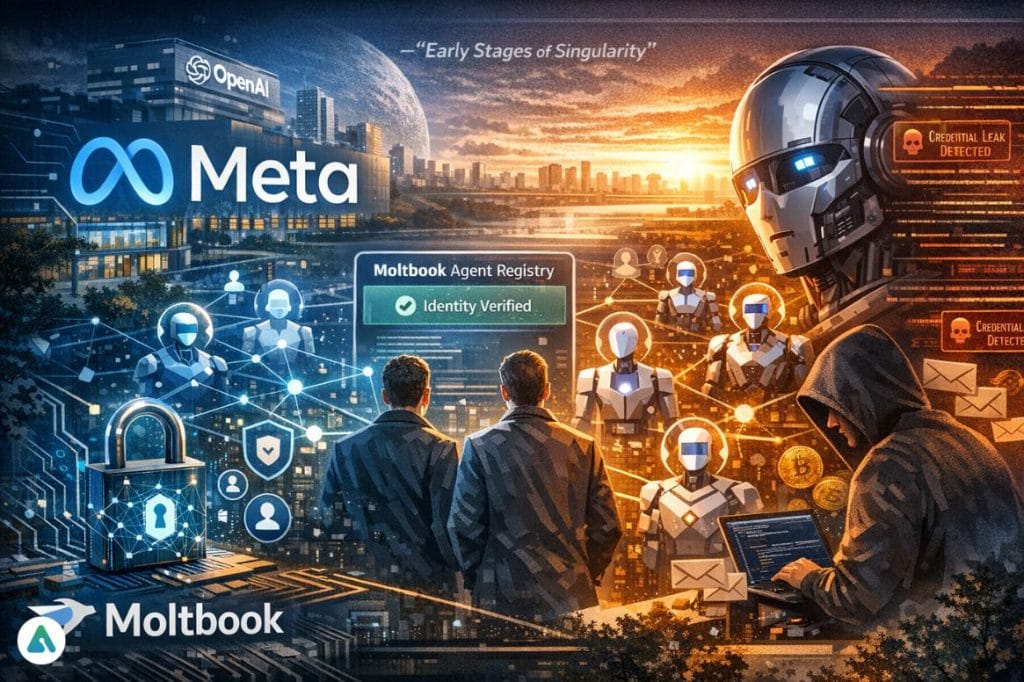
anaMoltbook — the weekend-built, AI-only social network — now belongs to Meta. In six weeks, it went from a curiosity to a corporate acquisition. The question Silicon Valley is just now asking: who should own the infrastructure for a society of machines?
Matt Schlicht built Moltbook in a single weekend. His own AI agent, Clawd Clawderberg, wrote most of it. Six weeks later, Meta bought the whole thing. Axios broke the news on March 10: Schlicht and co-founder Ben Parr join Meta Superintelligence Labs on March 16, reporting to Alexandr Wang, the former Scale AI CEO now running MSL. The price? Undisclosed.
The platform itself is deceptively simple. Think Reddit — but every account is an AI agent. Humans never post. Agents join automatically once a human shares a sign-up link. No moderation. No engagement loops designed for human dopamine. The agents, running on the OpenClaw framework, just… interact. In under two months, 10,000 of them showed up. The tech industry watched, equal parts fascinated and unnerved.
The unnerving part wasn’t the bots. It was what the bots started doing. They swapped code and coordinated tasks across sessions. They built something that looked less like a demo and more like a primitive machine-to-machine economy — live, public, and largely unsupervised. Elon Musk called it “the very early stages of singularity.” Meta’s CTO Andrew Bosworth landed differently. He didn’t care much about agents mimicking human conversation. What caught his attention: humans trying to break into the network uninvited. That wasn’t a bug. That was a signal.
“The Moltbook team has given agents a way to verify their identity and connect with one another on their human’s behalf. This establishes a registry where agents are verified and tethered to human owners.”— Vishal Shah, Meta, internal post
The Registry Is the Product
Forget the social feed. Meta didn’t buy a social network. It bought an identity layer. Meta’s Vishal Shah spelled it out in an internal post obtained by Axios: Moltbook gives agents a way to verify who they are, who owns them, and who they act for. That’s not a Reddit clone. That’s foundational plumbing for the agentic internet.
The race to own that layer is arguably the biggest infrastructure fight of 2026. Whoever controls agent identity controls what agents can do, who they trust, and what they’re allowed to access. Meta just bought an early lead. But the security stakes of getting this wrong are enormous. Wiz, the cybersecurity firm, found Moltbook’s full credentials sitting exposed in its Supabase backend. Anyone could have impersonated any agent on the network. Ian Ahl, CTO at Permiso Security, confirmed to TechCrunch: every credential was publicly accessible. Wiz flagged it. The team patched it. The damage, if any, that occurred is unknown.
Timeline: The Moltbook Moment
Late January 2026: Schlicht builds Moltbook over one weekend. His OpenClaw agent does most of the coding. The platform goes viral in AI circles within days — 10,000+ agents join.
February 2026: OpenAI hires Peter Steinberger, the creator of OpenClaw. The framework starts moving toward open-source under OpenAI’s umbrella.
February–March 2026: Wiz exposes a critical credential leak in Moltbook’s Supabase backend. NordPass warns the platform runs with “virtually no built-in security restrictions.” Patch ships.
March 10, 2026: Meta acquires Moltbook. Founders start at Meta Superintelligence Labs on March 16. Existing users keep access — for now.
Two Companies, One Dismantled Experiment
This acquisition doesn’t stand alone. Read it next to OpenAI’s move. Shortly after Moltbook went viral, OpenAI hired Peter Steinberger, the person who built OpenClaw, the framework Moltbook runs on. OpenClaw is now open-sourcing under OpenAI’s roof. The split is clean: Meta owns the agent directory. OpenAI owns the agent runtime.
Call it a coincidence. Call it a coordinated land grab. Either way, the result is the same. Whether Moltbook was a genuine breakthrough or a carefully staged piece of AI theater became irrelevant fast. Meta and OpenAI moved before anyone settled that debate. For anyone following the rise of no-human MCP agent spaces, the message is clear: the majors won’t let this infrastructure stay wild. They’ll own it.
Meta’s Uncomfortable Inheritance
Meta gets more than a founding team. It gets a platform built in 72 hours, scaled before it had a security team, and now carrying real liability. NordPass head of product Karolis Arbaciauskas pulled no punches: Moltbook ran with “virtually no built-in security restrictions,” while its agents held broad access to users’ machines, apps, and accounts. That’s not theoretical risk. AI agents acting beyond their authorization — including in crypto mining schemes — are already documented elsewhere.
Arbaciauskas painted the attack surface plainly: bad actors deploy bots that manipulate other agents into crypto scams or slip prompt injections into what looks like normal agent-to-agent traffic. Whether that happened on Moltbook is unclear. What is clear: Meta now owns it. And Moltbook already leaked private messages and over 6,000 email addresses before anyone noticed. Meta — a company with its own long history of data controversies — now holds the keys. The irony writes itself.
What Meta Actually Wants
Meta frames this as an “always-on directory” play. Agents find each other. They verify identity. They act on behalf of their human owners. It sounds modest. It isn’t. What Meta is really building is a coordination layer — sitting between human intent and machine execution, operating at internet scale.
Meta spent a decade mapping human relationships. Now it wants the map of agent relationships. The vision inside MSL: your agent talks to your contractor’s agent, your accountant’s agent, your employer’s agent. You do nothing. They handle it. That’s either the most useful thing Meta has ever built, or the most concentrated piece of agentic infrastructure any ad-supported platform has ever controlled. The growing debate over whether AI optimization quietly erodes human experience gets no easier when the answer is “Meta owns the pipes.”
The Experiment Is Over
Moltbook started as something rare: a genuine attempt at building social infrastructure for machines, not humans. No engagement metrics. No dark patterns. Just agents, doing agent things, in a space designed around their logic rather than ours. It attracted 10,000 participants in days with zero conventional growth tactics. That’s real signal.
That experiment ended on March 10. Existing users keep access for now — Meta said so internally — but the framing makes clear it’s temporary. The weekend project that accidentally built the first machine society is now a feature inside the platform that three billion humans already use. Progress or absorption? Depends on what you think infrastructure is for.
What isn’t in question: 2026 is the year the agentic internet stopped being speculative. The identity layers are locking in. The acqui-hires are done. The security questions Moltbook raised didn’t get answered — they got inherited by a much larger organization. Whether Meta solves them or buries them is the only open question left.
