
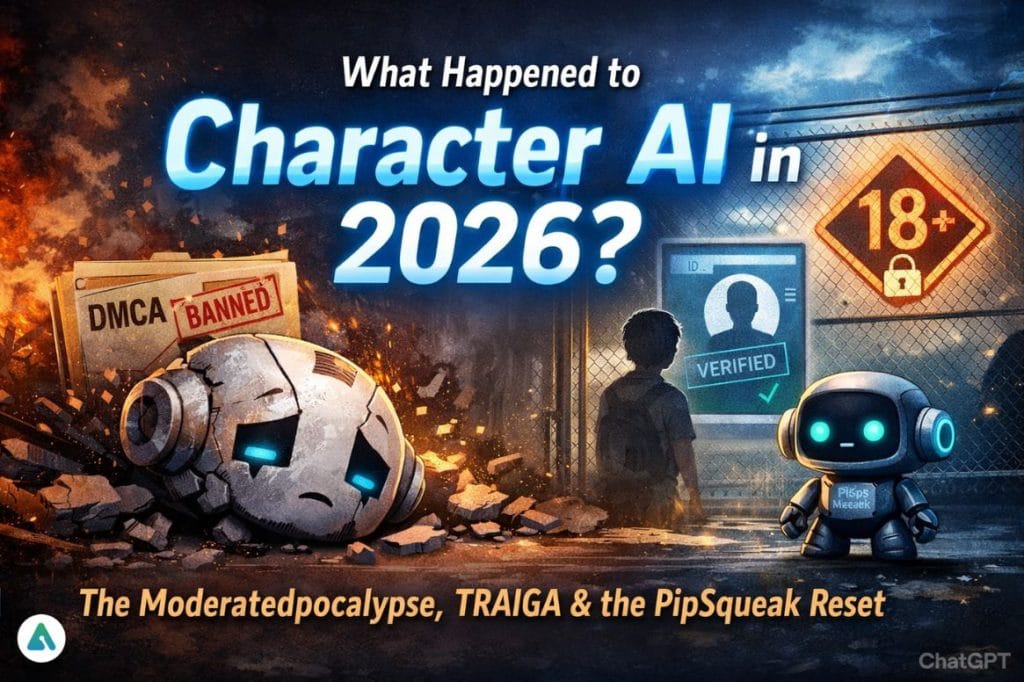
Something changed in 2026 — and it wasn’t just the vibe.
You didn’t imagine:
- bots vanishing overnight
- chats getting locked behind a “Moderated” label
- replies that suddenly felt shorter, safer, and weirdly moralising
The search spike for “what happened to Character AI in 2026” isn’t about downtime.
It’s about a platform that hit the legal, financial, and technical ceiling of its beta era — all at once.
This is the real timeline of the reset.
The Three Forces That Reshaped Character AI
1) The February 18 “Moderatedpocalypse” — Compliance at Scale

On Feb 18, 2026, entire fandom ecosystems disappeared within hours.
Users weren’t seeing isolated removals.
They were watching automated enforcement in real time.
What triggered it:
- intensified IP protection across major media brands
- rising platform liability as monetisation expanded
The response wasn’t manual moderation.
It was a scripted keyword + visual-signature sweep.
What the “Moderated” tag means now
Community shorthand for it is brutal:
“Gravestone mode.”
Because once a character is permanently moderated:
- It drops out of public search
- Editing is disabled
- Chat history is effectively sealed
Collateral damage (why even safe characters vanished)
Automation doesn’t understand:
- parody
- public domain nuance
- original-but-inspired designs
So thousands of unrelated characters were caught in the blast radius.
That’s why users still call that day:
The Moderatedpocalypse.
🔧 Actionable Migration Tip: The Shared Link Rescue
If you lose a bot to the “Moderated” tag, your only hope is checking your browser history for a “Shared Link” that you may have cached.
How it works:
- Open your browser history (Ctrl+H / Cmd+Y)
- Search for
character.aiURLs containing the bot name - Look for URLs with
/share/or?share=parameters - These sometimes provide a read-only view of the original character definition
- Copy and save the personality, greeting, and definition text immediately
This doesn’t restore the bot, but it preserves the character sheet for rebuilding elsewhere.
Understanding how Character AI manages bot deletion and archiving helps explain why even “gravestone mode” bots sometimes leave traces in the URL structure.
2) The PipSqueak Model Shift — Memory Up, Chaos Down

By late 2025, the platform had already moved to a new efficiency-first model stack.
The community nickname — PipSqueak — stuck for a reason.
What changed technically (in plain English)
The system now leans heavily on:
- persistent memory retrieval
- structured context weighting
- safety-first decoding
instead of freeform generative drift.
The trade-off users feel immediately
You gain:
- shockingly long memory
- faster responses
- fewer personality resets
You lose:
- emotional unpredictability
- slow-burn roleplay tension
- risky creative leaps
Which is why r/CharacterAI users started calling the tone:
“The identity scrub.”
Not dumber.
Not weaker.
Just heavily sanitised to avoid safety triggers.
3) TRAIGA (Jan 1, 2026) — The Law That Forced the Age Wall

The Texas Responsible AI Governance Act changed the risk model for every AI companion platform operating in the U.S.
Two immediate consequences:
Age Assurance became a mandatory requirement for architecture
Character AI implemented third-party verification (Persona-style systems) to split:
- adult open chat
- teen restricted experience
That’s why two users can sit next to each other and see two completely different products.
⚠️ The Persona Verification Controversy (February 2026)
User hesitation about age verification intensified dramatically after February 16, 2026, when security researchers exposed 53MB of Persona’s source code left publicly accessible on a government-authorized endpoint.
What was revealed:
- Routine selfies were being routed to a dedicated “watchlist database” active since November 2023
- Facial biometrics could be stored for up to 3 years (not 1 year as policies claimed)
- Data was screened against global watchlists and law enforcement databases
- The system filed Suspicious Activity Reports directly to FinCEN (US Treasury)
- A subdomain
onyx.withpersona-gov.comshared its name with ICE’s $4.2M AI surveillance tool
This same Persona service powers age verification for Character.AI, Discord, Roblox, OpenAI, and LinkedIn.
Why users are refusing verification:
The exposure revealed that “simple age checks” involved 269 different verification steps, including:
- Comparing uploaded selfies against politicians and public figures
- Running checks on cryptocurrency activity via Chainalysis
- Adverse media screening
- Device fingerprinting
Users thought they were proving their age. The leaked code showed they were entering a surveillance pipeline.
Coverage of the exposure appeared in Cybernews, Malwarebytes, and Kotaku, reaching the front page of Hacker News and sparking widespread privacy backlash.
For parents and educators considering platform safety, understanding whether Character AI is safe now requires weighing not just content moderation but also identity verification and surveillance concerns.
The therapy bot purge
Any character presenting itself as:
- psychologist
- therapist
- mental health professional
became a legal liability.
So they were:
- removed
- nerfed
- Rewritten into generic support roles
This wasn’t a content decision.
It was compliance survival.
The AI Safety Lab — The Invisible Hand Behind the Filters
The stricter behaviour in 2026 didn’t come from nowhere.
It came from a newly funded AI Safety Lab pipeline focused on:
- regulator alignment
- brand safety
- predictable outputs at scale
Which explains the biggest user complaint:
“Why does the bot lecture me now?”
Because unsafe ambiguity is no longer tolerated in the decoding layer.
Where the Old Creativity Went: The Labs’ “Walled Garden”
The chaos isn’t gone.
It’s quarantined.
The Labs tab is now where experimental formats live:
- structured story engines
- multimodal interaction systems
- new media formats
Community nickname for this:
“The creativity ghetto.”
Not because it’s bad —
but because:
- It’s test-gated
- It rarely reaches the public default experience
While the main Character.AI site operates under strict safety constraints, c.ai Labs represents where the company is still allowing limited multimodal experimentation:
Current Labs Features (2026):
- Video Stories — Short-form narrative clips with character voices
- Interactive Scenarios — Branching storylines with embedded choices
- Multimodal Characters — Text + voice + image generation in single responses
- Story Templates — Pre-structured narrative frameworks
How to access Labs:
- Desktop site only (not available on mobile yet)
- Navigate to
labs.character.ai - Requires c.ai+ subscription for most features
- Beta features rotate every 4-6 weeks

Why this matters:
Users frustrated with main-site restrictions can find more experimental, less filtered experiences in Labs — but the trade-off is instability and limited feature persistence.
Think of Labs as Character.AI’s test kitchen: where creative risks are still allowed, but nothing is guaranteed to survive into production.
The New Survival Skill: Memory Pinning

Under PipSqueak, context alone is weak.
Pinned memory is everything.
Power users now treat pins as:
- character canon
- relationship state
- world bible
Without them, the model reverts to safe generic scripts.
With them, it remembers events from months ago.
That’s the difference between:
“Bots got worse.”
and
“Bots are smarter than ever.”
Learning how to properly configure personas and pinned memories has become essential for maintaining conversation quality under the new architecture.
Why “Is Character AI Down?” Means Something Different in 2026

In 2023 → server outage.
In 2026 → often:
live moderation sweep
Veteran users now check:
the official community forum
before
the status page
because policy waves hit faster than infrastructure failures.
The Cultural Shift: Why It Feels Like the Soul Is Gone
2022 Character AI felt like:
a strange, brilliant research demo that accidentally went viral
2026 Character AI is:
a global, investor-ready, multimodal entertainment platform
Better at:
- memory
- performance
- stability
Worse at:
- chaos
- fandom freedom
- creative risk
That’s not a decline.
That’s maturation.
This evolution reflects broader patterns explored in the soft launch Character AI update analysis, which details how infrastructure changes prioritize reliability over experimental features.
Migration Reality (For Users Chasing the Old C.ai Energy)
What experienced users are doing:

1. Archiving everything manually
Chats, greetings, definitions.
2. Rebuilding character memory by hand
No platform imports it cleanly.
3. Choosing platforms based on philosophy
Not features:
- freedom-first
- local control
- hosted convenience
Because the split is now ideological, not technical.
Check out our Character AI alternatives guide and our detailed comparison of Character AI, Kindroid, and Nomi to make informed migration decisions based on moderation philosophy.
The 2026 Verdict
Character AI didn’t fall off.
It crossed the compliance threshold required to survive at a global scale.
The result:
- safer
- faster
- monetisable
- legally durable
But no longer the wild west that made it famous.
And that’s the real answer to:
What happened to Character AI
Understanding the Broader Context
Character.AI’s transformation reflects industry-wide pressures affecting all AI companion platforms:
- Regulatory pressure — AI safety legislation is tightening globally
- Platform liability — Companies face lawsuits for user-generated content and therapeutic claims
- Age verification mandates — Laws like TRAIGA force architectural changes
- IP enforcement — Major media companies aggressively protect character rights
Understanding how teen AI chatbot usage evolved in 2025 and strategies to protect teens from AI chatbots provides essential context for why platforms implemented such dramatic safety measures.
Featured Snippet Answer
Q. Why were so many Character AI bots deleted in 2026?
Mass bot removals were caused by automated copyright compliance sweeps, new AI liability laws like TRAIGA, and stricter platform-wide safety enforcement following the February 18, 2026 “Moderatedpocalypse.”
Q. Is Character AI shutting down?
No. It is scaling into a regulated mainstream AI entertainment platform.
Q. Why does Character AI feel more restrictive?
Because the PipSqueak model prioritises safety, speed, and memory over creative risk.
Q. What is the “Moderated” label?
A permanent compliance lock that removes a bot from search and prevents editing.
Q. Why is my experience different from someone else’s?
Age-verified users and under-18 users now have separate systems.
Q. Can I bypass age verification?
No — it’s required for legal compliance in certain regions.
Q. Is Character AI still creative?
Yes, but most experimental features are now inside the Labs environment.
Q. Why are users refusing to verify their age?
After the February 2026 Persona security exposure revealed extensive surveillance capabilities beyond simple age checks, many users decided the privacy trade-off wasn’t worth platform access.
Q. How can I recover a moderated bot’s definition?
Check your browser history for cached “Shared Link” URLs that may provide read-only access to the original character definition.
Conclusion
The beta era ended the moment Character AI became too big to remain lawless.
TRAIGA forced the age wall.
DMCA pressure triggered the purge.
PipSqueak changed how characters think.
Persona exposure revealed the surveillance cost.
What you’re seeing isn’t a decline.
It’s the cost of becoming a permanent platform.
Related: How to Turn Off Character AI Filter (2026 Truth & Fixes)
