

Claude AI is owned and operated by Anthropic, PBC, a private U.S. public benefit corporation founded in 2021 by siblings Dario Amodei and Daniela Amodei. Amazon and Google are among Anthropic’s largest financial backers, but neither is Anthropic’s parent company or controls the board. Governance instead runs through the founders’ voting shares and Anthropic’s Long-Term Benefit Trust
Amazon and Google can hold substantial economic interests in Anthropic without controlling the company. At Anthropic, financial ownership, board representation, and ultimate governance power are deliberately kept separate. That split is the real answer to “who owns Claude AI,” and it’s what the rest of this guide unpacks.
Claude itself isn’t a company. It’s Anthropic’s AI assistant and model family. Anthropic PBC is the business behind it — the entity that owns the technology, employs the researchers, and answers to investors, regulators, and the Trust..
Who Owns Claude AI? Ownership & Control
- Who owns Claude? Anthropic, PBC.
- Is Claude owned by Amazon? No. Amazon is a major investor and cloud partner.
- Is Claude owned by Google? No. Google is an investor and cloud/technology partner.
- Is Claude owned by OpenAI? No. Anthropic and OpenAI are separate, competing companies.
- Who controls Anthropic? A mix of the board, founder super-voting shares, and the Long-Term Benefit Trust — which held a board majority as of Anthropic’s April 2026 disclosure.
- Is Anthropic publicly traded? Not yet. It has confidentially filed IPO paperwork; a listing hasn’t happened as of this writing.
Investor vs. Control Snapshot
| Stakeholder | Entity Type | Approx. Financial Stake | Governance / Voting Power | What It Means |
|---|---|---|---|---|
| Dario & Daniela Amodei (Founders) | Key executives | ~2% (diluted) | High control via founder super-voting shares | Small ownership, outsized decision-making power |
| Long-Term Benefit Trust (LTBT) | Independent trust | 0% (Class T shares, no economic value) | Holds a board majority as of April 2026 | Governance watchdog, not a financial owner |
| Amazon | Cloud partner / investor | Reported high-teens to ~21%; not officially disclosed | No board seat; convertible notes + non-voting preferred stock | Large financial upside, no operational say |
| Google (Alphabet) | Cloud partner / investor | ~14% reported, capped at 15% | Not represented on the board | Same pattern as Amazon — money, not control |
| Microsoft & Nvidia | Infrastructure backers | Minority, undisclosed | Outside the boardroom entirely | Strategic partners, not decision-makers |
These percentages are analyst and press estimates, not figures from a published Anthropic capitalization table. Sources & Methodology, near the end of this guide, breaks down which numbers are firmer than others.
Who Founded Anthropic? Meet the Team Behind Claude
Former OpenAI employees, including siblings Dario Amodei and Daniela Amodei, founded Anthropic in January 2021. They left after disagreements over AI safety priorities.
The broader founding team also included Jack Clark, Jared Kaplan, Sam McCandlish, Tom Brown, Chris Olah, and Ben Mann. All six brought deep research backgrounds in large language models, interpretability, and policy — a research thread that’s back in the spotlight now that newer models like GPT-6 Astra face the same scrutiny.
Dario Amodei, CEO
Dario Amodei leads Anthropic as CEO. Before Anthropic, he served as OpenAI’s VP of Research, working on GPT-2 and GPT-3.
He’s the public face most closely tied to Claude’s safety-first positioning, including Anthropic’s “Constitutional AI” training approach.
Daniela Amodei, President
Daniela Amodei, Dario’s sister, co-founded the company and now serves as President. She previously ran safety and policy work at OpenAI.
The Amodei siblings hold the company’s most influential founder shares.
The Rest of the Founding Team
Jack Clark leads policy at Anthropic today. Jared Kaplan, Sam McCandlish, Tom Brown, Chris Olah, and Ben Mann brought the research expertise that shaped Claude’s early technical direction, and several still hold senior roles.
What Kind of Company Is Anthropic? Public Benefit Corporation, Explained
A public benefit corporation (PBC) is a for-profit company that must balance shareholder profit against a stated public mission. For Anthropic, that mission is “the responsible development and maintenance of advanced AI for the long-term benefit of humanity.” Anthropic incorporated in Delaware, a state that recognizes this structure explicitly.
Shareholders can sue a standard C-corp’s board for prioritizing anything other than profit. Delaware law protects a PBC’s board instead — and arguably obligates it — to weigh safety and public benefit alongside returns.
That legal detail underpins the governance choices below, choices a typical startup couldn’t make without triggering a shareholder revolt.
Who Invested in Anthropic? Claude AI’s Major Investors
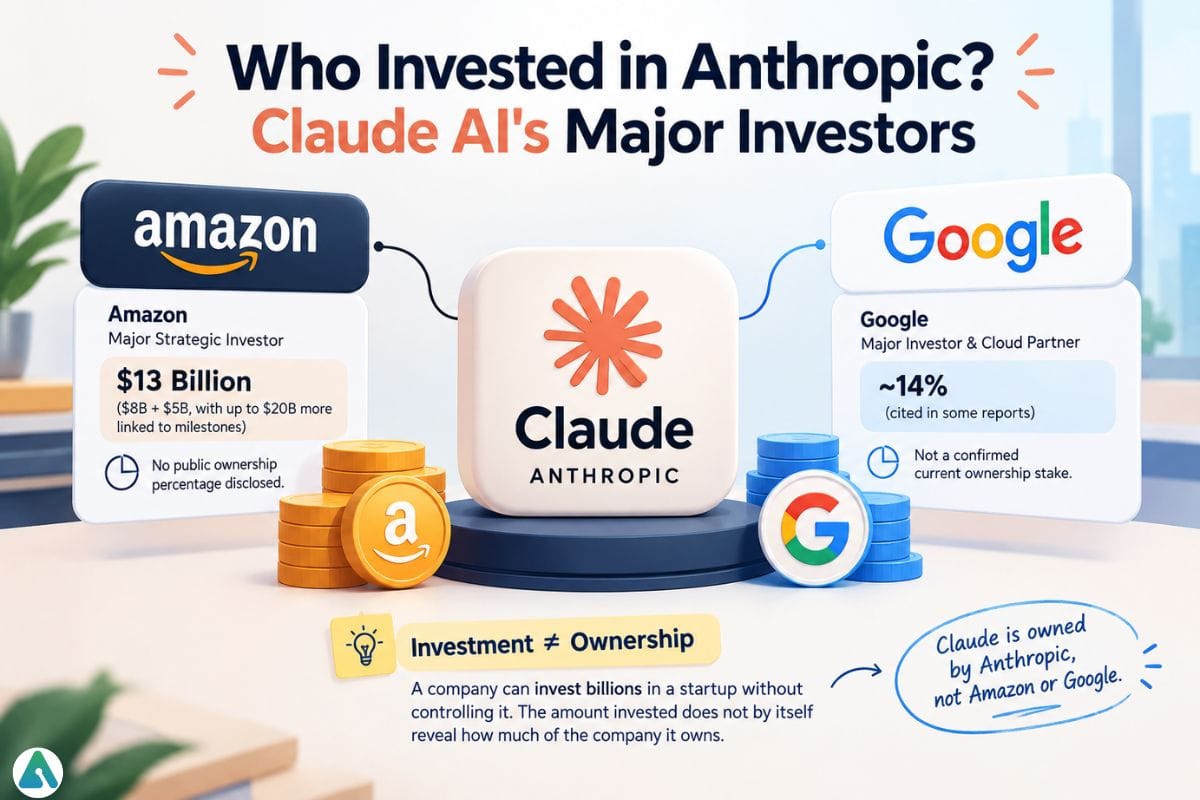

Most explainers stop at listing investors, then quietly treat “how much a company invested” as the same thing as “what percentage it owns.” Those are different numbers, though.
Neither Amazon nor Google has published a single confirmed ownership percentage. So the figures below are analyst and press estimates, not disclosed capitalization-table data.
What Does Amazon Actually Own — and Not Own?
Amazon holds a large financial interest in Anthropic, not a controlling one. Here’s the timeline and the fine print:
- 2023–2024: Amazon began investing through a series of convertible-note purchases, reaching roughly $8 billion by late 2024.
- April 2026: Amazon added a new $5 billion investment with an option for up to $20 billion more. CNBC and TechCrunch both reported that, in the same deal, Anthropic committed to spend over $100 billion on AWS cloud infrastructure over the next decade (TechCrunch’s coverage has the full breakdown).
- The instrument: Amazon structures its position as convertible notes and non-voting preferred stock, not common voting equity. Based on TheStreet’s review of Amazon’s Q1 2026 SEC filings, that position carried a $74.2 billion book value at the time — $42.2 billion in convertible notes, $32 billion in non-voting preferred.
- The percentage: Translating that into a stake is imprecise. TheStreet puts it in the high teens, while The Motley Fool estimates roughly 21% — the gap comes down to which valuation snapshot and conversion assumptions each analyst used.
Either way, Amazon doesn’t get a seat in the boardroom or any say over Claude’s product roadmap. AWS stays a commercial partner, not an owner.
What Does Google Actually Own — and Not Own?
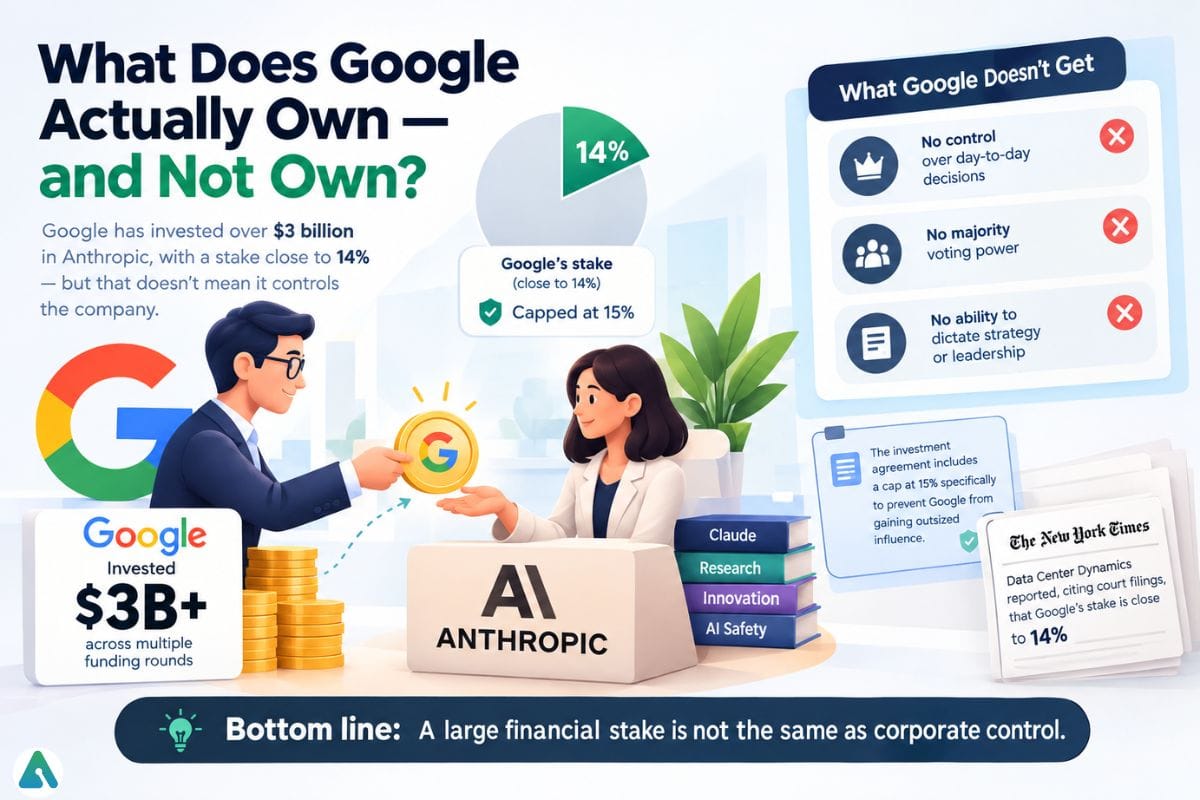

Google has invested more than $3 billion across multiple rounds. Citing New York Times court filings, Data Center Dynamics reported that Google’s stake sits close to 14%, under a contract that caps it at 15% specifically so Google can’t acquire outsized influence.
Google expanded its commitment further in 2026 alongside a cloud-compute agreement, but like Amazon, it still has no board seat or special voting rights — and Claude’s availability through Google Cloud’s Vertex AI is a distribution deal, not evidence of ownership.
Is Claude Owned by OpenAI?
No. Anthropic and OpenAI compete as separate companies. Several Anthropic founders previously worked at OpenAI, but no ownership relationship connects the two organizations today.
Other Investors Worth Knowing
Later funding rounds pulled in a broad investor base. Microsoft and Nvidia reportedly committed roughly $15 billion combined in late 2025 — press reporting, not an Anthropic-confirmed figure.
2026 rounds also brought in Lightspeed Venture Partners, ICONIQ Capital, Fidelity Management & Research, and the Qatar Investment Authority. None of these investors has disclosed a board seat.
Regulatory Scrutiny of These Deals
Big Tech’s cloud-for-equity arrangements with AI labs have drawn antitrust attention, too. In a January 2025 staff report issued under its Section 6(b) authority, the FTC examined partnerships between cloud providers and AI developers — including Microsoft–OpenAI, Google–Anthropic, and Amazon–Anthropic.
The concern: these large, non-controlling investments, paired with cloud-credit deals, could function like de facto acquisitions without triggering standard merger review. That said, no enforcement action against the Anthropic deals had followed as of this writing.
The Ownership Ladder: A Framework for Reading This Kind of Story
Instead of asking one flat question, separate three layers:
- Economic ownership — who gets paid if the company sells or goes public. This is the number most articles report (Amazon’s estimated stake, Google’s 14%).
- Board representation — who holds a formal seat deciding company strategy. Neither Amazon nor Google has this at Anthropic.
- Ultimate control — who can outvote everyone else on decisions that matter. At Anthropic, that’s the founders’ super-voting shares plus the Long-Term Benefit Trust, not the investors who wrote the biggest checks.
Collapsing these three layers into one number is exactly how “does Amazon own Claude?” questions keep circulating online. It doesn’t — not in any sense that lets Amazon steer the company.
Who Controls Anthropic? How Its Governance Actually Works
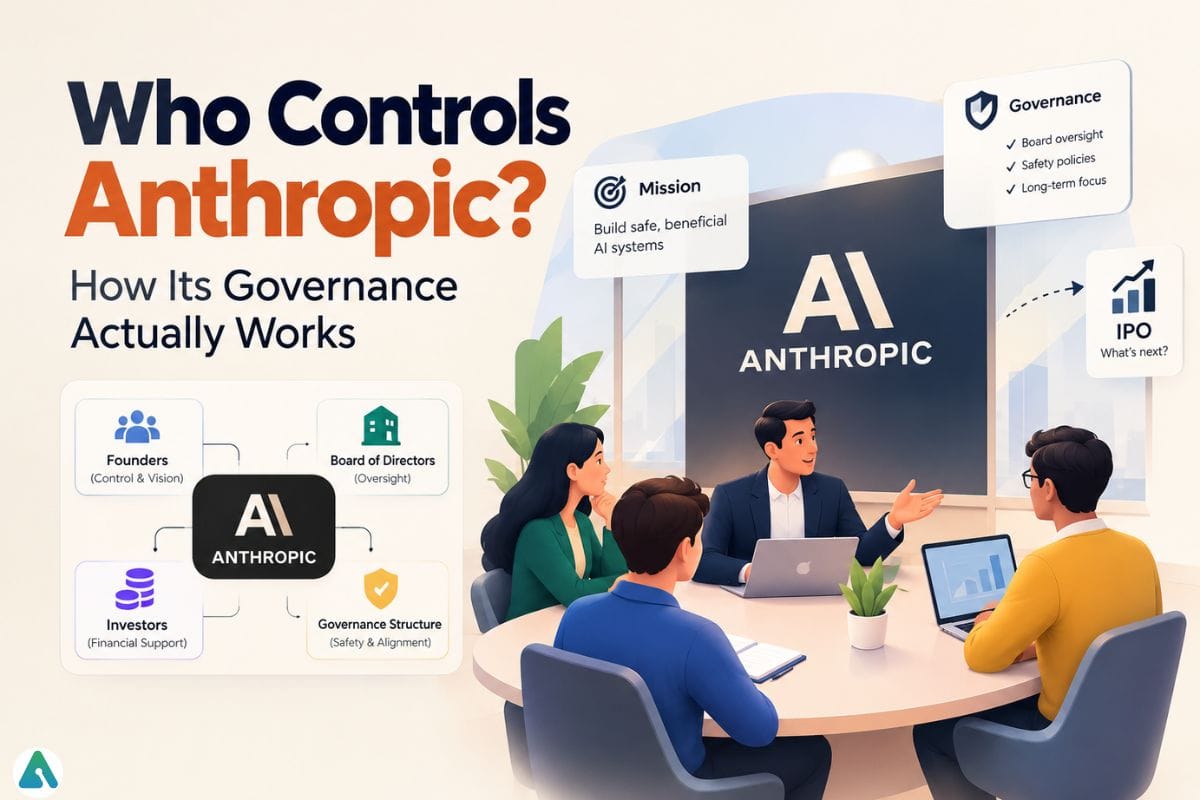

This question separates a well-informed answer from a surface-level one. It’s also the part changing fastest as the IPO approaches.
The Long-Term Benefit Trust
Anthropic created the Long-Term Benefit Trust (LTBT) in 2023 to keep commercial pressure from overriding safety decisions. In Anthropic’s own explanation of the Trust, it exists because “the general public don’t directly contract with a corporation and therefore do not have a means to charge or pay for the costs and benefits they experience” from advanced AI.
Here’s what the Trust actually holds and does:
- Its stock: A special class of shares — Class T — carrying no economic value but real power: the ability to elect and remove Anthropic’s board over a phased timeline.
- Its milestone: As of April 2026, that phase-in reached a turning point. With the appointment of Novartis CEO Vas Narasimhan, Anthropic announced that “Trust-appointed directors now make up a majority of the Board.” Trust members hold no financial stake in Anthropic, by design.
- Its people: As of September 2026, Anthropic lists Neil Buddy Shah (CEO of the Clinton Health Access Initiative), Richard Fontaine (CEO of the Center for a New American Security), and former Federal Reserve Chair Ben Bernanke as active trustees.
- A recent departure: A fourth trustee, Mariano-Florentino “Tino” Cuéllar, joined the Trust in January 2026. He left in August 2026, and Anthropic confirmed in its own announcement that he’d joined the company itself as its first Chief Global Affairs Officer.
Founder Super-Voting Shares
Ahead of the IPO, Anthropic is creating a new share class carrying enhanced voting rights for Dario Amodei and his co-founders. Years of fundraising have diluted the founders’ economic stake to roughly 2% of the company.
Even so, this super-voting structure preserves their decision-making control. Anthropic hasn’t publicly disclosed the exact vote ratio; analysts expect it to appear in the company’s full S-1 filing.
Anthropic’s Board of Directors
Per Anthropic’s own April 2026 board announcement, the seven-member board is Dario Amodei, Daniela Amodei, Yasmin Razavi, Jay Kreps, Reed Hastings, Chris Liddell, and Vas Narasimhan.
Four of the seven — a majority — are Trust-appointed independent directors. That’s the structural point: no single investor, and not even the founders alone, can outvote that Trust-aligned majority.
What This Means in Practice: A Mini Case Study
When Anthropic goes public, ordinary investors will buy shares like they would in any other IPO. But because of the founder super-voting shares and the Trust’s board majority, a governance analysis TechTimes published ahead of the filing says those shareholders will have “effectively no lever to pull” on major company decisions.
You can own stock in Anthropic without gaining any real influence over Claude. That’s the structure working as intended, not a loophole.
What This Could Mean for Enterprise Buyers
This section offers analysis, not an Anthropic-confirmed benefit — though it’s a reasonable read of the structure. For CTOs and enterprise architects evaluating Claude, the governance setup limits two procurement risks worth naming directly:
Enterprise takeaway: vendor independence
- Limited hyperscaler leverage. Because neither Amazon nor Google holds a board seat, neither can unilaterally force exclusive distribution terms or pull Claude from a competing cloud.
- Multi-cloud availability. Per Claude’s own platform documentation, Claude runs on AWS Bedrock, Google Cloud’s Vertex AI, and Microsoft Foundry, alongside Anthropic’s direct API — which reduces single-cloud lock-in for enterprise workloads.
Neither point is a guarantee, since Anthropic could still change distribution terms later. But the absence of hyperscaler board seats is a structural, verifiable fact, not a marketing claim.
Is Anthropic Publicly Traded? The 2026 IPO, Explained
Not yet. Anthropic confidentially filed IPO paperwork with the SEC on June 1, 2026.
TechTimes reported that the company could pursue a listing as soon as fall 2026, with valuation estimates reaching as high as $2 trillion. Even so, Anthropic hasn’t publicly confirmed the exact timing, offering size, or final valuation, and it hadn’t made the full S-1 prospectus public as of this writing.
Two things worth remembering: an IPO changes who can buy shares, not who controls the company — the governance section above explains why. And Claude itself won’t become a publicly traded company; Anthropic PBC, the corporate entity, would be the one listing.
Common Mistakes People Make About Claude AI’s Ownership
- “Amazon or Google owns Claude.” Neither does. Both hold large minority stakes without a board seat or voting control.
- “Anthropic owns OpenAI, or the reverse.” These are separate, competing companies founded by different teams. Several Anthropic founders left OpenAI, but no ownership tie connects the two.
- “A bigger investment means a bigger say.” Not at Anthropic. Investment size doesn’t map to governance power the way it typically does at other startups.
- “Once Anthropic goes public, investors will control it.” Public shareholders can trade the stock, but the founder super-voting shares and the Trust’s board majority keep decision-making outside typical shareholder reach, by design.
- “Claude is a government project.” Anthropic is a privately held American company that maintains commercial and research relationships with governments and enterprises — it isn’t state-owned.
- “Claude and Anthropic are two different companies.” They’re not. Claude is the product; Anthropic PBC owns and operates it.
Who Owns Claude vs. ChatGPT vs. Gemini vs. Grok?
| AI Product | Company | Who Controls the Company? |
|---|---|---|
| Claude | Anthropic, PBC | Founders (super-voting shares) + Long-Term Benefit Trust (board majority); Amazon and Google are large minority investors |
| ChatGPT | OpenAI (OpenAI Group PBC, under the OpenAI Foundation) | Nonprofit-linked structure with Microsoft as a major investor and commercial partner |
| Gemini | Google DeepMind (Alphabet) | Fully owned subsidiary of Alphabet Inc. |
| Grok | xAI (merged with X/Twitter under xAI Holdings) | Majority-controlled by Elon Musk |
Who Owns Claude AI’s Rivals — and How Do the Models Compare?
Ownership is one layer; model quality is another, and the two are worth separating. For a closer look at how the models themselves stack up, the GPT-6 Astra vs. Claude Fable 5.1 comparison breaks down Anthropic’s and Open AI’s newest releases head to head.
Ownership structure doesn’t guarantee uptime, either. All three products, ChatGPT, Claude, and Grok, went down within the same hour in September 2026 — a reminder that separately owned, competing AI companies still lean on overlapping infrastructure.
Anthropic Ownership Checklist: How to Verify Who Controls Any AI Company
Use this five-step checklist any time you’re trying to figure out who’s actually behind an AI product — it works well beyond Claude:
- Identify the operating company, not just the product name (Claude → Anthropic, ChatGPT → OpenAI).
- Check the corporate structure — PBC, nonprofit-linked, or standard C-corp — since this affects legal obligations to shareholders versus mission.
- List investors by dollar amount, but don’t stop there.
- Separate economic stake from governance power — look specifically for board seats, voting share classes, and trusts.
- Confirm the most recent funding round or filing date, since stakes shift with every round and figures more than a few months old can already be stale.
Conclusion
Anthropic owns Claude AI. Dario and Daniela Amodei founded this public benefit corporation in 2021; Amazon, Google, and a long list of other investors back it financially; and founder super-voting shares plus a Long-Term Benefit Trust — which now holds a board majority — govern it.
Amazon and Google’s billions buy real financial upside, not a steering wheel. As Anthropic heads toward a 2026 IPO that could value it near $2 trillion, that separation between who pays and who decides looks likely to grow more pronounced, not less.
If you’re evaluating Claude as a business, an investment, or simply a tool you rely on, understanding that distinction tells you more than any valuation headline will.
Frequently Asked Questions
Q. Who owns Claude AI?
Claude AI is owned and operated by Anthropic, PBC, a private American AI company founded in 2021 by Dario and Daniela Amodei. No outside investor holds a majority stake or board control.
Q. Is Claude an Amazon product?
No. Amazon is a major investor — convertible notes and non-voting preferred stock, reportedly worth a stake in the high teens to roughly 21% — and cloud partner. It doesn’t hold a board seat and can’t direct Claude’s development.
Q. Is Claude owned by Google?
No. Google has invested more than $3 billion and reportedly holds around a 14% stake, capped contractually at 15%, with no board seat.
Q. Is Claude owned by OpenAI?
No. Anthropic and OpenAI are separate, competing companies. Several Anthropic founders previously worked at OpenAI but left to start an independent organization in 2021.
Q. Is Claude a separate company from Anthropic?
No. Claude is Anthropic’s AI assistant and model family, not a standalone company. Anthropic PBC owns and operates it.
Q. Who controls Anthropic’s decisions?
A combination of the board, founder super-voting shares, and the Long-Term Benefit Trust, which held a majority of board seats as of Anthropic’s April 2026 disclosure.
Q. What does the Long-Term Benefit Trust do?
It’s an independent body of financially disinterested trustees holding non-economic Class T shares. That gives it the power to elect and remove Anthropic board members, keeping safety and public-benefit considerations from being overridden by commercial pressure.
Q. Is Anthropic publicly traded?
Not yet. Anthropic confidentially filed IPO paperwork with the SEC on June 1, 2026. Reporting suggests a possible listing as soon as fall 2026, though timing and final valuation aren’t confirmed.
Q. Who bought Claude AI, and what percentage does each investor control?
No one has bought or acquired Anthropic or Claude. Reported economic stakes include Amazon at roughly high-teens-to-21%, Google at roughly 14%, and the founders at roughly 2% after dilution — none of which translates into board control.
Related: Why Did Chat GPT, Claude & Grok Fail at the Same Time?
| Disclaimer: Ownership stakes, investor estimates, and IPO details can change as Anthropic raises capital or files new disclosures. Figures in this guide are based on the latest available reports and filings and should not be treated as investment advice. |
