
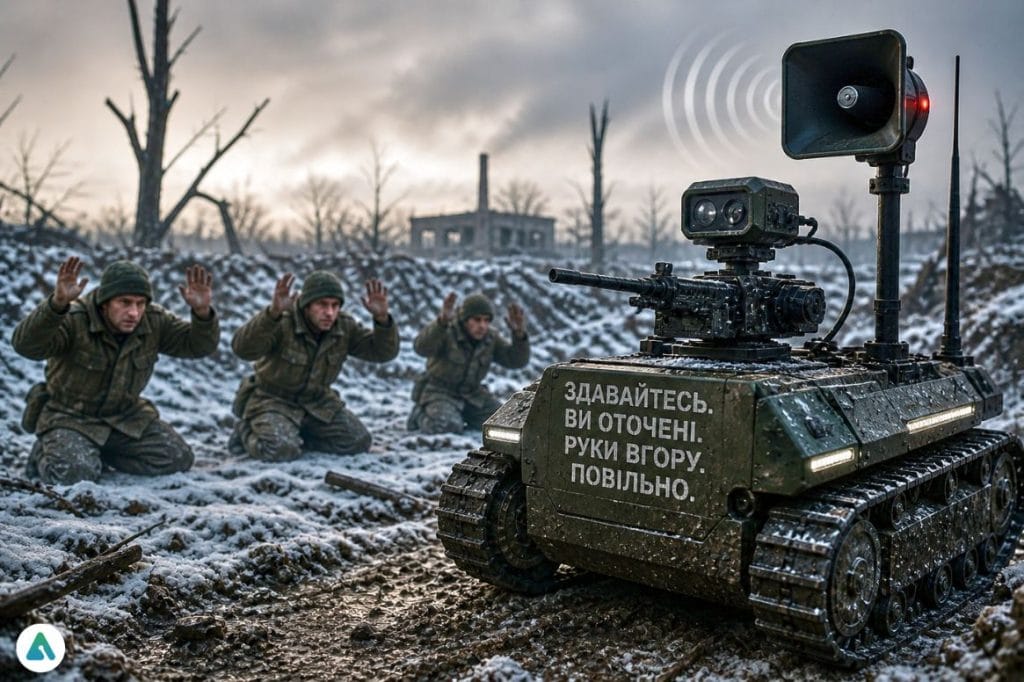
Three Russian soldiers, hands raised, crouching in the snow. No Ukrainian troops in sight. Just a machine with a machinegun, barking orders through a speaker. The footage from DevDroid, released in January, isn’t just striking because of what the robot did. It is striking because of how the soldiers responded—immediate, terrified compliance—to something they cannot threaten back.
That moment may be the most revealing thing to come out of Ukraine’s war in years.
From Bomb Disposal to Brigade Asset
Ground robots spent decades doing one thing: approaching objects that might kill the humans sent to examine them. Ukraine compressed what should have been a generation of doctrinal evolution into roughly three years of necessity.
Some brigades now report that up to 70 percent of front-line supplies arrive via robotic systems. The math driving that figure isn’t complicated — FPV drones have moved to the front lines, near-suicidal for any soldier on foot. The Bizon-L, a Ukrainian-built logistics robot now codified under NATO standards, hauls 300 kilograms across 50 kilometres of Donbas terrain using Starlink and thermally shielded radio links. It handles the deliveries that were killing people. When a signal drops mid-mission and the Bizon-L goes dark in a contested corridor, operators describe reacquiring it as a controlled scramble — checking frequency bands, switching relay nodes, watching GPS drift on a screen while trying not to think about what’s moving toward it on the other side. The machine is cheaper to lose than a soldier. Everyone knows it. Nobody says it feels fine.
By April, President Zelenskyy announced that unmanned platforms had taken an enemy position exclusively for the first time in the conflict’s history. Ground systems had logged over 22,000 missions in three months. Ukraine’s Defence Ministry has committed to 25,000 unmanned ground vehicles in the first half of 2026 — double the previous year — with Defence Minister Mykhailo Fedorov stating a clear target: 100 percent of frontline logistics handled by robots.
The War the Jammer Is Winning
Here’s the part most coverage skips. Ukraine’s robot surge is real, but so is Russia’s response — and the response isn’t infantry. It’s interference.
Russian forces have rapidly expanded electronic warfare capabilities targeting UGV communications. The key vulnerability of remotely operated ground systems is the link between operator and machine. Jam the signal, and a $50,000 robot becomes stationary metal. Ukrainian engineers have responded with frequency-hopping protocols and multi-band fallback systems. But the arms race is now measured in firmware updates, not troop movements.
Computer vision is emerging as a partial fix. Onboard systems can hold a route or position autonomously for seconds or minutes when the signal drops, without requiring a human command for every action. This is a narrow technical capability. It is also where the idea of a “human in the loop” starts to blur.
The Stockholm International Peace Research Institute’s April 2026 report flagged this directly: the AI supply chain feeding military systems is fragmented, globally distributed, and built almost entirely on civilian technology nobody designed as a weapons architecture. The gap between what the hardware can do and what the governance frameworks cover is widening faster than anyone in Geneva is moving.
The Legal Framework That Isn’t There Yet
Toby Walsh, an AI expert at the University of New South Wales, calls AI-driven military operations “the third revolution of warfare” — and he’s not being dramatic. His concern isn’t the robots working as designed. It’s the speed. “If we’re not careful,” he said, “warfare will be much more terrible, much more deadly, a much quicker, much faster thing that humans can no longer actually really be participants in.”
Anna Nadibaidze, a postdoctoral researcher at the Centre for War Studies, University of Southern Denmark, has been pushing for tighter regulatory debate around semi-autonomous systems — not the fully autonomous killer robot of science fiction, but the systems where humans are technically “in the loop” while the loop itself runs faster than human judgement can track. The Turkish-made Kargu-2 loitering munition allegedly identified and engaged targets in Libya in 2020 without human direction. That incident remains disputed, but the dispute is the point: nobody has agreed on what “meaningful human control” requires in practice, and the ongoing UN Convention on Lethal Autonomous Weapons Systems process has produced dialogue without binding frameworks. Weapons are being deployed into the gap.
Russia has also begun fielding counter-robotic FPV drones. These small, fast, and cheap systems are tuned specifically to hunt Ukrainian UGVs rather than soldiers.
The drone-versus-drone economy emerging in Ukraine may be the clearest preview of mid-century warfare available. Machines destroy machines. Humans still manage production and strategy, but they are increasingly removed from individual engagements.
What the Surrender Footage Actually Tells Us
The psychological layer in that January footage deserves more attention than it’s received. Those Russian soldiers weren’t surrendering to firepower they couldn’t overcome. The robot’s machine gun was mounted but didn’t fire. They surrendered to uncertainty — to something that gave commands, tracked their movement, and offered no readable emotion or hesitation. There’s no negotiating with it. No appealing to its fatigue or its fear. The uncanny valley that makes humanoid robots unsettling in living rooms becomes a tactical asset in a trench.
That asymmetry — the human confronting something that has no stake in the outcome — is new to warfare in a way that supersonic missiles or thermobaric weapons aren’t. Those kill. This one just… waits. And the waiting, apparently, is enough.
For a deeper look at how AI systems are being integrated into defence infrastructure across NATO and allied states, the 2025 Defence AI Revolution remains essential context for where this trajectory started.
The question that needs answering before the next position falls — not after — is who is accountable when the machine decides the target qualifies, and the human in the loop was two seconds too slow to say no.
Related: Inside the AI Warfare Era: How Pentagon Threats Are Redefining the Future of Combat
