

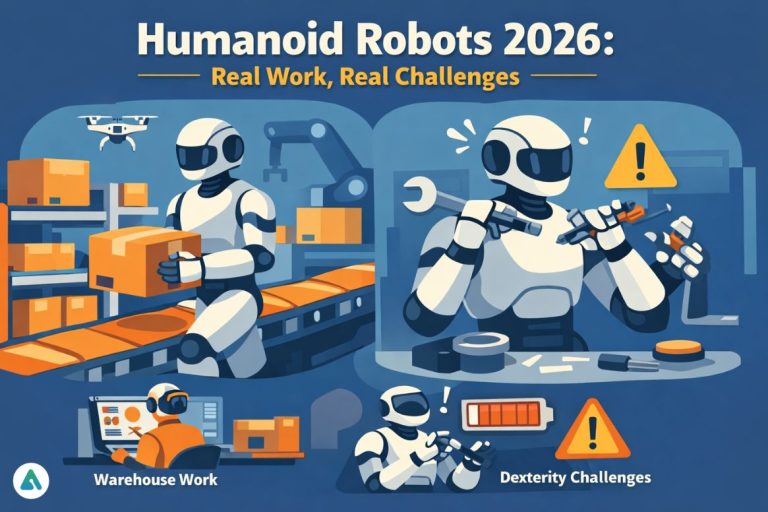
A few years ago, humanoid robots mostly lived in demos. Carefully staged videos, lab environments, and keynote presentations built around the future tense. In 2026, that’s changed — not completely, not without caveats, but in ways that matter.
These machines are now running in warehouses. They’re on pilot manufacturing lines. A handful are inside controlled home trials. They’re still not everywhere, and they still fail in ways that remind everyone how hard the problem is. But they’ve crossed a meaningful threshold: they’re doing useful work in real environments, not just impressing audiences in controlled settings.
The bigger shift wasn’t mechanical. It was software. New AI systems can interpret natural language, understand what they’re seeing, and translate both into coordinated physical action. Pair that with better actuators, declining hardware costs, and industrial pilots that are moving from “interesting” to “financially meaningful,” and humanoid robotics starts to look less like science fiction and more like an industry category with actual commercial momentum.
What follows is a practical look at where things actually stand in 2026 — what these machines are, how they work, who’s building them, what they cost, and what’s realistically coming next. No demo footage. Just the state of the field.
What a Humanoid Robot Actually Is (And Why the Form Factor Matters)

A humanoid robot is a robot built around the basic structure of the human body. Two arms, two legs, a torso, a head-like unit carrying sensors, and a compute. That description sounds obvious, but the reasoning behind it is worth understanding.
The world is already designed for human bodies. Doors, stairs, shelves, hand tools, carts, factory workstations, and homes all assume a roughly human-sized worker with arms and capable hands. A humanoid robot can, in theory, enter those spaces and do useful work without requiring the environment to be rebuilt around the machine. That’s the core commercial logic. Not aesthetic preference — operational compatibility.
Most systems include multi-fingered hands or dexterous grippers, onboard sensors for spatial awareness, and AI software that interprets instructions and adapts to situations the system hasn’t seen before. The goal isn’t to imitate humans for its own sake. It’s to make the robot compatible with human-scale environments that would otherwise require expensive infrastructure redesign.
The Technology Stack: What’s Actually Changed

AI Is Doing More of the Heavy Lifting
The most important advance in 2026 isn’t in the physical hardware. It’s in the intelligence running inside the machine.
Earlier robots depended on fixed programming. A task had to be explicitly scripted, and if the environment changed — an object in a slightly different position, a new container, a missing part — performance degraded fast. The newer generation of systems is moving toward what researchers call Vision-Language-Action models, or VLA models. In practical terms, this means a robot can receive a general instruction — “pick up the red bracket and place it on the assembly fixture” — process the language, identify the relevant object in its visual field, and attempt the motion, rather than executing a narrow command tree.
That is a genuine architectural shift. The robot is no longer just executing a deeply specific script. It’s responding to a general instruction in context, which is what makes these systems feel meaningfully different from their predecessors.
Simulation-based training has amplified this change considerably. Rather than teaching everything through costly physical trials, companies now train robotic systems in virtual environments first, compress enormous amounts of practice into short timeframes, then transfer the learned behavior into the physical machine and refine from there. That pipeline — simulation, transfer, real-world refinement — is one of the main reasons robots in 2026 look more adaptable than the ones people were watching two or three years ago.
This sits within the broader shift toward what’s increasingly called generative vs. predictive AI — systems that can reason and respond rather than just pattern-match to historical inputs. Humanoid robotics is one of the most demanding real-world tests of that distinction.
Walking Is Still Genuinely Hard
Bipedal locomotion remains one of the most stubborn engineering problems in the field. Humans walk without thinking about it. For a robot, staying upright while turning, carrying weight, stepping around clutter, and recovering from a stumble requires continuous calculation across force, timing, foot placement, momentum, and posture simultaneously.
Progress is real, though. The newer generation is smoother, quieter, and less awkward than what came before it. Electric actuation has helped significantly — compared with older hydraulic-heavy designs, electric systems are easier to control, less noisy, and less burdensome to maintain over time. The result isn’t human fluidity, at least not yet. But in structured environments like factories and warehouses, locomotion is increasingly good enough to be useful rather than just impressive.
Hands Remain the Weakest Point
If walking is difficult, hands may be the harder problem.
An enormous share of human work comes down to dexterity — pinching, aligning, twisting, holding, sorting, folding, repositioning, applying just the right amount of force without crushing or dropping. That’s far more complex than simply grasping an object, and it’s where current hardware most visibly struggles.
Progress is happening. Many 2026 humanoids feature multi-fingered hands with more degrees of freedom and improved tactile sensing. Some can detect when an object is beginning to slip, adjust grip pressure in real time, and handle objects that earlier systems would have destroyed. But this is still the weakest link in the stack. Real industrial pilots have consistently flagged wrists and forearms as stress points — hardware that breaks down under sustained repetitive load in ways that don’t show up in demo conditions.
“Can do it in a demo” and “can do it reliably across an eight-hour shift” remain meaningfully different things. That gap is narrowing, but it’s not closed.
Perception: Seeing, Measuring, and Deciding
Modern humanoid systems don’t just carry a camera and a map. They layer multiple sensing modalities to build a working picture of the environment.
Most combine RGB cameras for visual recognition, depth sensing for geometry and distance, force and torque sensing in joints, and tactile feedback in hands or fingertips. Together, those signals help the robot determine what it’s looking at, how far away it is, how to approach it safely, and how much pressure to apply when making contact.
The critical development is that perception now feeds directly into action rather than sitting upstream of it as a separate processing step. A robot isn’t just “seeing a box.” It may simultaneously estimate the object’s orientation, probable weight, optimal grasp points, and likelihood of slipping — and begin moving before that analysis is fully complete. That tight integration between sensing and doing is a large part of what makes newer systems feel more capable even when the hardware hasn’t changed dramatically.
The Companies Building These Machines
The field is moving quickly enough that any ranking risks becoming outdated within months, but a few platforms stand out for reasons beyond marketing.
Tesla Optimus Gen 3 remains closely watched primarily because of Tesla’s manufacturing scale. If any company has the supply chain and production capacity to bring humanoid robot costs down through volume, it’s Tesla. The latest generation focuses on precision and production-readiness rather than expanding capability. Widespread deployment is still early, but the industrial logic behind Tesla’s investment is coherent in ways that some competitors’ roadmaps are not.
Boston Dynamics Atlas (electric version) represents the maturation of one of robotics’ longest-running research programs. The shift away from hydraulics changed the machine’s character considerably — quieter, more controllable, more field-deployable. Atlas still sits at the high end of complexity and cost, but it continues to set the benchmark for whole-body movement and agility.
Figure 03 has earned serious attention by pairing capable hardware with an aggressive AI development track. The platform is being pushed toward longer-horizon task sequences rather than isolated motions — meaning the robot isn’t just picking up an object but working through multi-step tasks that require planning, not just execution.
1X NEO is the most interesting home-oriented platform in the current field. Most humanoid development has focused on industrial settings where the environment is structured and the economic case is clearer. NEO’s consumer-facing model is genuinely different, and the company’s soft-body design philosophy represents a meaningful departure from the metal-and-joints aesthetic that dominates the category.
Unitree G1 has disrupted the market primarily on price. It may not lead in every performance category, but it matters enormously from a market development perspective. Lower entry costs expand who can experiment — researchers, smaller developers, universities — and that experimentation generates the ecosystem effects that accelerate the whole field.
Top Humanoid Robots in 2026 (Updated)
| Robot | Company | 2026 Status | Key Milestone |
| Optimus Gen 3 | Tesla | Early mass production | 22-DoF hands; 0.08mm precision—handles eggs & laundry |
| Electric Atlas | Boston Dynamics | Enterprise-ready | Electric actuators, advanced mobility |
| Figure 03 | Figure AI | Fleet deployment | Helix VLA model for long-horizon tasks |
| NEO | 1X Technologies | Home beta | Soft-body design; $20,000 or $499/month |
| Unitree G1 | Unitree Robotics | Market leader (value) | $16,000 base price; open platform for developers |
Humanoid Robot Prices in 2026
| Category | Price Range | Best For |
|---|---|---|
| Entry / Prosumer | $16,000 – $30,000 | Small businesses, developers, and research labs |
| Mid-range / Commercial | $30,000 – $80,000 | Logistics pilots, multi-unit deployments |
| Enterprise | $80,000 – $150,000+ | Advanced manufacturing, precision assembly |
| Specialist / Custom | $150,000 – $500,000+ | Disaster relief, high-precision R&D |
Unitree G1: $16,000 entry-level robot—disruptive like Android in smartphones. Small warehouses and labs can now realistically access bipedal robots.
Robot-as-a-Service Is Gaining Real Traction

Not every organization wants to own a robot outright, and for many use cases, they probably shouldn’t.
Robot-as-a-Service — RaaS — addresses this by packaging robot access as a subscription, typically bundled with maintenance, software updates, and support. Pricing in 2026 varies widely depending on capability tier and service level, but the model matters less for any specific price point than for what it does to the adoption curve. A company that would never approve a six-figure capital expenditure for a robot may be willing to run a three-month operational pilot if the cost appears on the P&L as an operating expense rather than a capital commitment.
RaaS doesn’t just lower financial risk. It makes organizational experimentation possible in environments where experimentation is otherwise politically difficult.
The Hybrid Autonomy Reality Nobody Talks About Enough
One of the most important honest truths about humanoid robots in 2026 is that many of the most useful deployments aren’t fully autonomous. Especially outside tightly controlled industrial environments.
That’s not a failure. It’s a design choice that reflects operational reality.
A more accurate model has emerged across serious deployments: partial autonomy with human backup. For routine, predictable tasks, the robot operates independently. For unusual cases — an unexpected object configuration, an unfamiliar surface, an edge condition the training data didn’t cover — a remote operator steps in, helps complete the task, and in doing so often generates training data that improves future performance.
This hybrid model is more commercially useful than the all-or-nothing framing that dominated earlier robotics coverage. A company doesn’t need a perfect autonomous robot to benefit from deployment. It needs a robot that handles the common cases reliably, escalates gracefully when it can’t, and gets better over time. That’s achievable now. Perfect full autonomy across diverse real-world conditions is not — at least not yet.
The relationship between AI and human decision-making in these hybrid systems is also worth thinking carefully about. The risk over time is that human operators become less engaged as robots handle more of the routine work, which reduces the quality of oversight precisely when an unusual situation arises that genuinely requires it. That’s a governance and design problem as much as a technical one.
Where Humanoid Robots Are Actually Working

Logistics and Warehousing
This is the clearest early market, and for obvious reasons. Warehouses are structured, repetitive, and labor-intensive. The tasks — moving bins, loading items, transporting materials, performing routine handling — are exactly the kind of work current systems can begin to absorb without requiring perfect dexterity or creative problem-solving. The economics make sense in ways they don’t yet in less structured environments.
Manufacturing
Factories are the other strong candidate. Automotive and battery assembly pilots are particularly telling because they expose whether robots can handle repetitive physical stress across extended periods, not just in showcased demonstrations. The results have been mixed — promising enough to justify continued investment, uneven enough that “production-ready” still means something different from “demo-ready.”
Healthcare Support
Healthcare use remains limited and appropriately cautious. The realistic near-term roles involve support functions rather than direct care — fetching supplies, delivering materials, handling low-risk logistics in controlled hospital environments. AI’s role in healthcare settings remains a subject of active research and debate, and humanoid robots are a long way from clinical autonomy.
Home Use
This is the most overhyped segment in the current market.
Yes, some robots can demonstrate household tasks in controlled conditions — folding laundry, carrying items, simple cleaning sequences. “Can do it in a demo” is genuinely impressive. It is also genuinely different from “can do it reliably in an ordinary home with pets, variable lighting, clutter, and constant exceptions to every pattern the system was trained on.”
Home humanoids are real, early-stage platform products. The right comparison isn’t a finished appliance. It’s an early smartphone — interesting, capable in specific ways, and nowhere near its eventual form.
Sim-to-Real Training: Why It Changes Everything

The shift from manual programming toward simulation-based training is one of the structural changes that makes 2026 humanoids feel different from their predecessors.
The basic logic: train robot behavior in simulation, transfer the learned model to the physical system, refine it through real-world experience. Simulation lets companies compress what would otherwise require years of physical trials into weeks of compute time. The robot learns broader patterns rather than brittle task-specific scripts, which is why it handles novelty better — not perfectly, but better than anything that came before.
The MIT Technology Review has tracked this training paradigm shift extensively, noting that sim-to-real transfer has become one of the core technical battlegrounds in robotics — not the hardware itself, but how quickly and effectively behavior learned in virtual environments translates to physical performance.
Failure modes still exist, sometimes dramatically. But the failure profile is different. These systems fail because they haven’t generalized well enough, not because a programmer forgot to account for a specific case.
What They’re Good At, Where They Still Break
Humanoid robots in 2026 are genuinely useful in structured environments — spaces that are already built for humans, where tasks are repetitive and physically demanding, and where some adaptability is required but extreme novelty is rare. That description fits a large portion of industrial and logistics work.
They struggle with sustained reliability. Battery life remains a practical constraint. Dexterity is improving but incomplete. Hardware durability under load — particularly joints, wrists, and actuators — is still a real operational concern rather than an engineering footnote. And once a robot leaves a structured environment and enters a setting with genuine unpredictability, failure rates climb sharply.
The current story does not have unlimited capability. It’s expanding its usefulness within clear operational boundaries. Companies deploying these systems are finding value not by treating them as general-purpose workers, but by identifying the specific tasks where the current capability level is sufficient, and the economics justify deployment.
Will They Replace Human Workers?

Not in the way the popular conversation tends to assume.
Some tasks — repetitive warehouse handling, routine industrial support work, certain physical jobs with high injury rates — will increasingly be automated. That’s already happening in early deployments. But the picture is more complicated than simple displacement.
New categories of work are emerging around robot supervision, deployment management, maintenance, task design, safety oversight, and AI training. These aren’t hypothetical compensatory roles invented to soften the narrative. They’re real job functions appearing in organizations that are actually deploying robots at scale.
The broader question of AI and human dependency in automated systems is one that researchers are tracking carefully — not just in robotics but across the range of AI tools entering workplaces. The concern isn’t only job displacement. It’s whether human skills erode in environments where automation handles most of the routine work, and what that means for the humans who remain responsible for oversight.
The more accurate frame for what’s happening isn’t “robots replace humans.” It’s “tasks get redistributed.” Humans still handle judgment, improvisation, communication, and accountability in ways machines don’t. Robots contribute consistency, endurance, and physical repetition. That balance is shifting, but it’s shifting more slowly and unevenly than the breathless coverage suggests.
What to Watch in the Next Phase
A few trends are likely to shape where humanoid robotics goes from 2026 forward.
The embodied AI narrative is becoming central to how the largest AI companies think about their roadmaps. Intelligence that can act physically in the real world — not just generate text or analyze images — is increasingly seen as the next meaningful frontier. That framing is bringing investment and talent into robotics from the AI side of the industry, which historically operated separately.
The market is also moving toward general-purpose platforms rather than single-purpose machines. Not because one robot will do everything well, but because versatility is becoming more commercially valuable than perfect optimization around one narrow task. A machine that can handle five different tasks adequately is often more useful than one that handles one task perfectly.
Hardware is finally catching up to software ambition. Better actuation, improved control systems, and more practical mechanical designs are making deployment less theoretical. The gap between what AI can direct a robot to do and what the physical body can actually execute has been narrowing.
And price pressure is accelerating. Aggressive manufacturers — particularly from Asia — are forcing the entire market to move faster. Lower-cost platforms expand developer ecosystems, accelerate iteration, and compress the timeline between capability development and commercial deployment.
The risks that come with rapid AI deployment — including in physical systems — deserve attention alongside the capability advances. Moving fast has costs when the systems involved can act in the physical world.
Frequently Asked Questions
Q. What is a humanoid robot?
A humanoid robot is a machine built around the human body plan — arms, legs, sensors, onboard computing, and AI software — specifically so it can operate in spaces that were designed for people rather than machines.
Q. What’s the cheapest humanoid robot available in 2026?
The lowest-cost well-known platforms are now in the $16,000 range, a significant shift from where the market sat just a few years ago. That price point has opened the category to universities, developers, and smaller organizations that previously couldn’t participate.
Q. Can humanoid robots actually do housework?
In limited, supervised conditions — sometimes. In ordinary homes, reliably, across a full day of variable conditions — not yet. Household robotics is still genuinely early, even if the demos look more impressive than they used to.
Q. What is sim-to-real training?
It’s the process of training robot behavior in virtual simulation environments, then transferring those learned behaviors into a physical robot and refining them through real-world experience. It’s one of the main reasons current robots adapt to novelty better than earlier systems did.
Q. What is Robot-as-a-Service?
A subscription model where companies lease robots rather than purchasing them outright, with maintenance, software updates, and support typically bundled into the monthly cost. It changes the adoption decision from a capital investment to an operating expense, which matters a lot for organizational buying behavior.
Q. Are humanoid robots going to replace jobs?
They’ll automate specific tasks — especially repetitive, physically demanding, or hazardous ones — and that process is already underway in early deployments. But the broader pattern is likely to be task redistribution and human-machine collaboration rather than straightforward displacement. New job categories are appearing alongside the automation.
Q. What’s the biggest remaining technical challenge?
Dexterous manipulation — what hands can do — remains the clearest gap between what humanoid robots can demonstrate and what they can do reliably under real operational conditions. Locomotion has improved significantly. Hands are still catching up.
Final Verdict
Humanoid robots in 2026 have cleared a meaningful bar. They’re no longer interesting science experiments. In specific settings, they’re economically useful enough to justify real deployment. That’s a different statement than it was two years ago.
But the gap between “useful in structured settings” and “reliable across the full range of human work environments” is still large. Battery life, dexterity, durability, and robust autonomy remain works in progress. The honest picture isn’t robots taking over — it’s a category that has finally found its first genuine commercial footholds and is now figuring out how far those can extend.
Where that line gets drawn, and how fast it moves, is what makes the next three years worth watching closely.
Related: ERP AI Chatbot in 2026: Architecture, ROI, Guardrails & Real Enterprise Risks
| Disclaimer: This article reflects the state of humanoid robots as of 2026. Capabilities, pricing, and real-world performance may vary, especially as many systems are still in early deployment. This content is for informational purposes only and not technical or investment advice. |
