
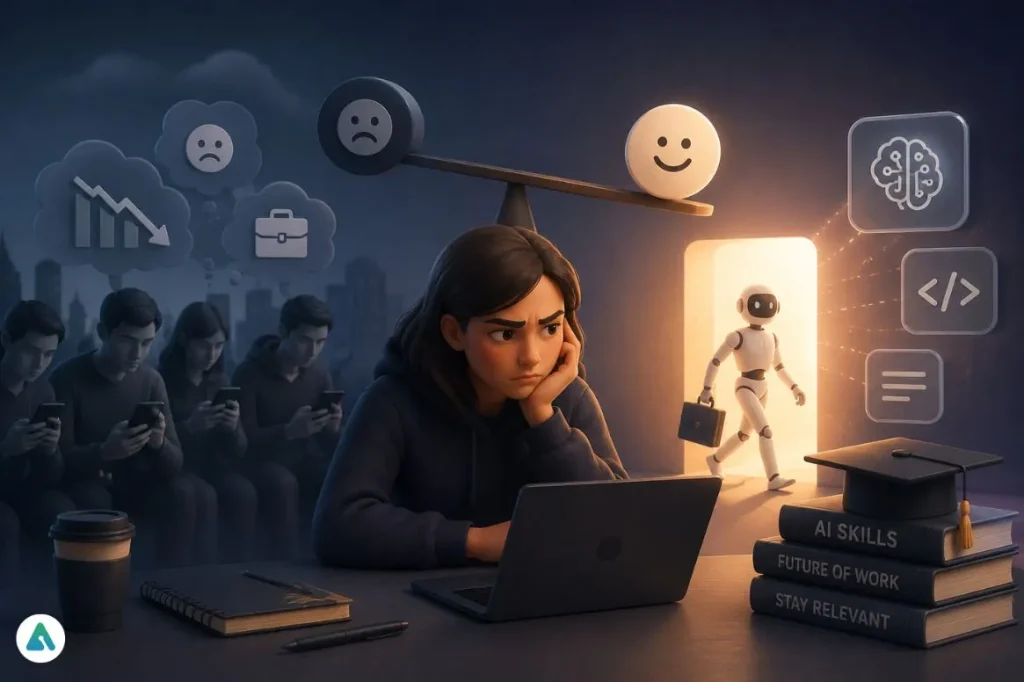
Anger doesn’t slow adoption. It changes the relationship people have with the thing they can’t avoid.
The Mood Crashed. The Usage Didn’t
A year ago, AI looked much more exciting to young people. Now, that enthusiasm has cooled sharply, according to Gallup’s latest release for the Walton Family Foundation and GSV Ventures, officially titled The AI Paradox: More Exposure, Less Confidence Among Gen Z.
| Feeling | 2025 | 2026 | Shift |
|---|---|---|---|
| Excitement | 36% | 22% | -14 |
| Hopefulness | 27% | 18% | -9 |
| Anger | 22% | 31% | +9 |
| Anxiety | 41% | 42% | steady |
But the biggest surprise is what didn’t move. Gen Z’s AI usage remained almost identical:
- 22% use AI daily
- 29% use it weekly
The most common feeling is still curiosity, reported by 49% of respondents.
Gen Z didn’t fall out of love with AI. The relationship was never a simple love story. It was a negotiation between opportunity, uncertainty, and the feeling that AI is becoming impossible to ignore.
Where the Anger Actually Comes From
The frustration isn’t random.
Gallup researcher Zach Hrynowski points out that older members of Gen Z — those entering college, graduating, and searching for their first jobs — show the strongest negative feelings toward AI, a pattern he links to the sense that entry-level work is disappearing before they get a shot at it.
For someone already established in a career, AI can feel like a productivity tool. For someone trying to enter the workforce, it can feel like competition arrives before they even get their first chance. Older generations encountered new technology as something that created opportunities. Gen Z is encountering AI during a different moment entirely — a job market where entry-level paths already felt uncertain, and automation is now part of the conversation before many have even started.
The Skepticism Goes Deeper Than Jobs
The concern isn’t only employment.
According to Gallup’s findings, 42% believe AI hurts their ability to think critically, against just 25% who think it helps. Agreement that AI speeds up learning fell to 46%, down seven points from 53% last year.
It’s not abstract for them, either. Eight in 10 Gen Zers — 34% “very likely,” 46% “somewhat” — think relying on AI to finish things faster will make learning harder down the road. That’s not mild unease. That’s a generation watching convenience eat into competence in real time, and saying so out loud.
Trust Has Limits
Gen Z may use AI, but that doesn’t mean they trust it. Fewer than one in five would choose AI over a human for:
- tutoring
- financial advice
- customer service
The wariness doesn’t stop at school. Employed Gen Zers are more than three times as likely to say AI’s risks outweigh its benefits at work — 48% versus 15%. And when it comes to trusting the finished product, the math is lopsided: 69% trust work done without AI, against 28% for anything AI touched.
A generation raised with smartphones and online platforms still wants a human connection when the outcome actually matters.
Obligation, Not Affection
The biggest contradiction is this: Gen Z is skeptical of AI even as it prepares to rely on it.
More than half of students say AI skills will be necessary to get through college. One respondent summed up the mood: “We use AI because we don’t have a choice.”
Schools are adapting fast. The share of K–12 students whose schools have formal AI policies jumped from 51% to 74% in a single year. The number of students who believe they’ll be ready to use AI daily after graduation rose from 44% to 56%.
Readiness is climbing. Enthusiasm isn’t.
What This Actually Signals
The AI industry has spent years selling curiosity, creativity, and possibility. Gen Z’s reaction suggests a different message is landing: AI is becoming inevitable.
Inevitability doesn’t create loyalty. It creates dependence.
The next challenge for AI companies isn’t getting people to use AI — they already are. The harder challenge is turning “I have no choice” into “I trust this.” Because the generation most likely to shape the future of AI is also the generation least sure it wants that future.
Related: Is AI Ruining Everything in 2026? A Reality Check on Mismanaged Artificial Intelligence
