
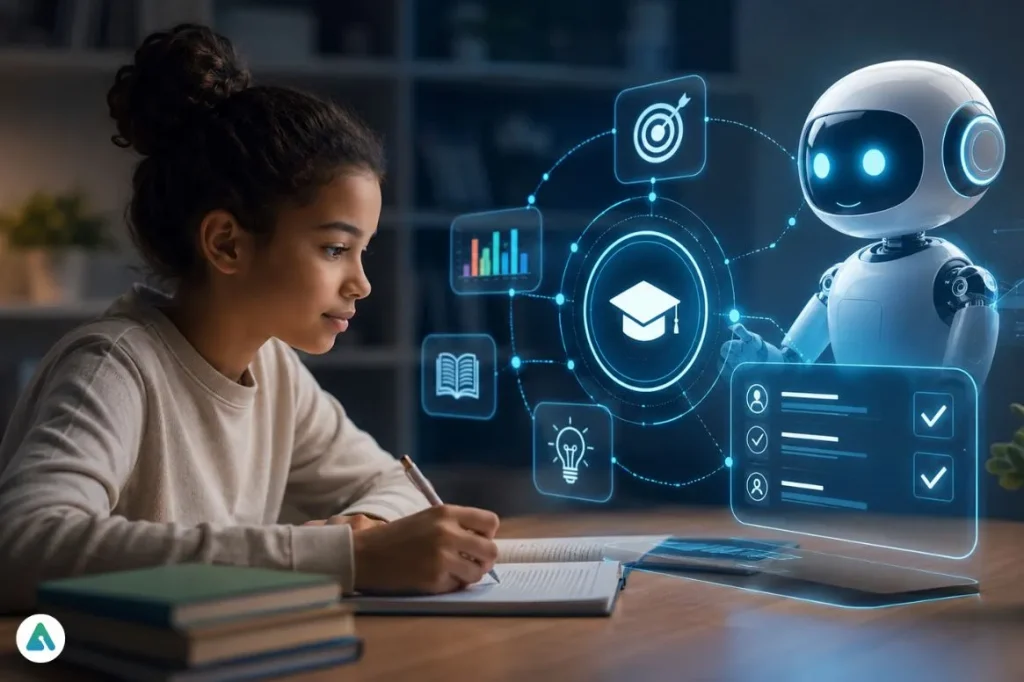
The oldest finding in education research is also the most inconvenient: one-to-one tutoring works dramatically better than classroom instruction, and it has never been affordable to deliver at scale. Adaptive learning powered by AI is the most serious attempt yet to close that gap — to give each learner something closer to a personal tutor without a human tutor for every learner. This article examines how these systems work, what the evidence actually shows, and where the technology is mature versus oversold.
What is adaptive learning, really?
Adaptive learning is instruction that changes in real time based on data about the individual learner. It is not the same as branching, where a designer pre-scripts a fixed set of paths. True adaptation uses a model of what the learner knows to decide what comes next — which concept to review, which problem to serve, and when to advance.
The distinction matters. A branching course offers the same handful of routes to everyone; an adaptive system constructs a different route for each person from continuous performance signals. Personalized learning in the strong sense means the content sequence itself is generated from the learner’s behavior, not chosen from a menu.
How AI tutors work

AI tutors combine three layers: a model of the learner, a model of the content, and a decision engine that connects them. The learner model tracks mastery — which skills are solid, which are shaky — and updates with every response. The content model maps prerequisites and difficulty. The decision engine picks the next action to maximize learning.
What generative AI adds is flexibility at the surface. Earlier intelligent tutoring systems relied on hand-authored hints and feedback for every step, which made them expensive to build. Generative models can now produce explanations, hints, and worked examples on demand, and interpret open-ended learner input rather than only multiple-choice answers. The underlying adaptive logic is decades old; the language layer on top is what is new.
The evidence: Does personalization actually improve outcomes?
The research is encouraging but more modest than the marketing. The benchmark is Benjamin Bloom’s classic 2-sigma study, which found that one-to-one human tutoring moved the average student to roughly the 98th percentile of a conventionally taught class — a two-standard-deviation gain.
AI systems do not reach that bar, but they close part of the gap. A meta-analysis of 50 controlled evaluations in Review of Educational Research found intelligent tutoring systems raised test scores by about 0.66 standard deviations over conventional instruction — meaningful, roughly moving a median student to the 75th percentile, but short of full human tutoring. The honest framing for an AI audience: real, replicated effect sizes, not a 2-sigma miracle.
Who is building this — and how
The ecosystem has three tiers that increasingly overlap. Foundation-model providers supply the generative layer; dedicated platform companies build adaptive engines and learner-data infrastructure; and e-learning developers integrate these capabilities into actual courses for clients. The interesting shift is at that third tier, where production studios that once built static content now design adaptive logic and data instrumentation into their work — firms such as Blue Carrot company operate in this content-production layer, combining instructional design with AI-assisted delivery. The practical takeaway: building a credible adaptive course requires expertise in pedagogy and data modeling, not just access to a model API.
The hard constraints: data, privacy, and bias
Personalization runs on learner data, and that is the technology’s central liability as much as its engine. An adaptive system needs continuous behavioral signals to function, which raises real obligations — especially with minors, where regulations like FERPA in the US and GDPR in the EU constrain what can be collected and stored. Learning analytics that power adaptation are also the analytics that create privacy exposure.
Bias is the subtler risk. If the learner model misjudges a student — underestimating ability from noisy early data — the system can route them to easier content and quietly cap their progress. Adaptive decisions made at scale can entrench inequities unless they are audited, which most deployments do not yet do rigorously.
What AI tutors still can’t do
Adaptive systems optimize the what-next of instruction; they do not supply the why-bother. They are weak at exactly what human tutors do best:
- Motivation and accountability — sustaining effort when a learner wants to quit.
- Ambiguous judgment — coaching open-ended skills with no single correct path.
- Accuracy on niche content — generative tutors can state wrong information confidently.
- Mentorship — the relational, trust-based part of teaching.
These are not gaps that a larger model closes. They are the parts of education that remain irreducibly human.
Conclusion
AI tutors and adaptive learning are real, evidence-backed technologies that make personalized instruction far more scalable than it has ever been — closing part of Bloom’s gap, though not all of it. The systems work best as an augmentation: handling sequencing, practice, and feedback at scale while humans supply motivation, judgment, and oversight of the data and bias risks. The organizations that benefit are the ones treating adaptation as a design and governance discipline, not a feature to switch on.
Related: Think for Yourself in the Age of AI: The Cognitive Sovereignty Survival Guide
