
Most AI memory systems are built around personalization. They remember your preferences, your writing style, and your recurring requests, then use that information to make the experience feel more tailored.
Perplexity is taking a different route — and pricing it like a luxury tool.
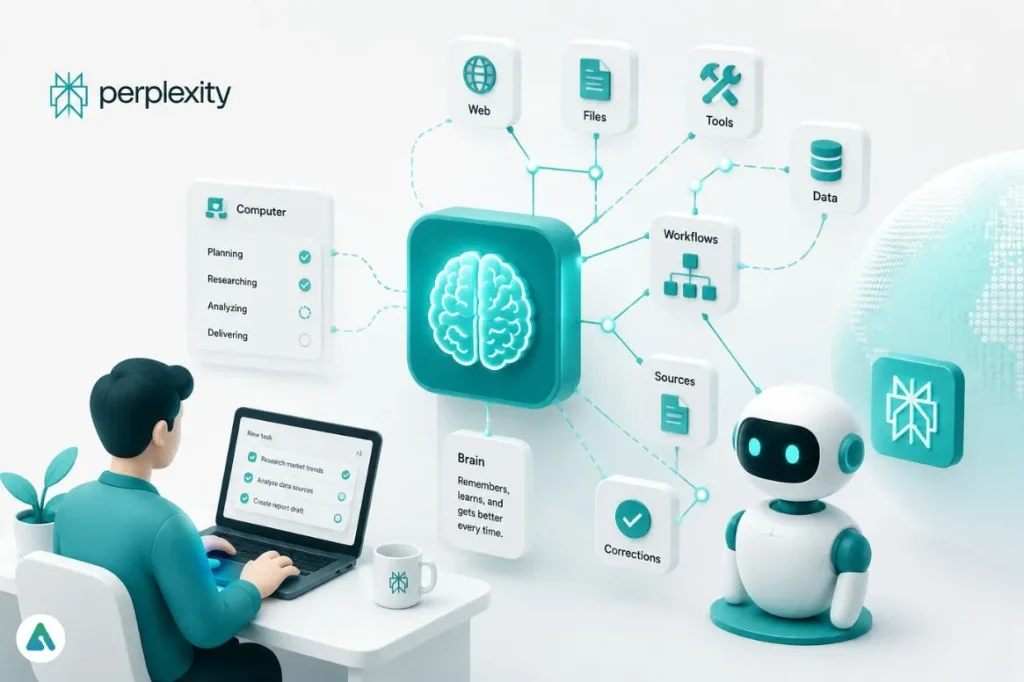
Brain, the new memory system the company launched today, is built for Computer, the cloud-based agent Perplexity shipped back on February 25, 2026, to orchestrate 19 different models across multi-step tasks. Brain isn’t designed to build a profile of who you are. It’s designed to remember the work itself: what Computer tried, what failed, what got corrected, which sources held up, and what should carry into the next task.
That distinction could reshape the AI memory race. It also comes at ten times the price of a normal AI subscription.
The Question Everyone Else Got Wrong
The competition around AI memory has mostly focused on intimacy.
AI assistants have increasingly moved toward remembering user preferences: how you like answers written, what topics you care about, and how you typically work. The goal is simple — make future interactions feel more personal.
Perplexity’s Brain takes a different approach. Instead of asking “how do we know the user better,” it asks “how do we make the agent better at the task.” Brain is built around the idea that an AI assistant shouldn’t restart from zero every time. It should learn from previous work.
ChatGPT remembers that you write in third person and prefer Oxford commas. Brain remembers that last Tuesday, Computer’s own script choked on a malformed API response — and it isn’t supposed to make that exact call again.
Traditional AI memory is about the user. Brain is about the process.
How It Actually Works
Brain isn’t a flat preferences list or a vector store. It’s a relational context graph — internally shaped like an LLM wiki — that gets compiled overnight and loaded straight into Computer’s sandboxed runtime the moment a new task starts.
The graph pulls from previous sessions, connected tools, files, research, and user corrections, then organizes that history into a structured memory system rather than a pile of disconnected facts.
The goal isn’t just remembering facts. It’s remembering decisions. A failed approach becomes a warning. A useful source becomes a shortcut. A workflow that worked becomes a reusable pattern.
The Overnight Lag
Here’s the part Perplexity doesn’t put in the headline: Brain doesn’t learn in real time.
Synthesis runs on a schedule — “such as overnight,” in Perplexity’s own framing — which means a correction made at 9 a.m. doesn’t necessarily change anything until the next sync. Make the same mistake again at 2 p.m., and Computer can repeat it the exact same way, because the lesson hasn’t been written into the graph yet.
That’s a deliberate tradeoff, not an oversight. Batching the learning keeps the system cheap to run. It also means today’s fix is tomorrow’s feature, not this afternoon’s.
Who Actually Benefits
The best use cases here are not flashy. They’re repetitive, professional workflows.
A data scientist running the same pipeline checks every week avoids repeating dead ends, because Brain remembers which sources and methods worked before. A support team resolves tickets faster because the system remembers which fixes worked last time. A developer debugging across repositories skips the paths that have already proved irrelevant.
None of that requires knowing your favorite color. It requires knowing what happened last time.
The Numbers
Perplexity’s early internal testing showed improvements on tasks where Computer had prior context: 25% higher answer correctness, 16% better recall, and 13% lower cost on tasks that lean on historical context. Those numbers come from Perplexity’s own testing — independent benchmarks haven’t weighed in yet.
| Traditional AI memory | Perplexity Brain | |
|---|---|---|
| Tracks | User preferences, tone, history | Work logs, failures, corrections |
| Updates | Real-time, in-session | Nightly batch synthesis |
| Format | Profile or flat vector store | Relational context graph (“LLM Wiki”) |
| Top-tier price | ~$20/month (ChatGPT Plus) | $200/month (Perplexity Max) |
Still, the direction is interesting. Perplexity is effectively arguing that today’s token usage can become tomorrow’s efficiency gain.
The Price of Admission
Brain ships in Research Preview, restricted to Perplexity Max and Enterprise Max subscribers. Perplexity joined the $200-a-month club this year alongside Anthropic and OpenAI — ten times what ChatGPT Plus charges for its own, very different kind of memory.
That means the people most likely to benefit from a self-improving work memory are also the ones already paying the highest price to access one. And the history powering Brain doesn’t travel. Once a team’s broken workflows, custom pipelines, and months of corrections are mapped into Perplexity’s closed context graph, walking away costs more than canceling a subscription — it costs the institutional memory itself. Call it a switching-cost moat dressed up as a feature.
Context Rot
There’s a sharper risk hiding behind the convenience. Persistent memory creates new security questions once a system accumulates enough history to shape its own future behavior. If a bad correction or a corrupted source gets synthesized into the graph overnight, it doesn’t just cause one wrong answer — it hardcodes itself into Computer’s baseline going forward. Some engineers call that compounding failure mode “context rot,” and fixing it means manually pruning the wiki, not just correcting a chat.
Memory can make an agent smarter. It can also make mistakes last longer if nobody notices. The bigger the memory layer gets, the more important auditing, transparency, and control become.
The Next AI Memory Battle
Perplexity is betting that the future of AI memory isn’t about making assistants feel more human. It’s about making them more reliable.
The next generation of AI agents may not win because they remember your preferences. They may win because they remember what failed — and avoid doing it again.
The real test isn’t whether Brain can learn overnight. It’s whether it knows when it learned the wrong lesson.
Related: Is Perplexity Pro Free for Students in 2026? What Still Works
