
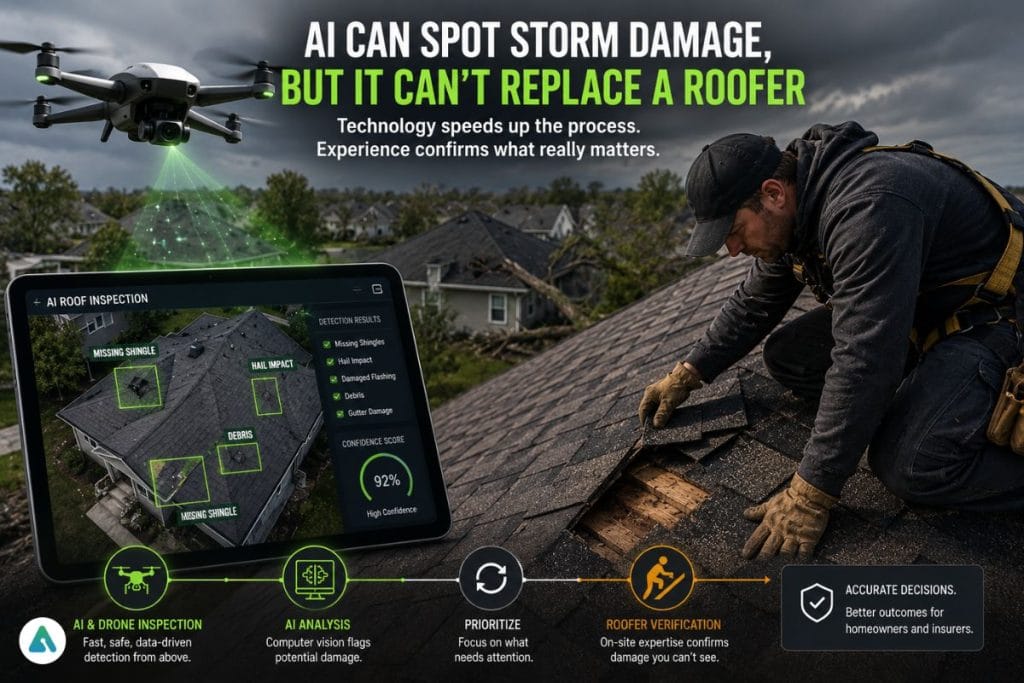
A hailstorm hits a neighborhood, and within hours an insurer’s drone is already circling overhead.
That scene has gotten ordinary fast. Roofing contractors, insurance carriers, and property inspectors now lean on AI software, drones, satellite imagery, and computer vision to catch wind, hail, and debris damage before a homeowner even calls. Inspections move quicker. Nobody has to balance on a wet slope to get the shot. Still, the technology runs into the same wall every time, and it’s the same wall an old-school adjuster would’ve hit: what’s happening under the surface.
The Ladder Problem
Manual inspection means someone climbing up, walking a pitch, and eyeballing shingles from a few feet away. It works. It’s also slow, and it puts a person on a roof that might already be structurally iffy.
Storms make the job worse. Wind can loosen shingles without ripping them off — no obvious gap, just a weak seal waiting to fail in the next gust. Hail leaves marks that are almost impossible to catch from ground level. One branch coming down can hit three or four sections of roof at once. Now stack a couple hundred claims on top of that after a single bad storm system rolls through a county.
What the Cameras Actually Catch
A good inspection platform can chew through thousands of images in minutes. Add a drone, and it flags missing shingles, lifted flashing, standing water, damaged gutters — all without anyone touching the roof.
The math works out too. A drone flight runs somewhere around $150 to $400 per property. A traditional ladder inspection runs $300 to $600. That’s not a rounding difference, and it comes with a lot less liability sitting on the inspector’s shoulders.
Construction estimating has picked up the same trick. Instead of a person manually counting fixtures off a blueprint, AI now reads the drawing set directly and pulls quantity takeoffs — square footage, linear feet, fixture counts — straight from the plans. The estimator’s job shifts from counting to double-checking the count. Roofing inspection is drifting toward the same setup: software does the first pass, a person signs off on it.
Where It Falls Apart
A drone can photograph a shingle. It cannot lift one.
Moisture trapped under the surface, decking that’s gone soft, underlayment that’s failed quietly for months — none of that shows up cleanly in an aerial image. Computer vision reads what’s in front of the lens. It doesn’t feel a spongy spot underfoot the way a roofer walking the same section does.
Insurers are already facing pushback over exactly this gap. California now requires carriers to tell homeowners before they use aerial data to decide a claim — a rule that exists because remote assessments started making calls that used to belong to a person standing on the property. More homeowners are asking for a second look before they accept whatever the algorithm decided, and honestly, that’s a reasonable instinct.
That second look is where roofing professionals earn their keep — confirming in person whether the damage the imagery flagged is cosmetic, worth repairing, or serious enough to put the whole roof system at risk.
For Homeowners in Michigan Specifically
Jackson County and the towns around it get hit with all of it — high wind, hail, heavy snow load, freeze-thaw cycling, branches coming down in ice storms. Damage there is common, and it’s easy to underestimate from a photo shot 200 feet in the air.
AI is good at telling you which roofs need a closer look first. That part’s real, and it’s useful. It’s not good at telling you whether a roof needs a patch or a full tear-off — that’s still a call someone on-site makes, not someone scrolling through a dataset. J. Wrozek Roofing & Home Improvements treats the technology as a starting point rather than a verdict — roughly how every company should use it.
The roofs that end up failing usually aren’t the ones AI missed. They’re the ones AI flagged and nobody followed up on.
Related: AI Construction Forecasting in 2026: Why CFOs Are Spotting Cost Overruns Earlier
