
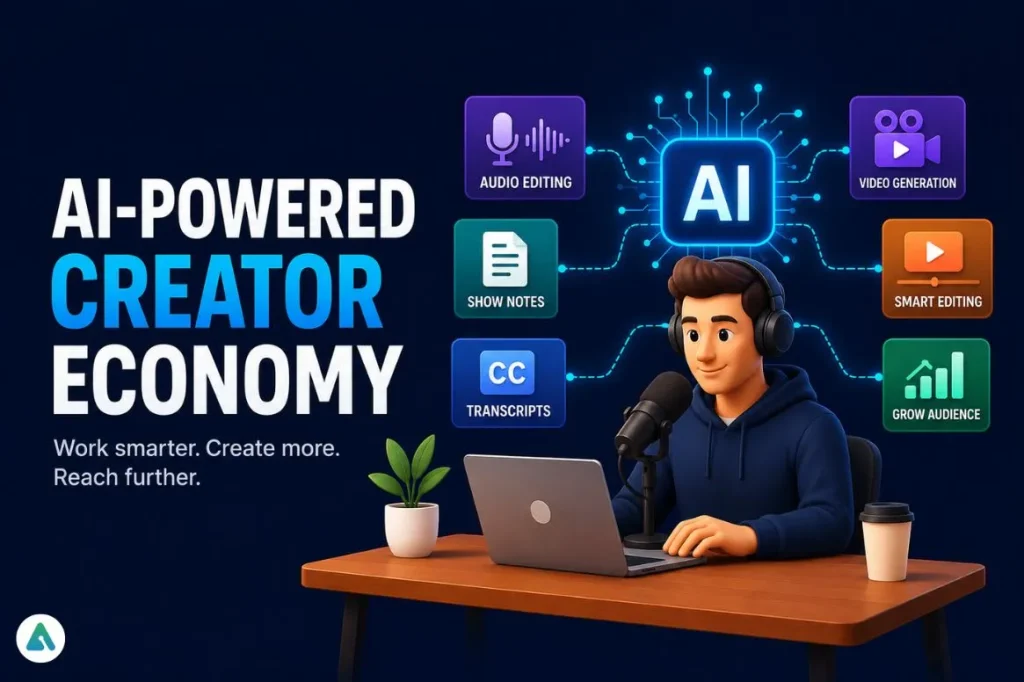
Marcus Holt runs a one-person investigative finance podcast out of a spare bedroom in Austin. In 2023, producing a single episode took him most of a Saturday — recording, editing out dead air, balancing levels, writing show notes, cutting the intro music in at the right moment. He published twice a month because that was all he could manage without burning out.
By early 2025, he was publishing three times a week.
Nothing changed about his research process or his editorial judgment. What changed was everything that happened after he finished thinking — the production layer that used to eat his weekends now runs in under an hour. His subscriber count crossed 80,000 last quarter. He hasn’t hired anyone.
Marcus isn’t an outlier. He’s the new normal.
The Numbers Behind the Shift
The global AI content creation market reached $2.72 billion in 2025, growing at a 22.1% compound annual rate. The creator economy’s feeding has expanded into a $500 billion industry with over 245 million independent creators globally. By 2025, approximately 83% of those creators had integrated AI into their production workflows.
That 83% figure deserves unpacking. It doesn’t mean 83% of creators handed their work to a machine. It means 83% found specific, repeatable parts of their process — the parts that were never really creative — and handed those over instead. Editing. Formatting. Audio cleanup. Show note generation. Transcript production. The logistics of creation, not the creation itself.
A Harvard Business School-controlled study found AI users completed tasks 25.1% faster than non-users while simultaneously achieving over 40% higher quality ratings. Speed and quality improving together break the old assumption that faster output means lower standards. The data says otherwise.
Marketers report saving an average of 3 hours per piece of content with AI assistance. For a creator running a weekly publishing schedule, that math reclaims over 150 hours annually — time that goes back into research, audience relationships, and the thinking that actually differentiates one creator from another.
What AI Did to Audio Production
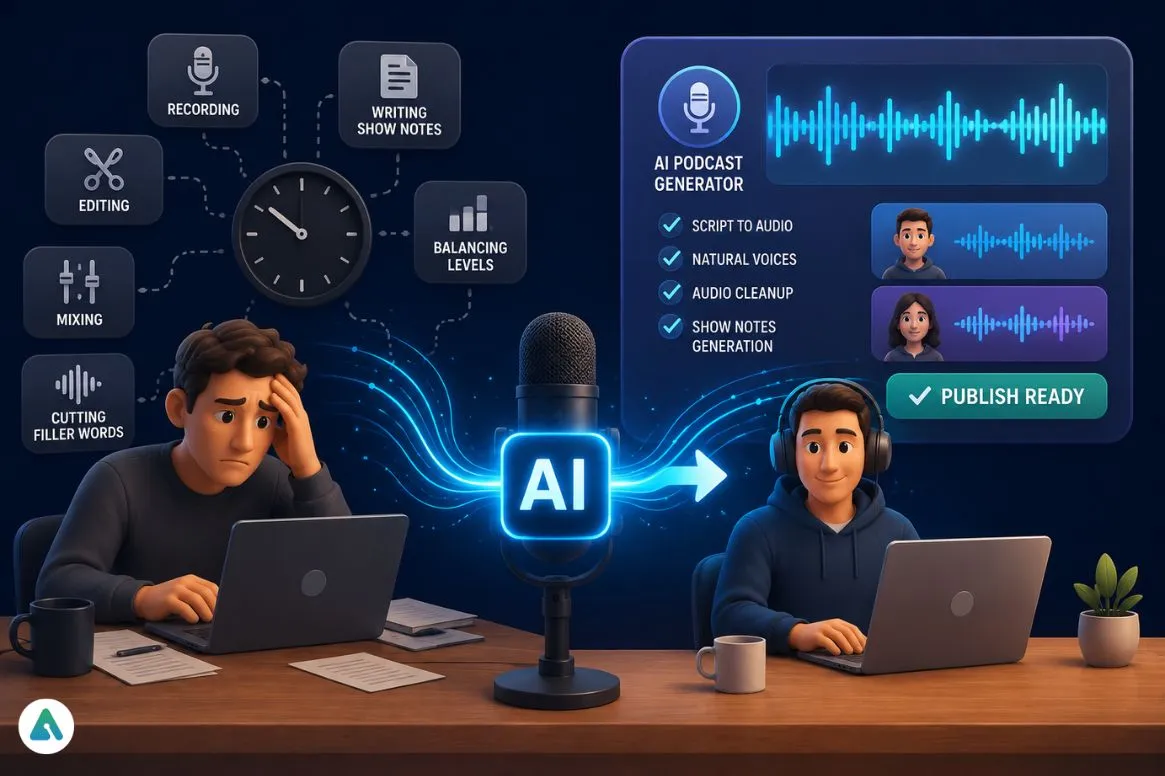
Podcasting grew fast in the 2010s, then hit a ceiling — not from lack of audience interest, but from production friction. Recording, editing, mixing, writing show notes, cutting filler words, balancing levels — a 30-minute episode could consume an entire day for someone without a dedicated setup.
Tools like the AI Podcast Generator handle the full production pipeline: script-to-audio conversion with natural-sounding voices, multi-host narration formats, automated audio cleanup, and show note generation — collapsing what once took hours into minutes. The output isn’t a rough cut. It’s publish-ready.
The downstream effect matters more than the efficiency gain. Lowering the production barrier from “people with budgets” to “people with something worth saying” changed who publishes. Teachers, independent researchers, niche subject experts, and working professionals who could never justify the time cost of weekly production now publish consistently. The format didn’t just get faster — it got more diverse, more specialized, and more trust-driven because the voices entering it changed.
ElevenLabs, Descript, and similar tools now handle voice cloning, accent matching, and real-time audio cleanup at a quality level that would have required a professional studio three years ago. The technical floor for professional-sounding audio effectively disappeared.
Video: The Last Expensive Medium Gets Disrupted
Video held out longer. The technical complexity ran deeper, equipment costs sat higher, and the gap between amateur and professional output was more visible to audiences than in audio.
That gap is closing fast — and the numbers confirm it.
By 2026, AI-generated video is projected to account for 10% of all digital video content. 42% of marketers have already adopted generative AI for video creation. Google reported advertisers used Gemini to generate nearly 70 million creative assets in the second half of 2025 alone — a 3x year-over-year increase.
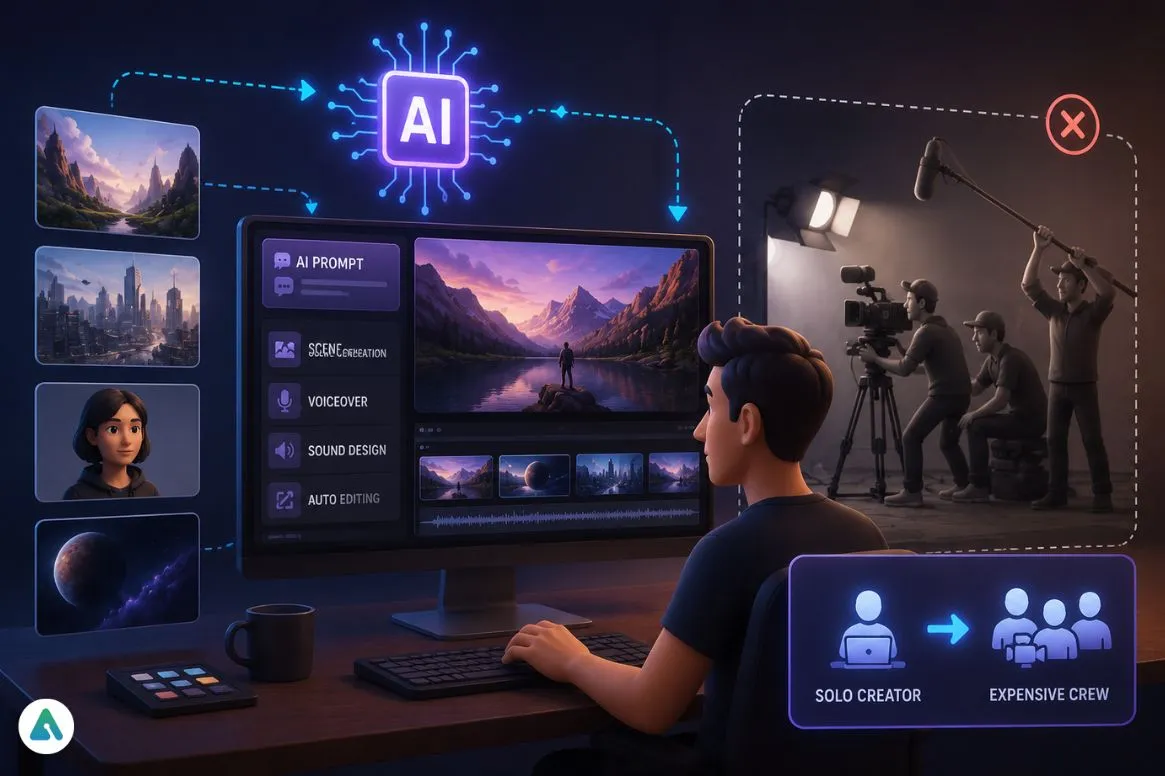
Tools like Runway Gen-3 and Sora now let creators generate realistic video clips from text descriptions, maintain consistent characters across multiple scenes, integrate voiceovers and sound design automatically, and handle editing tasks — pacing, transitions, color correction — without touching timeline software.
The AI Film Maker category fully represents this shift. A creator supplies the story, the characters, and the creative vision. AI handles the production execution that previously required a full crew and a five-figure budget. Scene generation from written prompts. Automated visual continuity. Voiceover integration. The production capability gap between a solo creator and a small studio has narrowed to a tool subscription — typically $50–$150 per month versus the $3,000–$8,000 a comparable production crew once cost per project.
The Platform Labeling Problem Nobody Is Talking About
Here’s where the 2026 landscape gets genuinely complicated — and where most coverage stops asking the right questions.
YouTube, TikTok, and Spotify now require creators to disclose AI-altered content through mandatory labeling systems. YouTube’s “Altered Content” tag, TikTok’s AI-generated content labels, and Spotify’s disclosure requirements for AI-voiced podcasts all went into effect in 2024 and 2025.
The CTR impact of these labels is real and still being measured. Early data suggests disclosure labels reduce click-through rates by 8–15% on average for entertainment content, while having minimal impact — sometimes positive impact — on educational and informational content. The pattern makes sense: audiences consuming entertainment want human authenticity; audiences seeking information care more about accuracy and depth.
This creates a strategic question for creators that pure efficiency math doesn’t answer. An AI-assisted workflow that speeds production by 60% delivers less value if the platform label attached to the output reduces audience conversion by 12%. The smart operators are using AI heavily in research, scripting, and post-production while keeping human narration and on-screen presence front-facing — capturing the efficiency gains without triggering the label conditions that affect audience behavior.
What Google’s Updates Actually Mean for AI Creators
One of the biggest misconceptions in content marketing is that Google penalizes AI-generated content. It’s 2025 and 2026 updates suggest something different: Google evaluates content quality, originality, and usefulness—not whether AI assisted in creating it.
Analyses of recent core updates found little correlation between AI usage and ranking declines. What consistently underperformed was low-value content lacking original insights, expertise, or unique information.
For creators, the takeaway is straightforward. AI can accelerate production, but it cannot replace expertise, reporting, research, or a distinctive point of view. The creators benefiting most from AI are using it to improve execution while keeping human insight at the center of the work.
The Skill Set That Actually Matters Now

73% of content roles are being redefined around AI collaboration. Content teams are shifting from pure creation toward editing, strategy, and AI prompt engineering. The technical skills that once separated professionals from amateurs — mastering Adobe Premiere, Pro Tools, or professional recording setups — matter less than they did.
What matters more: the quality of ideas, the sharpness of editorial judgment, and the ability to direct AI tools toward a specific creative outcome rather than accepting their defaults.
The creators building durable audiences in 2026 treat AI as a production layer beneath a distinctive human perspective — not as a content source. Brands standing out are those adding original research, unique data, and a genuine point of view to AI-assisted workflows. As creators increasingly combine multiple AI tools across research, production, editing, and distribution, effective AI orchestration is becoming a competitive advantage rather than a technical curiosity. Homogeneity is the actual competitive risk when everyone accesses the same tools. Originality became a scarce resource the moment execution stopped being one.
Marcus Holt’s finance podcast keeps growing, not because his audio quality improved — it was always good enough. It keeps growing because he now spends his Saturday time doing deeper source interviews and original analysis instead of fighting with audio software. The AI handles the production. He handles the thinking.
That division of labor is the whole point.
Related: AI Agent vs Chatbot: Don’t Buy the Wrong AI in 2026
