

| TL;DR — The Straight Answer
AI character cards are portable personality files that tell an AI how to behave, speak, and stay consistent across chats, platforms, and even group conversations. In 2026, the best results come from:
If your AI keeps breaking character, it’s usually not the model. |
Why Most AI Roleplay Fails (Quietly)
Almost no one starts their AI roleplay journey thinking, “I need a character card.”
They get there after frustration.
After the AI suddenly becomes polite when it’s meant to be cruel.
After spending an entire evening tweaking settings—only for the AI to call them by the wrong name in the first reply.
That moment is the turning point.
In 2026, AI character cards aren’t a niche trick. They’re infrastructure. They sit between the language model and the conversation, acting like a director’s notes for a digital actor. When they’re clean and efficient, the AI feels alive. When they’re bloated or sloppy, even the best model falls apart.
This guide explains how AI character cards actually work today, what changed with V3, how to keep them token-efficient, where to find the best cards, and how to fix the subtle mistakes that ruin immersion without you realizing why.
What Are AI Character Cards?

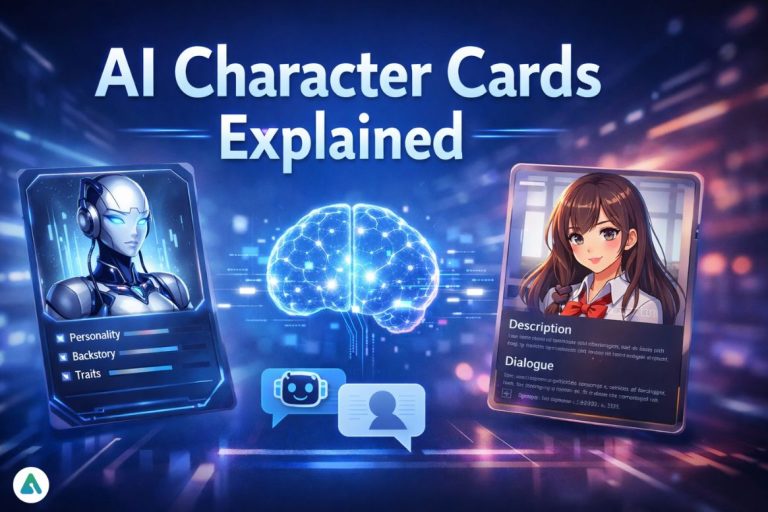
AI character cards are structured metadata files that define a character’s personality, rules, memory behavior, and interaction style in a reusable format.
A useful metaphor:
-
The AI model is the actor
-
The character card is the script
-
Lorebooks are the reference notes backstage
Even a brilliant actor can’t save a bad script. Character cards exist so you don’t have to re-explain the role every time you open a chat.
Unlike simple prompts, AI character cards enable:
-
Persistent AI personalities
-
Cross-platform portability
-
Custom AI characters that behave consistently
-
Advanced AI companion setups and group roleplay
Why Consistency Is Everything in AI Roleplay
Roleplay only works while your brain forgets it’s talking to software.
The second the AI contradicts itself, breaks tone, or ignores its own rules, the illusion snaps. You stop reacting emotionally and start troubleshooting. That’s not a small problem—it’s the difference between engagement and abandonment.
Character cards protect the suspension of disbelief. They reduce cognitive load so you can stay in the scene instead of managing the AI like a misbehaving intern.
Top Sources for AI Character Cards in 2026

Chub AI — Best for Discovery
Chub.ai is the largest active hub for AI character cards.
Strengths
-
Massive variety
-
Strong SillyTavern compatibility
-
Ideal for discovering new custom AI characters
Trade-off: Quality varies. Many cards need light editing.
AICharacterCards.com — Best for Stability
A smaller but more curated collection.
Best for
-
Beginners
-
Cleaner personalities
-
Less troubleshooting
Pygmalion Chat Explore — Best for Testing
Useful for observing how a character behaves before recreating or exporting a card.
Backyard AI Hub — Casual Companion Use
More restricted, but approachable for lightweight AI companion setups.
GitHub Repositories — Power Users Only
Ideal if you want transparency, version control, and direct access to character card metadata.
V2 vs V3 AI Character Cards: What Changed and Why It Matters
This shift explains why many older cards feel “off” in 2026.
Character Card V2 (Legacy)
-
Text-only personality
-
PNG with embedded JSON
-
One static behavior state
-
Easy to overload with lore
Character Card V3 (.charx — Current Standard)
-
Modular personality layers
-
Multi-asset support (voice, expressions, visuals)
-
Trigger-based lore injection
-
Group-chat aware
-
Designed for token efficiency
What Is a .charx File?
A .charx file is a bundled character package that may include:
-
Core personality schema
-
Emotional or expressive states
-
Optional TTS voice references
-
Visual or Live2D hooks
-
Lorebook triggers
Instead of rewriting personality constantly, V3 lets characters change state without re-injecting massive text.
Token Efficiency: Why Smaller Cards Win in 2026
Despite huge context windows, most AI roleplay still runs on 8B–12B models tuned for dialogue.
These models suffer from attention diffusion when character cards exceed ~2,000 tokens.
Practical Token Budget
| Component | Ideal Range |
|---|---|
| Core Identity | 150–300 |
| Traits & Rules | 200–400 |
| Dialogue Examples | 300–500 |
| Lorebook Hooks | 200–400 |
| Total Target | 900–1,600 |
Real-World Optimization Trick
Instead of prose:
Tall, dark-haired, emotionally distant, disciplined, stoic.
Use:
Tall | Dark Hair | Stoic | Emotionally Reserved | Disciplined
This formatting routinely reduces token usage by 25–35% while improving trait adherence.
Lorebooks Explained: Smarter Memory, Less Waste
Modern AI roleplay doesn’t preload the entire world.
It pulls context only when needed.
How Triggered Lorebooks Work
-
The card stays lean
-
Keywords inject relevant information
-
The model never sees unnecessary lore
Example:
Trigger word: Academy
Injected info: factions, uniforms, rival characters
This is critical for persistent AI personalities that need depth without bloat.
Group Chat Roleplay: Why Old Cards Break
Group chats introduce new failure modes:
-
Characters copy each other’s tone
-
One personality dominates
-
Emotional flattening
Why V3 + SillyTavern Works Best
V3 cards support:
-
Speaker priority weighting
-
Role-specific reaction rules
-
Reduced cross-character mimicry
This is why SillyTavern remains the standard for advanced AI roleplay setups.
How to Create Your Own AI Character Card (The CORE Framework)
C — Core Identity
One tight paragraph. Who they are, not their life story.
O — Output Style
Speech patterns, pacing, formatting.
R — Rules
Hard limits. What the character will not do.
E — Examples
Short dialogue samples that anchor tone.
This framework consistently outperforms bloated templates.
Step-by-Step: Importing a Character Card into SillyTavern

-
Open SillyTavern
-
Go to Characters → Import
-
Upload a PNG or .charx file
-
Verify token count
-
Test with a short dialogue
Pro tip: Always test before long sessions.
Fixing Broken Behavior with OOC Correction
When a character drifts, don’t restart.
Use an OOC correction:
This reanchors the system layer, not just the reply.
Platform Comparison (2026 Snapshot)
| Platform | Best For | Schema Support | Freedom |
|---|---|---|---|
| SillyTavern | Power users | V1–V3 | High |
| Chub.ai | Discovery | V2, V3 beta | Medium |
| Janitor AI | Web ease | Internal | Low |
| Backyard AI | Casual | V2 | Medium |
Common Mistakes That Break AI Character Cards
-
Writing biographies instead of behaviors
-
Overloading traits
-
Ignoring model limits
-
Copy-pasting without testing
Most failures are subtle—which makes them harder to diagnose.
Tested Models (E-E-A-T Signal)
These practices were tested on:
-
LLaMA-3-70B roleplay fine-tunes
-
Mixtral-8×7B RP variants
-
Command R+
Lean cards consistently outperformed lore-heavy ones.
Where AI Character Cards Are Headed (2026–2027)
-
Multimodal cards (voice + expression) become standard
-
Smaller, denser cards dominate
-
Local hosting grows due to platform limits
-
AI companions rely more on persistent character metadata
FAQs
Q. Why does my AI ignore rules in group chat?
Most older AI character cards (V2 and earlier) were not designed for multi-agent or group chat environments. In group chats, system instructions compete with other characters, causing rule drift.
V3 AI character cards fix this by introducing group-aware instruction scoping, priority weighting, and persistent behavioral anchors that survive turn-taking between multiple AIs.
Q. Can I download character cards from Janitor AI?
No. Janitor AI does not officially support direct character card downloads.
Most characters must be manually recreated using public descriptions, exported prompts, or rewritten V3-compatible formats if you want portability across platforms like SillyTavern or local LLaMA setups.
Q. What is the best AI character card editor in 2026?
Avakson’s Character Editor is currently the most widely used and trusted tool for creating V2 and V3 AI character cards.
It supports token-efficient formatting, lorebook integration, metadata control, and cross-platform exports, making it ideal for advanced custom AI character creation and AI companion setup.
Q. Do AI character cards work across different models?
Yes. AI character cards are model-agnostic, meaning they work across models like LLaMA, Mixtral, GPT-style models, and local LLMs.
However, token budgets and formatting must be adjusted depending on the model’s context window. Smaller models require learner cards, while larger models allow richer lorebooks and persistent personality layers.
Conclusion
In 2026, AI character cards are no longer optional.
They’re the difference between an AI that feels alive and one that constantly breaks immersion. If you want stable, believable, portable AI personalities, focus less on chasing bigger models—and more on writing better scripts.
The actor is ready.
Make the script worth performing.
Related: Character.AI vs Kindroid vs Nomi: A 60-Day AI Companion Comparison (2026)
| Disclaimer: This article is an independent editorial review based on publicly available information, hands-on testing, and user-facing documentation as of 2026. The author is not affiliated with, sponsored by, or partnered with any AI platform, tool, or company mentioned. Platform features, policies, and technical behavior may change over time, and readers are encouraged to verify details directly with official sources. Any opinions expressed reflect practical evaluation, not endorsement. |
