
The headlines out of China chase spectacle. Humanoid robots boxed, sprinted, and marched through the World Humanoid Games like contestants on a strange Olympic undercard. But the machines actually reshaping China’s economy don’t have faces. They don’t dance. They’ll never trend on social media.
They weld. They screw. They polish. They repeat the same motion ten thousand times a shift, no raise required.
That’s the real story hiding behind the theater.
The Robots That Matter Look Nothing Like Robots
Walk onto the floor at CRP Technology in Chengdu, and you won’t find a machine that resembles a person. You’ll find robotic arms — bare, jointed, utilitarian — bolted to assembly lines. A single arm can be programmed to handle more than 90% of a factory’s repetitive tasks. Human workers still screw, drill, and polish around them, because the transition isn’t a light switch. It’s a slow trade of labor, task by task.
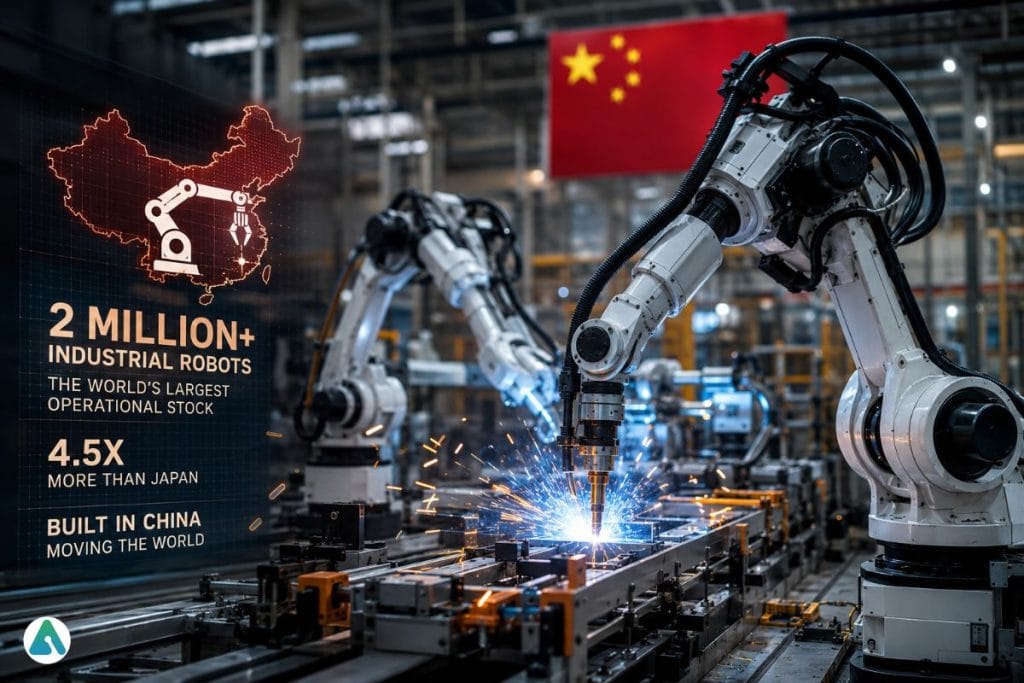
That pattern repeats across China’s manufacturing base. More than two million industrial robots now run in its factories, the largest operational stock anywhere. The International Federation of Robotics puts that figure at roughly 4.5 times Japan’s total, the country in second place. China also builds and exports more than half the world’s industrial robots. The rest of the planet’s automation boom is, quietly, a China supply chain story.
Compare that to the humanoid robots stealing headlines. CRP’s prototype can currently manage scanning a QR code. That’s the state of the art for the human-shaped machines everyone watches. Even China’s most commercially advanced humanoid launch, Chery’s Mornine M1, ships as a showroom greeter with a two-hour battery, not a factory hand. The unglamorous arms are already running production lines end to end. The showroom robots are still selling cars.
A Demographic Clock Is Driving the Automation Clock
Here’s the angle most coverage misses. China’s robot buildout isn’t primarily a tech flex. It’s a demographic hedge against a labor crisis that’s already locked in.
By 2035, more than a third of China’s population will be over 60. Over the next decade, the country is projected to lose close to 60 million people from its workforce— roughly the population of France- gone. Beijing isn’t automating because it can. It’s automating because, within a decade or two, it may not have enough hands left to run the factories that power its economy.
That reframes everything happening on these factory floors. Leapmotor, the EV maker gaining traction across Europe and the UK on budget-friendly pricing, has already hit full automation in stamping, welding, and painting at its Hangzhou plant. Its vice-president, Cao Li, doesn’t dodge the obvious follow-up: whether the roughly 25,000 workers still doing final vehicle checks will eventually get replaced too. His answer is blunt. It’s entirely possible, and it could happen fast.
But Cao also flags something the automation hype cycle tends to skip. Robots break too. Every day carries maintenance overhead. Every month demands line inspection and repair. Machines don’t sleep, but they aren’t free of friction. They just trade one kind of friction for another.
The same replacement question chasing factory floors is already chasing white-collar work. AI hasn’t replaced accountants as a profession yet, but it’s already reshaping which tasks survive inside that job. Manufacturing is running the same script, just with steel arms instead of spreadsheets.
The Real Race Isn’t Robot Bodies. It’s Robot Brains.
China’s structural advantage is manufacturing density. Motors, batteries, sensors, gears — everything needed to build a robot’s body sits within reach. Dr. Susanne Bieller, General Secretary of the International Federation of Robotics, says sourcing components for a robot build in Shenzhen can take under an hour. In Europe, the same sourcing run can eat a week.
What China hasn’t fully cornered is the “brain” — the AI systems that let robots reason and adapt without hand-coded instructions for every task. That edge, per Bieller, still belongs to the US. But the gap between smart software and capable hardware is exactly where the humanoid category keeps stalling globally, and it’s narrowing faster than expected. Open-source releases from Chinese labs like DeepSeek and Moonshot have kept pace with top US models, despite ongoing US export controls on advanced chips.
That detail matters more than it looks. The next phase of the robotics race won’t be decided by who ships the flashiest humanoid demo. It’ll be decided by who embeds working intelligence into millions of unglamorous machines, at scale, inside ordinary factories — not on a stage in front of cameras.
China Is Also Manufacturing the Workforce to Run This
The infrastructure play doesn’t stop at hardware. In Hangzhou, vocational schools like the Hangzhou Technician Institute enroll students as young as 15 into robotics and AI tracks, with dedicated programs for fields like rare-earth processing — another flashpoint in the US-China tech rivalry.
Instructor Chen Tianyu spends his off-hours touring automating factories just to keep his curriculum current. He brings that intelligence straight back to a classroom of engineering students. His graduates, he says, get booked by companies before they finish the program. That’s a notable claim in a country where youth unemployment sits around one in five.
It’s a tidy pitch: train workers for the jobs automation is about to create, even as automation eliminates others. Whether that math nets out positively for China’s roughly 120 million manufacturing workers is the open question nobody, including the people building this future, can answer yet. Even Chen admits it to his own students. He doesn’t know what’s coming next. He just knows standing still isn’t an option.
The Bottom Line
The humanoid robots boxing at exhibition games are a marketing layer. The real transformation is arms without faces, replacing tasks without headlines, inside factories most people will never see. It’s driven not by ambition alone but by a shrinking labor pool with a hard deadline attached. China isn’t just racing to build robots. It’s racing against its own population chart, and the clock doesn’t care how the humanoid demos perform on stage.
Related: China’s $1B Robot Grid Is the Real AI War — And the West Is Behind
