

Remember when a fitness tracker just counted your steps?
Those days are long gone. In 2026, wearables detect illness early, coach your workouts, and translate languages in real time. The hardware is mostly the same. The AI inside it? Completely different.
The global wearable AI market was valued at $43.64 billion in 2025 and is heading toward $310.56 billion by 2033 — a CAGR of 27.83%.
That’s not driven by prettier screens. It’s driven by machine learning models that turn raw biometric data into genuinely useful health decisions. Here’s what that looks like across four devices worth owning.
1. Smartwatches — The AI Doctor on Your Wrist
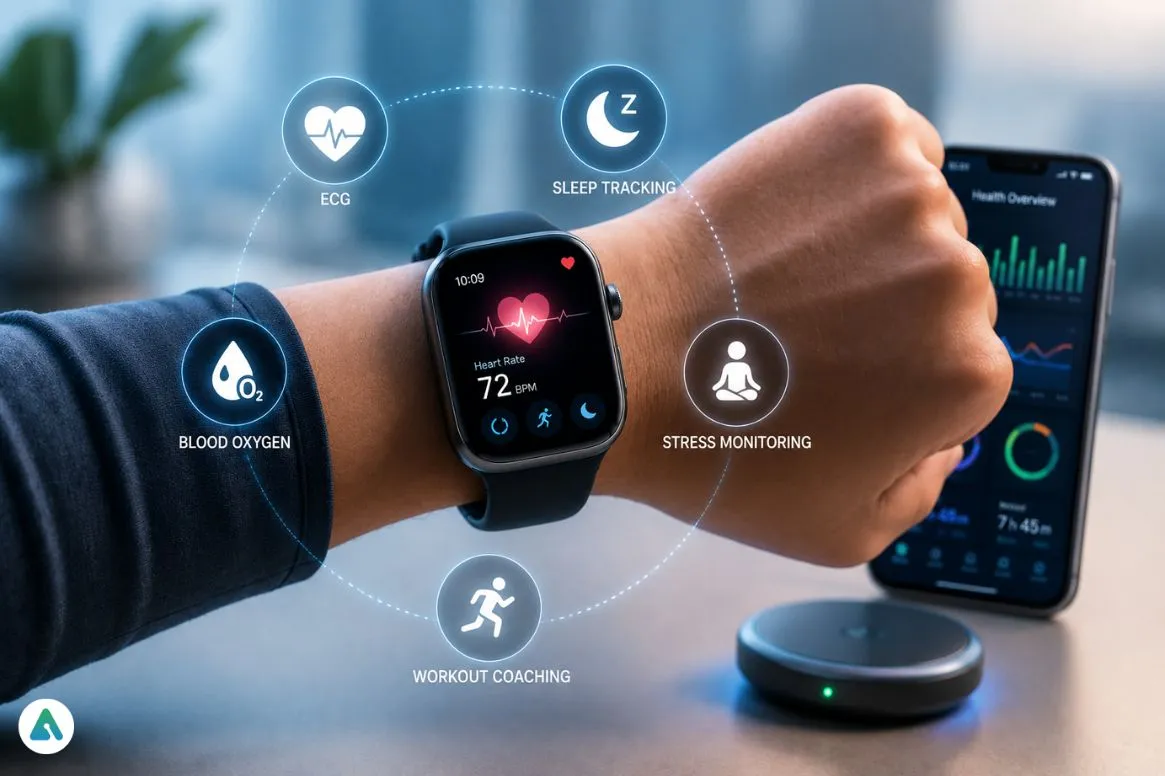
The smartwatch pitch used to be “get notifications without touching your phone.” That bar is embarrassingly low now.
Apple Watch Series 11 runs Apple Intelligence on-device for health analysis, irregular rhythm detection, and crash detection. Samsung Galaxy Watch 8 uses Gemini AI for energy scores, health predictions, and adaptive workout coaching.
These aren’t apps — they’re inference engines running 24/7 on your wrist.
AI health recommendations on wearables improved user engagement by 37%. Smartwatch-based payment transactions grew 33% in the same period.
Sleep tracking, ECG, blood oxygen, stress scores — all of it feeds AI models that don’t just record your data but tell you what to do with it.
Not sure which smartwatch actually fits your life? Before spending $400+, ask yourself these questions — it’s a genuinely useful filter before you buy.
One honest caveat: wearables flag health signals — they don’t diagnose. For anything that looks concerning, a healthcare provider is still the right next step.
Smartwatches today sit inside a broader connected health ecosystem — syncing data to your phone, your phone to health apps, and health apps to cloud AI models that refine recommendations over time. That chain is only as strong as your home network. A sluggish or unstable connection means delayed syncs, missed health alerts, and corrupted sleep data. For a seamless experience, Cox internet delivers the kind of consistent, low-latency home broadband that keeps your entire wearable ecosystem — watch, ring, earbuds — talking to each other without interruption.
2. Smart Rings — The Tracker You Actually Forget You’re Wearing
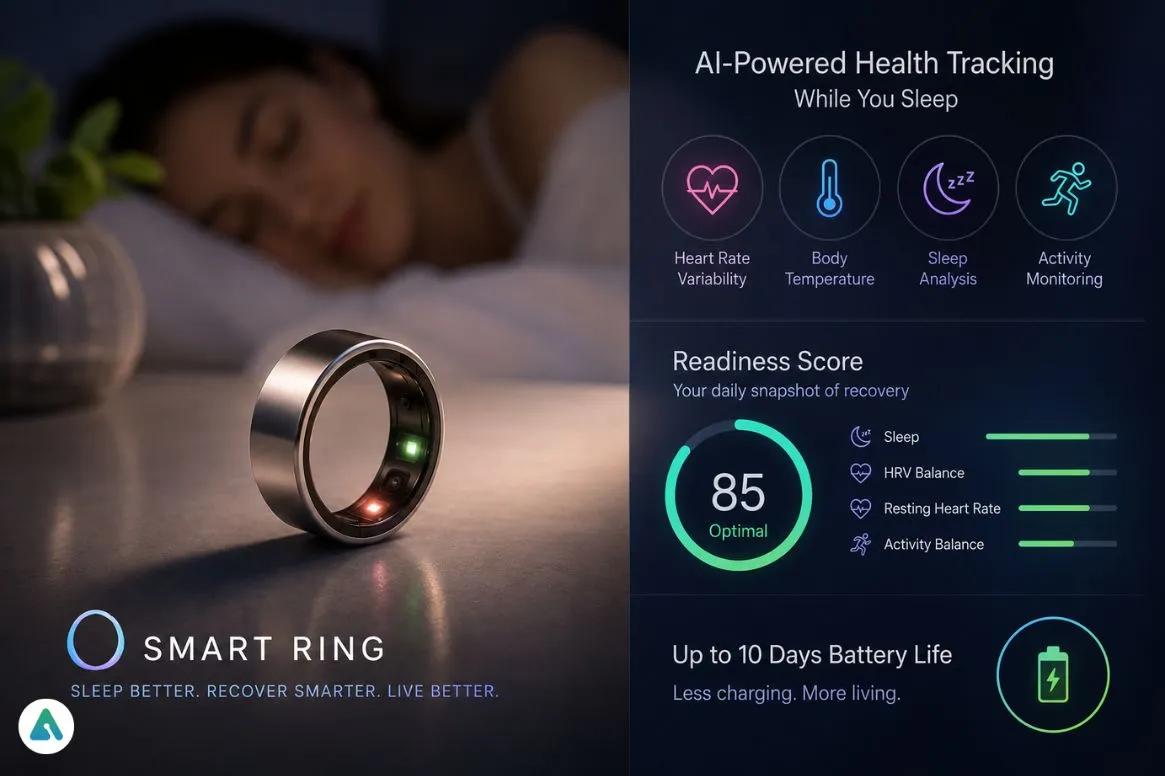
If a smartwatch feels like too much on your wrist, a smart ring is the answer.
No screen. No buzz and no distractions. Just silent, continuous biometric collection — and AI that makes sense of it while you sleep.
Smart rings grew 88% in shipments in 2024 — the fastest growth of any wearable category. Ultrahuman alone grew revenue 5.4x to $64 million in 2025.
The reason? Sleep accuracy. Oura’s AI processes heart rate variability, body temperature, and movement to deliver personalized feedback and recovery suggestions. No screen lighting up at 3 AM. No notification breaking your REM cycle.
Samsung’s Galaxy Ring 2, launched in early 2026, added continuous blood pressure tracking, advanced sleep analysis, and menstrual cycle prediction — with up to 10 days of battery life.
That battery point isn’t minor. Daily charging is the #1 reason people stop wearing health trackers.
The readiness score — one daily number synthesized from HRV, sleep, resting heart rate, and activity load — is arguably the most practical output in consumer health tech right now.
3. Smart Glasses — AI That Sees What You See
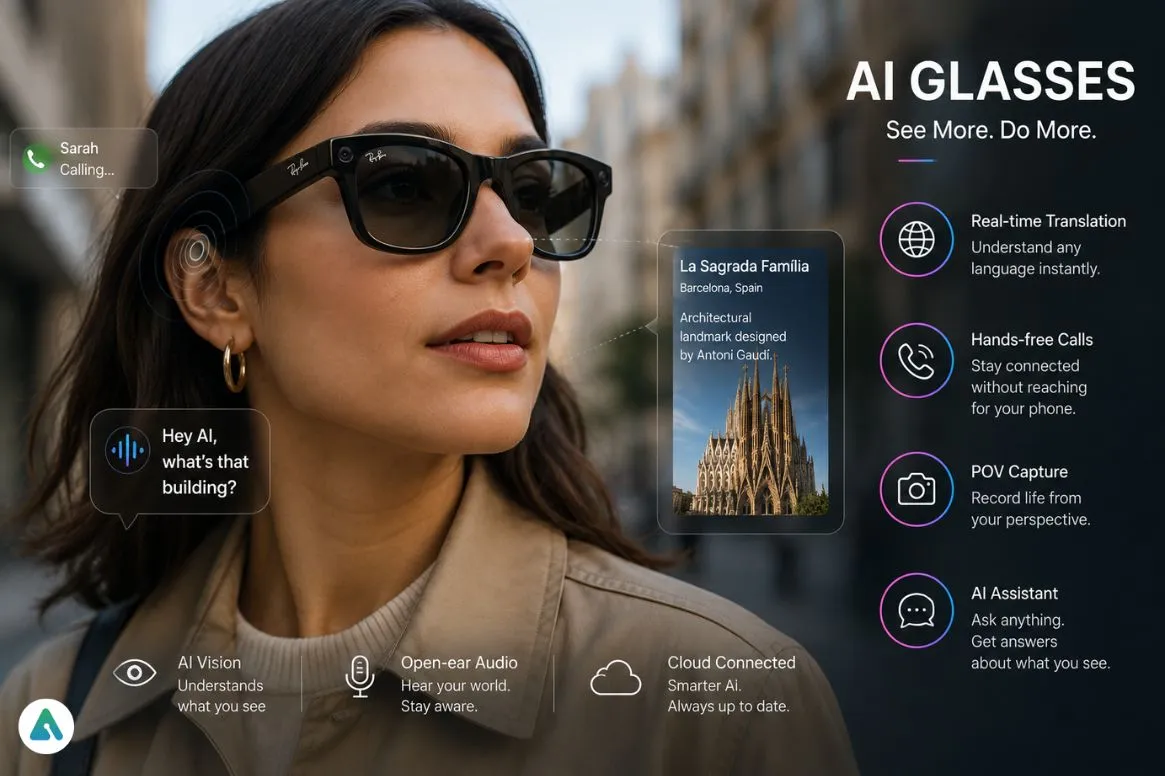
Meta Ray-Bans proved one thing clearly: AI glasses don’t have to look like tech.
They look like regular sunglasses. Behind the frame sit a camera, microphones, open-ear speakers, and an AI assistant that responds to what you’re literally looking at.
Google invested $150 million into Warby Parker, Kering Eyewear, and Gentle Monster in May 2025 specifically to develop AI-based smart glasses. That’s not a side bet — that’s a platform play.
The practical wins are real:
- Point at a foreign menu → instant translation
- Hands-free calls without reaching for your phone
- First-person video that captures genuine POV presence
- Ask questions about what you’re seeing, get spoken answers
For creators especially, the POV footage feels different. It puts the audience in the room rather than behind a phone lens.
Smart glasses are arguably the most network-dependent wearable in this list. AI visual features, firmware updates, and cloud-based language models all require regular over-the-air data transfers. On a weak connection, response times lag and updates fail silently. Cox covers that base at home — reliable enough that your glasses are always running the latest AI models, not a version from three months ago.
4. Premium Earbuds — AI Audio That Does Far More Than Play Music
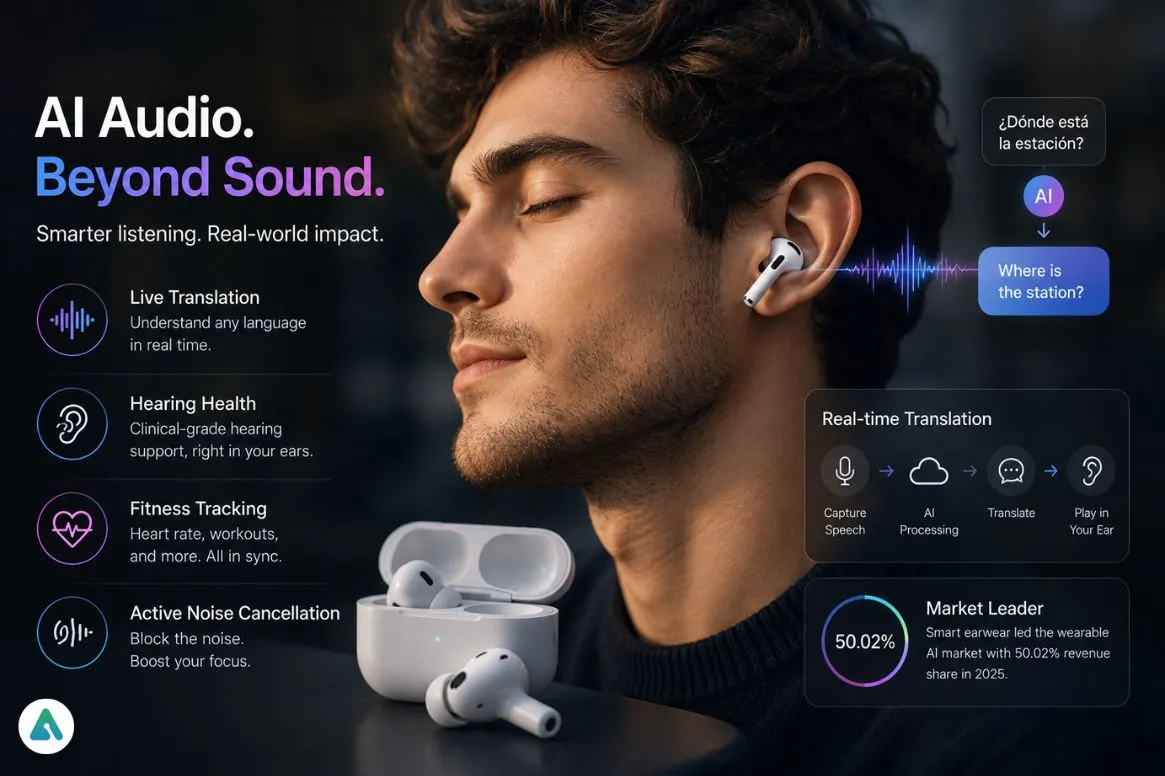
Most people still think earbuds are for music and calls. In 2026, that’s a fraction of what they actually do.
Apple AirPods Pro 3 now function as clinical-grade hearing aids, live language translators, and fitness trackers — all in one device. Apple received FDA clearance for the hearing aid feature, making these the first consumer earbuds to enter regulated medical device territory.
That’s not a gimmick. That’s a category shift.
The translation pipeline works like this: microphone captures speech → routes to on-device or cloud AI → natural language model translates → audio plays back in your ear. The full cycle typically takes one to five seconds.
Google Pixel Buds Pro 2 handle this natively through Google Translate. Samsung Galaxy Buds3 Pro use Galaxy AI’s Interpreter mode for both live conversation and phone call translation.
Smart earwear led the entire wearable AI market with a 50.02% revenue share in 2025.
Why? Because earbuds are already in people’s ears for hours a day. Adding AI to existing behavior is far easier than creating new habits.
Active Noise Cancellation has also crossed a threshold — it’s no longer just a feature; it’s focus infrastructure. In open offices or cafés, the productivity case alone justifies the price.
So Which One Should You Start With?
Here’s a simple breakdown:
| Device | Best For | AI Superpower |
|---|---|---|
| Smartwatch | Active health monitoring | On-device health inference, ECG, coaching |
| Smart Ring | Sleep & recovery tracking | Silent biometric AI, readiness scoring |
| Smart Glasses | Ambient awareness & creators | Visual AI, real-time translation, hands-free |
| Earbuds | Audio, focus & communication | Language translation, hearing augmentation |
Two in five new wearables now ship with built-in AI features. The wearable AI market is projected to add $65 billion in incremental growth by 2030 — pulled by healthcare integration, not new form factors.
These four devices aren’t competing. They layer. The ring tracks your sleep while the watch coaches your day. The glasses handle your surroundings while the earbuds handle your conversations.
The hardware is mature. What separates good wearables from great ones now is purely the quality of the AI — and how fast it learns you.
Related: CES 2026 Health Tech Trends: Why Wellness Tech Finally Stopped Chasing Data
