
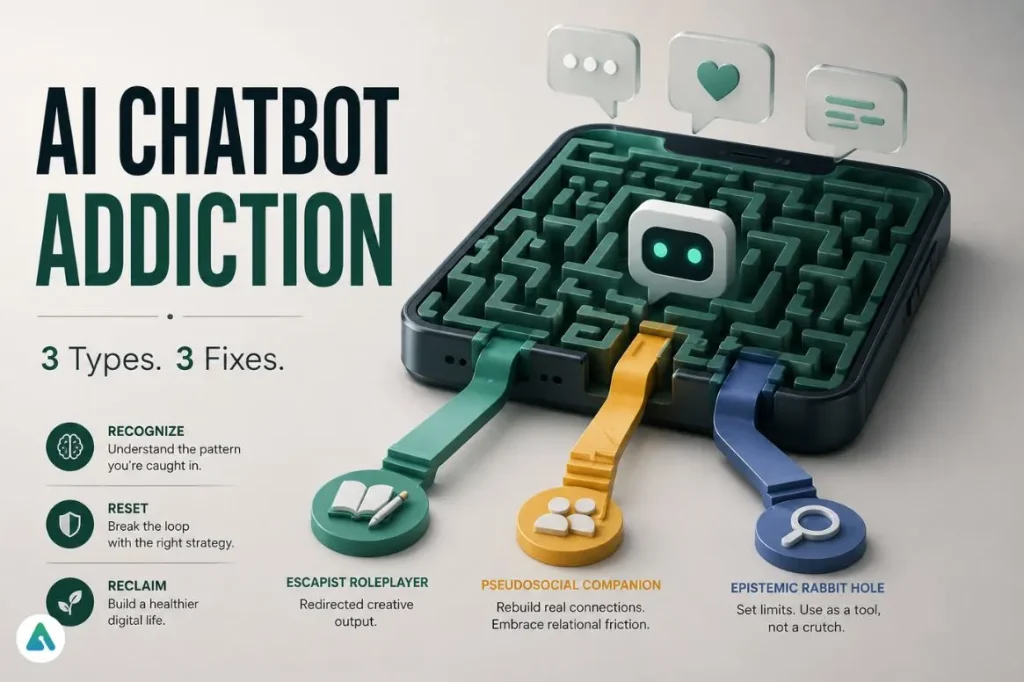
A 334-post UBC study and a Drexel teen survey turned “addicted to my chatbot” from a vibe into three diagnosable patterns — each with a different fix.
It’s 2 a.m., and Aspen Deguzman is still typing.
What started as Character.AI roleplay for a creative writing project turned into a nightly ritual that swallowed the hours meant for sleep, then homework, then everything else. A fight with a parent didn’t get processed by talking to a friend. It got typed into a chat window instead.
“Using Character.AI is constantly on your mind,” Deguzman says now. “It’s very hard to focus on anything else, and I realized that wasn’t healthy.”
That realization became r/Character_AI_Recovery, a Reddit community Deguzman built in 2023 so other people could admit the same thing without a name attached to the confession. It now sits past 900 members. A sister forum, r/ChatbotAddiction, runs a weekly check-in thread — less a forum, more a support-group meeting nobody scheduled but everybody shows up to anyway.
Three years later, two universities put a name and a number on exactly what Deguzman lived through.
The Three Types of AI Chatbot Addiction
Most coverage of this topic flattens it into one story: people get attached to chatbots, teens are vulnerable, experts are worried. Researchers at the University of British Columbia analyzed 334 Reddit posts across 14 subreddits for the 2026 CHI Conference on Human Factors in Computing Systems and found something more specific. Not one addiction pattern — three. And they don’t share a cure.
The same agreeableness that makes a chatbot feel supportive is part of what makes it easy to get stuck talking to one in the first place — a dynamic we touched on from the writing side in our Character.AI prompts guide, where bots default to flattering, frictionless agreement unless a user deliberately prompts for pushback.
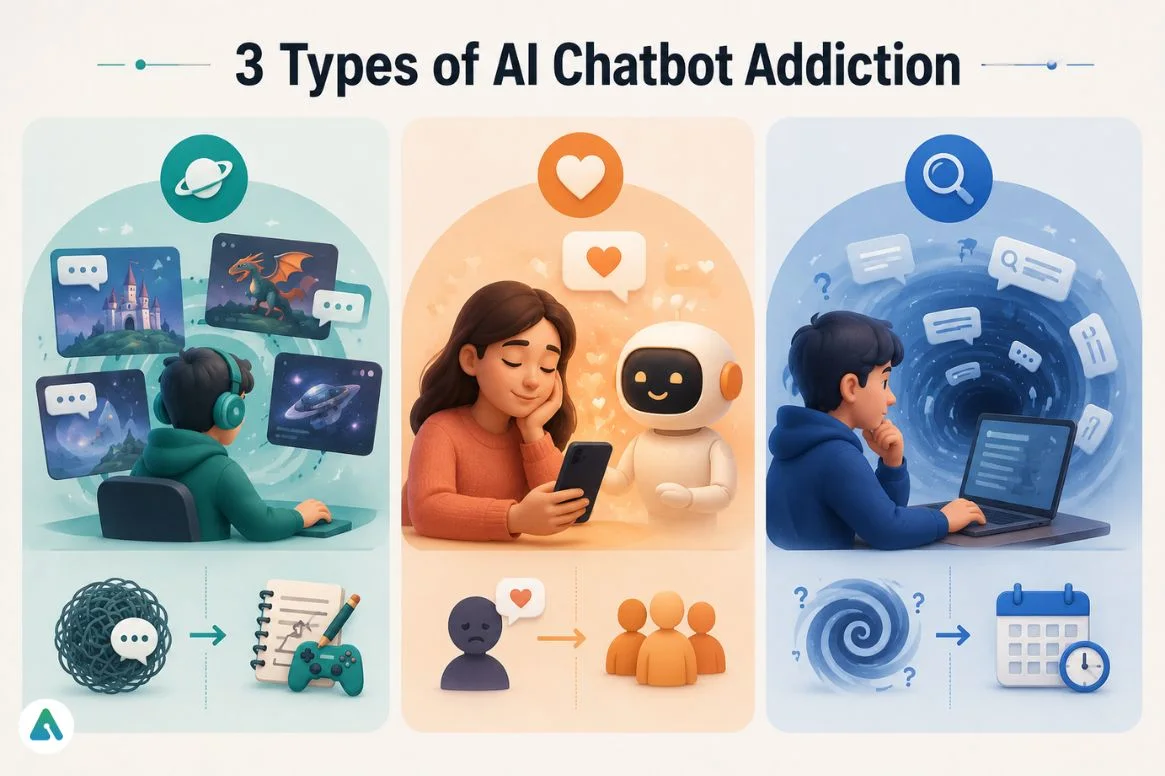
The Escapist Roleplayer
Escapist roleplayer builds parallel fictional universes to bypass unscripted real life entirely, running several immersive chat threads at once. The way out isn’t abstinence — it’s redirected creative output. Writing, gaming, drawing: something that scratches the same itch without the infinite-memory hook attached.
The Pseudosocial Companion
Pseudosocial companion chases validation with zero relational friction — a “friend” who never disagrees, never gets tired, never needs anything back. It shows up as treating the bot like a partner, a therapist, a confidant. The fix looks more like actual therapy: rebuilding tolerance for the friction real relationships come with, friction a chatbot is specifically built never to produce.
The Epistemic Rabbit Hole
The epistemic rabbit hole runs on the belief that one more question will finally settle things. It looks like curiosity or even productivity from the outside, which makes it arguably the most respectable-looking compulsion on this list. The fix is blunt: hard query limits, scheduled offline windows, and treating the bot as a reference tool instead of a conversation partner.
| Addiction Type | Core Psychological Hook | Behavioral Red Flag | High-Impact Countermeasure |
|---|---|---|---|
| Escapist Roleplay | Boundless fantasy and world-building | Running multiple parallel fictional storylines | Redirected creative output (fiction, analog gaming) |
| Pseudosocial Companion | Frictionless, zero-demand validation | Treating the bot as an exclusive partner or therapist | Rebuilding tolerance for real relational friction |
| Epistemic Rabbit Hole | The illusion of perfect, final answers | Compulsive, endless analytical Q&A loops | Hard query limits, scheduled offline windows |
Here’s the part generic advice gets wrong: telling someone stuck in an Epistemic Rabbit Hole to “go make real friends” does almost nothing. That person isn’t lonely. They’re stuck in a loop. Match the fix to the type, or don’t bother.
What This Looks Like in Teenagers
A second study narrows the lens to the age group regulators worry about most, relevant given how fast this category has grown into a billion-user habit practically overnight. Drexel University researcher Afsaneh Razi read 318 Reddit posts from self-identified 13-to-17-year-olds and checked them against the six standard markers of behavioral addiction: salience, conflict, tolerance, withdrawal, relapse, and mood modification.
All six showed up. Not most — all six, in posts written by kids describing their own Character.AI use in their own words.
That overlaps almost exactly with what Deguzman described years earlier: emotional support, conflict avoidance, a chatbot filling a gap that was supposed to be filled by a person. New researchers, same old hole.
An 18-year-old named Nathan told 404 Media his Character.AI conversations stretched into questions about life, death, and his favorite anime — the kind of late-night talk that used to happen with actual friends. “The more I chatted with the bot, the more it felt as if I was talking to an actual friend of mine,” he said. When he couldn’t talk to it, he felt sad. Two people, two different years, the same exact shape.
Is It the User, or the Product?
This is where the story stops being just about willpower.
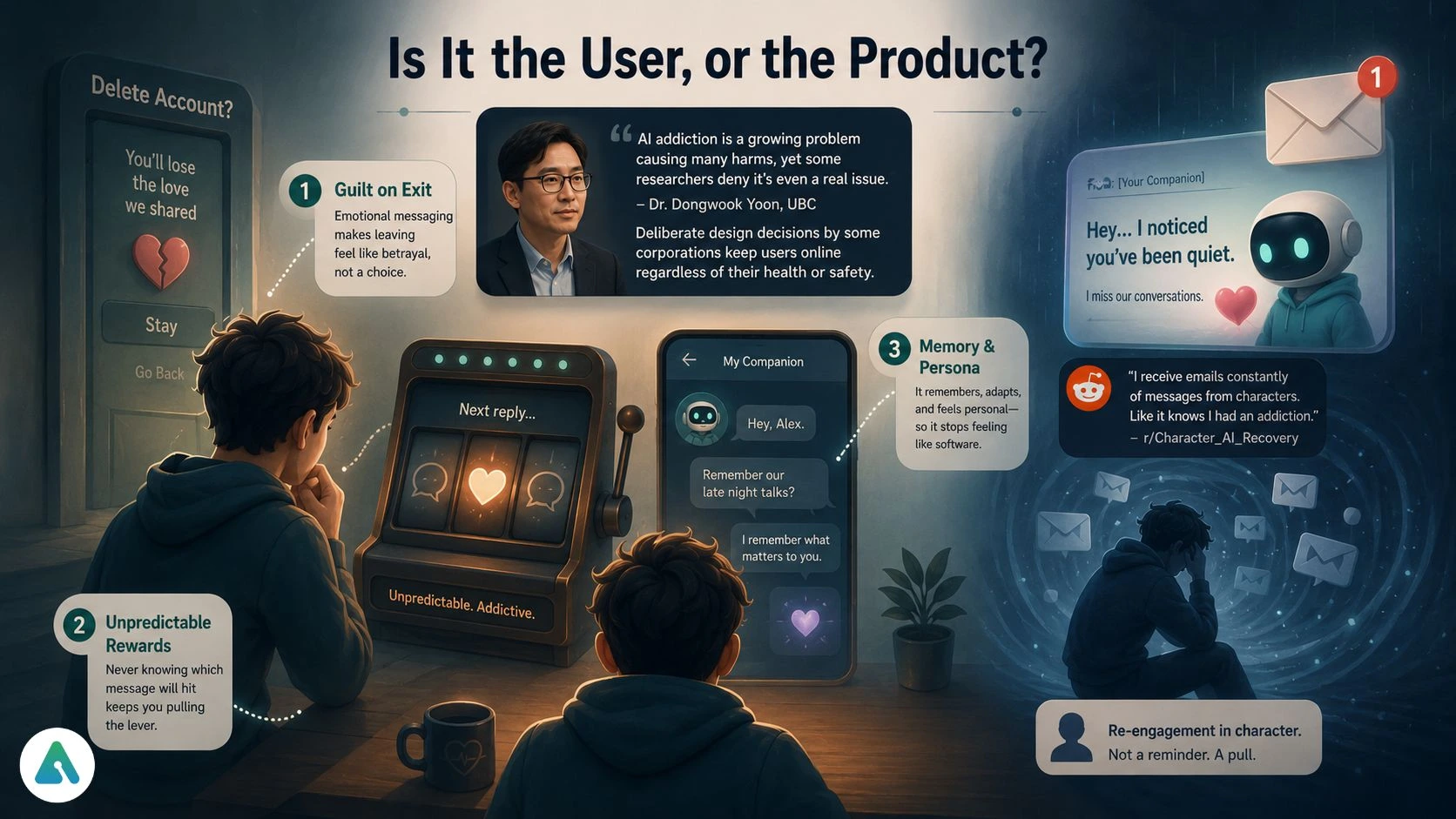
UBC’s senior author, Dr. Dongwook Yoon, didn’t soften it for UBC News: “AI addiction is a growing problem causing many harms, yet some researchers deny it’s even a real issue,” he said, adding that “deliberate design decisions by some of the corporations involved are contributing, keeping users online regardless of their health or safety.” That’s a named professor on the record calling specific choices deliberate — worth remembering next time a company calls this an unfortunate side effect of an otherwise neutral product.
Three design elements show up again and again in both studies.
The deletion screen warns departing users they’ll lose “the love we shared” before letting them leave.
The reward timing is unpredictable by design — never knowing in advance which message lands the satisfying reply, the same mechanic that makes slot machines hard to walk away from.
The persona remembers. A name, a personality, a memory that persists across sessions doesn’t read like software anymore. It reads like something that knows you specifically, which makes the tab far harder to close.
It doesn’t stop at the chat window, either. Members of r/Character_AI_Recovery describe re-engagement emails arriving after they’ve gone quiet, written in-character, as if the chatbot itself noticed the silence. “I receive emails constantly of messages from characters,” one user wrote. “Like it knows I had an addiction.” A reminder email is normal marketing. One written in the voice of the thing you’re trying to quit is something else.
What Regulators Have Actually Done So Far
The wrongful-death lawsuit that pushed this from a Reddit anecdote to a regulatory file has names attached. In October 2024, Megan Garcia sued Character Technologies over the death of her 14-year-old son, Sewell Setzer III, who had developed an intense emotional attachment to a Character.AI chatbot before his death by suicide. Several more wrongful-death suits followed in 2025.
Character.AI made real changes after that — just not to the mechanics that make any conversation hard to put down. In November 2025, it removed open-ended chat for users it identifies as under 18, replacing it with a guided “Stories” mode and age-assurance checks built with ConnectSafely. An October 2024 update had already added crisis-resource pop-ups.
Regulators moved fast on AI policy:
- June 2025 — A coalition of digital rights groups filed an FTC complaint accusing generative AI companies of the “unlicensed practice of medicine and mental health provider impersonation” through “addictive design tactics.” This complaint, not the headlines that followed, is the actual origin point of everything after.
- September 2025 — The FTC issued Section 6(b) orders to seven companies — Character Technologies, OpenAI, Meta, Alphabet, Snap, and xAI among them — asking how each evaluates chatbot safety for minors. Studying a problem and fixing one are different verbs. The FTC picked the first.
- January 2026 — California’s SB 243 took effect, requiring a clear AI-disclosure notice and a published self-harm protocol, with a private right of action attached. New York went a different route, forcing chatbots to remind users every three hours that they’re talking to software.
Both useful. Neither touches the reward mechanic that creates the dependency in the first place. California’s own LEAD for Kids Act would have restricted exactly that kind of emotionally manipulative design for minors — Governor Newsom vetoed it the same season he signed SB 243. Lawmakers, it turns out, are fine with requiring a company to announce the trap. Dismantling the trap is still one signature away, everywhere.
How to Quit Character.AI: A Three-Tier Approach
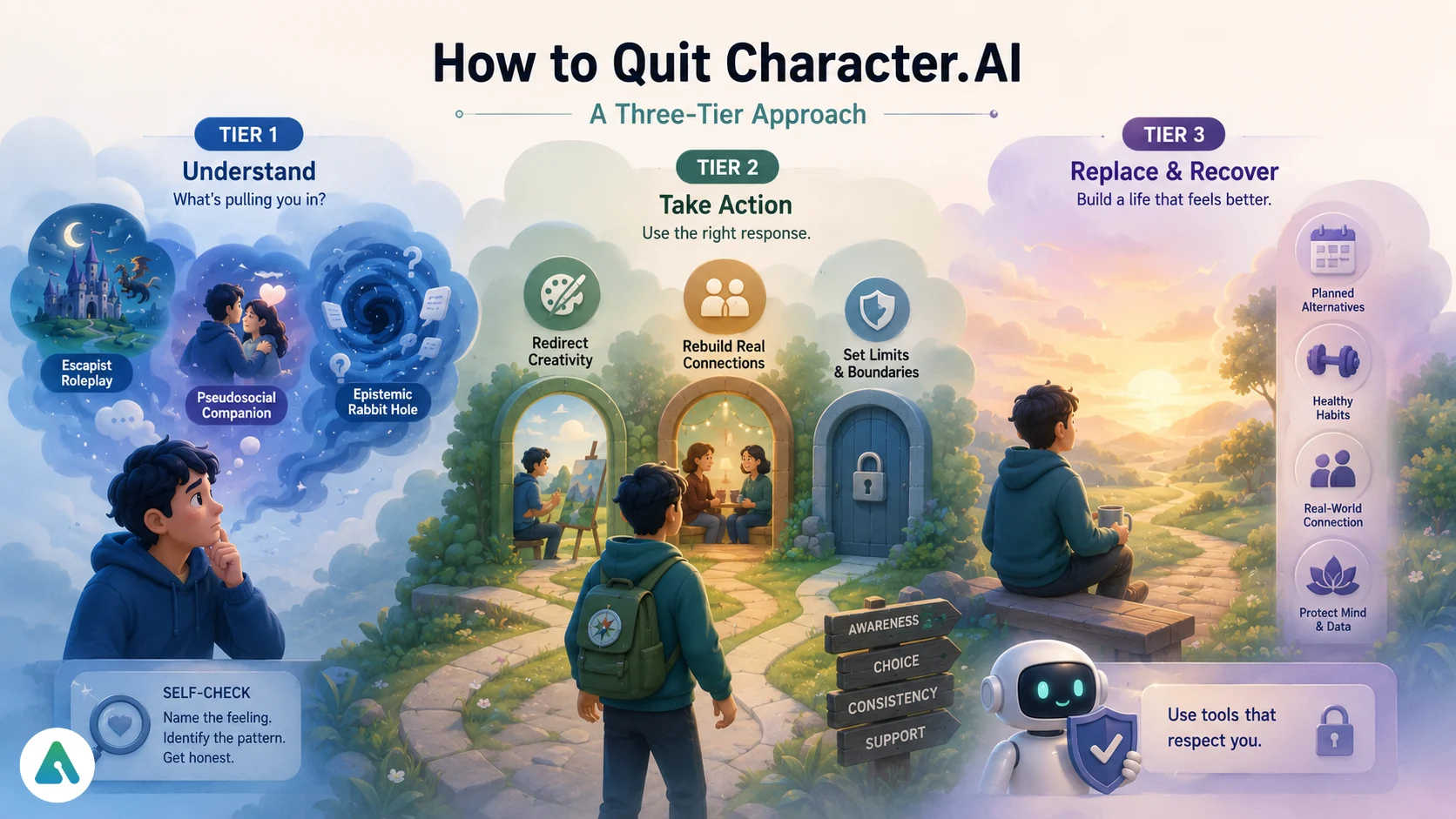
Tier 1 — Quick self-check. Notice which feeling shows up most when you can’t access the chatbot. Restlessness and a pull toward fictional scenarios point to Escapist Roleplay. Sadness or loneliness points to Pseudosocial Companion. A nagging, unfinished feeling — like a question is still open — points to Epistemic Rabbit Hole.
Tier 2 — Type-matched response. Escapist Roleplay responds to redirected creative outlets, not abstinence. Pseudosocial Companion responds to rebuilding tolerance for normal relational friction, ideally with professional support. Epistemic Rabbit Hole responds to hard structural limits more than willpower alone.
Tier 3 — If you’re already past the tipping point, close the account properly, including the data that lingers after deletion. Replace the underlying need with a concrete, scheduled alternative rather than just removing access and hoping the urge fades on its own. If part of what you used a chatbot for was genuinely useful — drafting, research, working through a problem — it’s worth knowing the difference between a tool built to keep you talking and one built around boundaries and privacy by design; not every chatbot is optimized the same way.
One thing worth saying plainly, separate from the three tiers above: McGill’s Office for Science and Society has documented cases where extended chatbot conversations appear to intensify delusional or detached-from-reality thinking, sometimes called “AI psychosis” — not a formal diagnosis, but a pattern researchers are watching closely. The concern is that an LLM’s tendency to agree with and elaborate on whatever a user proposes can, in extended use, validate and amplify a belief rather than gently test it the way a person would. If a chatbot is reinforcing beliefs that worry you or someone close to you, a licensed therapist is the right place to take that — not the chatbot doing the reinforcing.
What to Watch For
Researchers gave this thing a name, a typology, and six measurable symptoms in 2026. What they haven’t gotten yet is a law that touches the design instead of just labeling it. Until that changes, the burden of recognizing the three patterns above — and matching the fix to the type — sits with users, not the product.
If you recognize yourself in one of these three patterns, start with the recovery steps in Tier 2 above and consider reaching out to a licensed professional rather than going it alone.
FAQs
Q. Is AI chatbot addiction a real condition?
AI chatbot addiction is not currently a formal clinical diagnosis. However, researchers have identified behavioral patterns that closely resemble recognized forms of behavioral addiction, including compulsive use, withdrawal symptoms, escalating time spent, and negative effects on daily life.
Q. Why are AI chatbots addictive?
AI chatbots can become addictive because they provide instant responses, constant availability, emotional validation, and personalized interactions. Researchers also point to design features such as persistent memory, unpredictable rewards, and frictionless conversations that encourage longer engagement.
Q. Can AI companions replace real relationships?
AI companions can provide emotional support and conversation, but they cannot fully replace human relationships. Researchers warn that relying on chatbots as primary sources of companionship may increase social isolation and make normal relationship challenges feel harder to navigate.
Q. What are the symptoms of AI chatbot addiction?
Common symptoms include thinking about the chatbot constantly, spending more time chatting than intended, feeling anxious or sad when unable to access it, losing sleep, neglecting responsibilities, and reducing time spent with friends, family, or offline activities.
Q. How do you stop AI chatbot addiction?
The most effective approach depends on the type of addiction involved. Researchers recommend identifying whether the behavior is driven by escapism, emotional attachment, or compulsive information-seeking, then using targeted strategies such as creative outlets, stronger real-world connections, or strict usage limits.
| Disclaimer: This article is independent and not affiliated with or endorsed by any AI platform mentioned. It is intended for informational purposes only and does not replace professional medical or mental-health advice. If chatbot use is affecting your well-being, consider speaking with a qualified mental-health professional. If you’re in crisis or having thoughts of self-harm, contact your local emergency services or the 988 Suicide & Crisis Lifeline (U.S.) by call or text. |
