
The enterprise AI market has reached a strange point.
Almost every company has access to the same basic tools. Employees can open ChatGPT, use an AI assistant, or generate code with a few clicks.
Yet the spending data suggests that companies are not adopting AI in the same way.
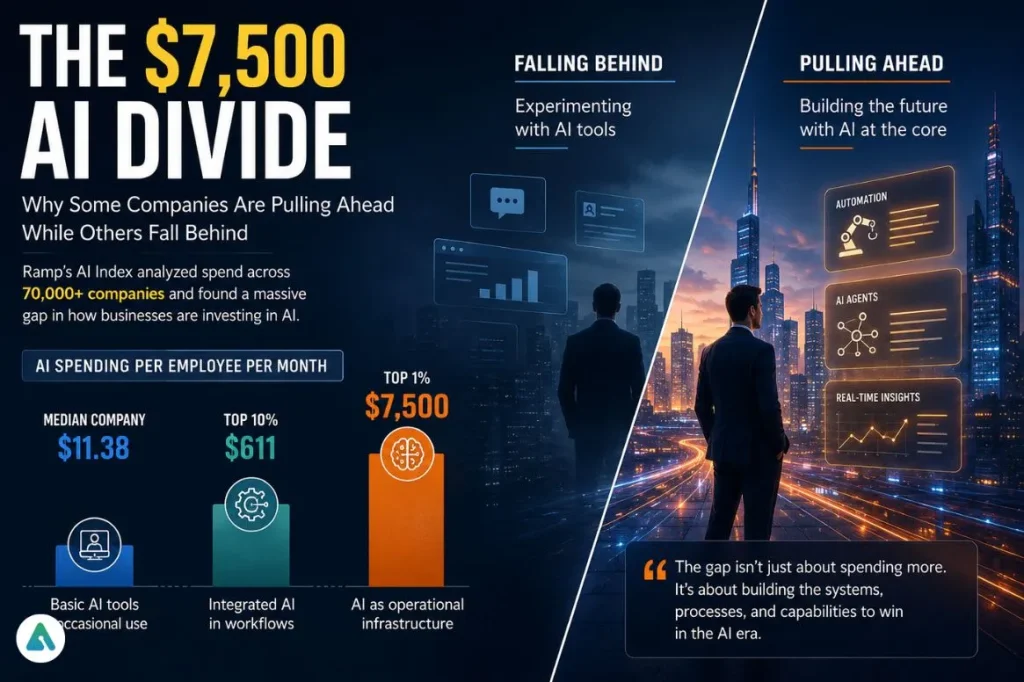
The latest Ramp AI Index reveals a dramatic divide in corporate AI investment. The median company spends just $11.38 per employee per month on AI-related tools.
The top 10% of companies spend around $611 per employee monthly.
And the most aggressive adopters — the companies Ramp describes as “AI-pilled” — spend approximately $7,500 per employee every month.

The gap is not simply about budget.
It reflects a bigger difference between companies that are adding AI to existing workflows and companies redesigning their operations around it.
Three Levels of Enterprise AI Adoption
The spending curve shows three very different approaches.
At the median level, AI often looks like traditional software adoption.
Companies buy seats. Employees use tools when needed. AI helps with writing, research, coding assistance, or everyday productivity.
The top 10% operate differently.
AI becomes more connected to business processes. Teams use more advanced tools, integrate AI into departments, and rely on it for repeatable workflows.
The top 1% are playing another game entirely.
Their spending suggests AI is becoming part of their operating infrastructure rather than just another application.
The AI Replacement Debate Is Still Early
The biggest question around AI has been whether machines will become cheaper than human workers.
The current numbers suggest that the moment has not arrived.
Even companies spending thousands of dollars per employee on AI remain below the monthly cost of many US software engineers, where total compensation can approach around $16,000 per month.
But the more important shift may not be replacing employees.
It may be changing how much output a single employee can produce.
A developer with AI tools can potentially handle more tasks. A researcher can analyze more information. A support team can automate more interactions.
The economic impact comes from leverage.
Why the Median AI Spend Can Be Misleading
The $11.38 figure does not mean every company is deeply using AI.
Many organizations have adopted AI in a limited way: purchasing access without rebuilding processes around it.
That creates a gap between AI availability and AI integration.
A company with an AI subscription is not necessarily an AI-driven company.
The firms at the top of the spending curve appear to be using AI across more critical functions:
- software development
- internal analysis
- automation
- research workflows
- operational tasks
The difference is not the existence of AI tools.
It is how deeply they are connected to the business.
AI Is Moving From Software Expense to Infrastructure
Traditional enterprise software was predictable.
A company purchased licenses, assigned employees, and paid a fixed cost.
AI introduces a different model.
Usage matters.
A company running occasional AI prompts has a completely different cost profile from one running large workflows, automated systems, or frequent model interactions.
This is why AI spending increasingly resembles cloud infrastructure.
The question for businesses is changing from:
“How many employees have access to AI?”
to:
“How much of our operation depends on AI?”
The Companies Spending Most Are Building Flexibility
The largest AI investors are also unlikely to rely on only one tool.
As AI models evolve quickly, companies are increasingly thinking about flexibility: choosing the right model, system, or provider depending on the task.
That means the future enterprise AI stack may not be built around one dominant platform.
It may be built around orchestration — deciding where different workloads should go and how AI fits into existing systems.
The Real AI Divide
The biggest lesson from the spending data is not that every company needs to spend $7,500 per employee.
It is that the gap between experimenting with AI and operating with AI is becoming measurable.
Some companies are still using AI as a faster search box or writing assistant.
Others are redesigning workflows around it.
That difference will likely become one of the defining competitive factors of the next phase of business technology.
The AI race is not only about who has access to the best models.
It is about who builds the systems, processes, and internal capabilities to use them effectively.
Related: AI Was Supposed to Cut Costs — Now It’s Burning Budgets Faster Than Salaries
