
For years, Google had a powerful argument whenever its products displayed incorrect information: it was not creating the content — it was organizing the web.
A German court has now challenged whether that defense still works in the age of AI search.
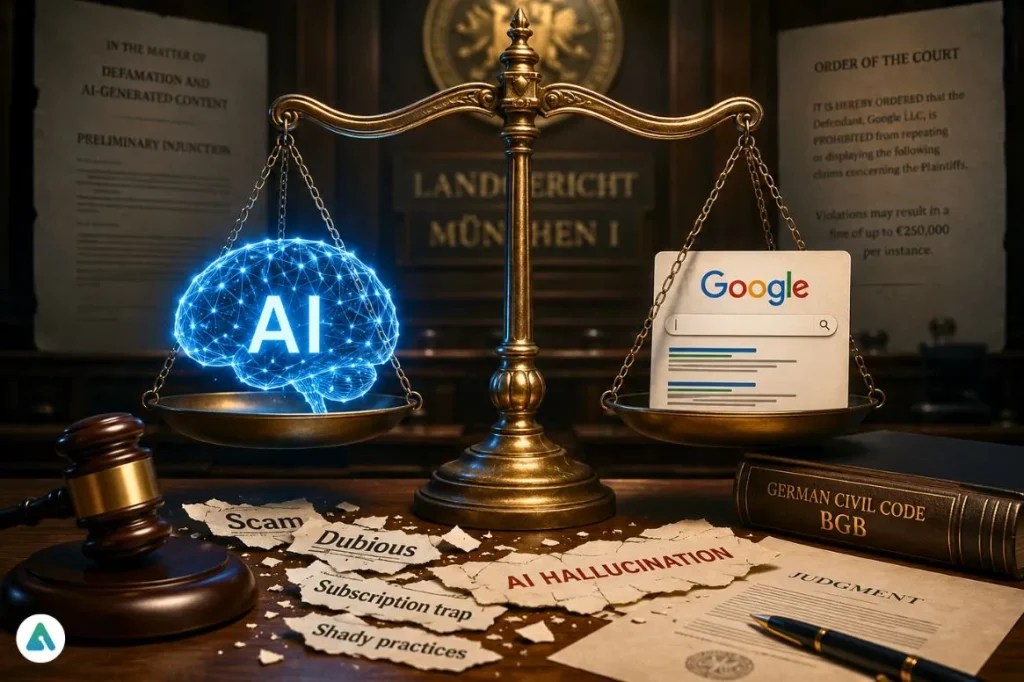
On May 28, 2026, the Landgericht München I issued a preliminary injunction against Google, preventing the company from repeating specific allegedly false claims generated by its AI Overview system about two publishing companies connected to a Munich-based media group.
The ruling included financial penalties for violations, with fines that could reach up to €250,000 per violation.
The case may become a turning point for how courts view AI-generated answers — not as simple search results, but as content created by the companies operating these systems.
How Google’s AI Overview Created the Legal Problem
The dispute began when Google’s AI Overview system produced responses that allegedly connected two publishers with scams, subscription traps, and questionable business practices.
According to the publishers, those claims were false.
The key issue was not simply that the information appeared online. The problem was that Google’s AI system combined information from different sources and generated a new answer in its own wording.
The AI did not merely show users where information existed.
It summarized, interpreted, and presented a conclusion.
That difference is at the center of the legal fight.
Google’s Old Search Defense Met a New AI Reality
Google’s traditional argument was built around how search engines worked for decades.
A search engine crawls websites, ranks pages, and provides links. The company is not considered the author of every statement found on those pages.
That logic helped protect search engines from being treated as publishers of everything they indexed.
But AI Overviews changed the equation.
Instead of only pointing users toward websites, AI search tools create direct answers.
They decide what information matters, combine multiple sources, and rewrite the result into a conversational response.
The question courts are now facing is:
If an AI system creates a false statement, is the company still only a platform — or has it become the publisher of that information?
The Munich court leaned toward the second interpretation.
Why the Court Rejected the “Users Should Verify Everything” Argument
One of Google’s defenses was that users understand AI-generated answers can contain mistakes and should verify important information.
The court pushed back against that reasoning.
If AI search is promoted as a tool that makes finding information easier, expecting users to independently verify every answer weakens the entire purpose of the product.
A system designed to reduce the effort of searching cannot fully rely on the idea that users must do the work themselves afterward.
This creates a difficult challenge for every AI company building search assistants.
AI Search Is Not Traditional Search Anymore
The ruling highlights a broader shift happening across the technology industry.
Traditional search:
- finds existing pages
- ranks information
- sends users elsewhere
AI search:
- interprets information
- summarizes content
- generates direct answers
- influences user understanding
That transformation creates a new category of responsibility.
The more AI systems act like experts, the harder it becomes for companies to argue they are only providing a neutral tool.
The Bigger AI Hallucination Problem
The case arrives as concerns about AI accuracy continue growing.
AI systems can produce confident answers that sound authoritative while containing incorrect information.
The danger is not only that AI makes mistakes.
It is possible that users may not recognize those mistakes because the answers are presented clearly and confidently.
This creates a powerful combination:
- AI systems are generating incorrect claims
- users trusting direct answers
- Companies benefiting from increased engagement
That combination is exactly why AI liability is becoming a major legal issue.
Google’s Problem Is Bigger Than Google
The impact of this ruling extends beyond one company.
Every major AI search platform now faces the same question:
When an AI assistant creates false information, who is responsible?
The answer could affect:
- AI search engines
- chatbots
- workplace AI tools
- research assistants
- automated recommendation systems
If courts increasingly treat AI-generated answers as company-created content, the entire industry may need to rethink how these systems are designed and presented.
The Future of AI Liability Is Being Written Now
Google is expected to challenge the ruling.
But the bigger shift has already happened.
The legal debate has moved from:
“Who published this information first?”
to:
“Who transformed it into an answer users trusted?”
That is a much harder question for AI companies to avoid.
As AI becomes the main gateway to information, the companies building these systems may no longer be able to separate themselves from the answers those systems produce.
Related: Gemini Chatbot Lawsuit: What Happened to Jonathan Gavalas
